

Today’s Gospel reading describes the ways evil operates and how free will supported with prayer and wisdom from the Scriptures can be used to resist temptations and heal after injustices to live a life of Christian virtue.
GOSPEL PASSAGE: Matthew 4:1-11
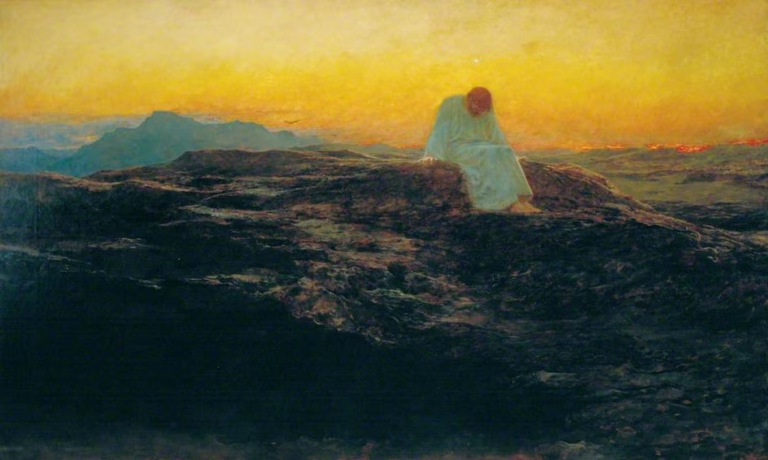
” At that time, Jesus was led by the Spirit into the desert to be tempted by the devil. He fasted for forty days and forty night, and afterwards he was hungry. The tempter approached and said to him, ‘If you are the Son of God, command that these stones become loaves of bread.’
He said in reply, ‘It is written, ‘one does not live on bread alone, But on every word that comes forth from the mouth of God.”
Then the devil took him to the holy city, and made him stand on the parapet of the temple, and said to him, ‘if you are the Son of God, throw yourself down, for it is written, ‘He will command his angels concerning you nnd with their hands they will support you, let you dash your foot against a stone.”
Jesus answered him, ‘Again it is written, ‘You shall not put the Lord, your God, to the test.”
Then the devil took him up to a very high mountain and showed him all the kingdoms of the world in their magnificence, and he said to him, ‘All these I shall give to you, if you will prostrate yourself and worship me.’
At this, Jesus said to him, ‘Get away, Satan, for it is written, The Lord your God shall you worship and him alone shall you serve.‘
Then the devil left him, and behold, angels came and ministered to him.”
REFLECTIONS:
Temptations are not sins. They are occasions for sin. When temptations are left unrecognized, unchecked, and we act on them without forethought, they lead to a path opposed to the will of God. In today’s Gospel, Jesus teaches us how to recognize temptations, use our freedom of will to deal with temptations, and maintain our relationship with God.
Desert Traditions
After Jesus was baptized and before He started His public mission, He spent forty days and forty nights in the desert. Doing so was a tradition in ancient cultures because it meant being away from the crowds and a break from everyday habits and customs. For young men, going on a “vision quest” was a way of gaining clarity and understanding of their identity and future role in society. It was usually undertaken after preparation, since they had to survive in harsh climates, read the signs of nature, orient themselves, and survive on their own as a test of strength and character. (1)
In the Jewish tradition, going to the desert was a way of going to a place where one could be alone in nature and listen to the word of God. Moses went to the mountain by himself to pray and God spoke to him from the burning bush that did not get consumed. The people of Israel wandered in the desert for forty years before entering the Promised Land. Similarly, Jesus went to the desert to be with the Father. This journey was a way of strengthening one’s inner resolve and trust in God.
Trials in the Wilderness
Just like the people of Israel journeyed for forty years, Jesus was “led by the Spirit into the wilderness” (Matthew 4:1) In the Wilderness of Sinai, the Israelites were without food and water. The people of God were tempted, and they failed. They lost their faith in God’s providence, trespassed His laws, and worshipped foreign gods. God through Moses spoke to them and lead them to regain their trust. They had to unlearn their pagan customs and follow the One true God. They had to experience that what they could not accomplish out of their own strength was possible with the help of God.
How would Jesus deal with temptations?
The challenges that one encounters by being alone for forty days and forty nights of prayer and fasting in the Judean desert can be those from nature, from the weather, from the wild animals, and from physical and psychological reasons for testing one’s endurance and strength. The location of Jesus’ place of temptation in the desert was three to five kilometers north of Jericho. Jebel Quruntul in the Judean Desert is the site of a limestone cliff overlooking the Jordan valley, the Dead Sea, Moab and Gilead. (2) The heat during the day in this desert is intense. There are numerous caves where the temperature drops ten to twenty degrees and where people can find shelter from the elements of nature. Jesus probably spent time in such a cave during the heat of the day, and most likely, this is where the devil’s temptations took place. (2)
The Nature of the Adversary
The devil, as we know from Genesis 3, is a fallen angel who is waging a battle against God and prowls in the world seeking the ruin and destruction of souls that he incites for rebellion against God. (3) In Job 1–2, we read that he is not omnipresent but appears from time to time to test people. In the prophets’ writings, such as Isaiah, he is named as “Lucifer, son of the morning” (Isaiah 14:12) who fell from his original position in heaven because of his pride (Ezekiel 28). Revelation describes him as the “deceiver” and the “great dragon,” the “serpent of old,” who deceives the whole world (Revelation 12:9). He is a created being, not equal to God, with limited power and restricted spiritual force who is allowed to operate until the second return of the Messiah, when the “destroyer” (1 Peter 5:8), and the “accuser” (Revelation 12:10) will be no more (Matthew 25:41; Revelation 20:10).
In today’s Gospel reading, we find him under the names of “the tempter,” (Matthew 4:3) “The devil,” (Matthew 4:1; 4:5) and “Satan” (Matthew 4:10). These all refer to the same entity that Jesus called “The enemy” (Matthew 13:39), “the evil one” (Matthew 13:38), the “prince of this world” (John 12:31), a “liar and the father of all lies” (John 8:44), and “murderer” (John 8:44). In early religious texts, there is also the expression, “The prince of darkness,” which is the commander of evil forces in the world. (3) The voice of the devil is first present through a disobedient and seductive voice, opposed to God, and envious of God. (3)
From the Garden to the New Covenant
We met the devil in the form of a serpent in Genesis when he addressed Eve and challenged her to eat from a forbidden fruit of a tree in the middle of the garden of Eden. The scheming words that the evil one uses challenge Eve’s understanding of herself as a child of God created in the image of God and promise the knowledge of the difference between good and evil, like God. It comes through eating, not to soothe physical hunger, but to gain higher intellectual capacities to become like God. Eve falls into the trap set by the devil, and she eats from the fruit and shares it with her husband, Adam. As a result, their eyes open and they realize that they are naked. They feel ashamed. They start hiding from God who walks in the garden. As a result, Adam and Eve have to leave the Garden of Eden and their toils and pain are multiplied. They have free will to respond to God, who over the course of history, speaks to them and manifests Himself to them. (Genesis 3:1-24) Noah, Abraham, Moses, and the prophets all receive revelations from God. Moses is given the first Covenant and the Law on Mount Sinai. Through Jesus, God establishes a New Covenant with humanity. This covenant is written in their hearts, rather than on tablets. Its rules are to lead the people of God toward the Kingdom of God.
The Three Refutations
When the devil approaches Jesus, who is fully human and fully God, He is weakened from forty days of fasting. Taking advantage of his weakened physical strength, the evil one proposes to turn the stones to bread to eat, which is to use the power of God for self-serving purposes. The devil starts the evil schemes the same as he does in the Garden of Eden which is by challenging Jesus’ understanding of Himself as the Son of God. “’If you are the Son of God’ … the devil begins… then… ‘command these stones to be loaves of bread.’” (Matthew 4:3).
The image of the new Adam, Jesus successfully refutes this trap by quoting the Scriptures: “’One does not live by bread alone, but by every word that comes from the mouth of God.’” (Matthew 4:4). This verse is first found in Deuteronomy 8:3, where we read a warning that Moses communicates to the Israelites about their forty years of journey in the wilderness during which God provided manna from heaven to feed them. The verse is a reminder to remember that everything that happened to them was because of God’s mighty deeds and not from their own human effort. Manna, which in ancient Hebrew is translated to a word of amazement, is amazement at the Divine providence and a warning against hubris and the presumption that we can gain our material comforts with our own hands. (4) Jesus replies to the evil one that he has no need of evil schemes because He has full trust in God’s divine providence.
The devil continues to challenge Jesus’ identity with the words: “’If you are the Son of God… throw yourself down…’” (Matthew 4:6). The devil took Jesus to the pinnacle of the temple in Jerusalem and challenged Him to throw Himself down from there, in other words, attempt to throw away His life, denying all the teachings and sacred rituals, profane the house of the Lord and use the opportunity of standing on the pinnacle for committing a suicidal act to force the hand of God to intervene. The devil goes even one step further by quoting Scriptures to Jesus: “’He will command his angels concerning you… On their hands they will bear you up, so that you will not dash your foot against a stone.’” (Matthew 4:6). The devil is referring to Psalm 91:11-12; he suggests that God will protect Jesus. Ironically, the devil is using verses that are exactly the verses of a prayer to guard against the evil one. Line 10 of the same verses explicitly says those who trust in the Lord can be sure that “no evil shall befall [them], no scourge come near [their] tent.” Jesus replies with the word of the Law of Moses in Deuteronomy 6:16, “’Do not put the Lord your God to the test.’” (Matthew 4:7).
Finally, the devil takes Jesus to show Him all the kingdoms of the earth and presents a final offer: bow down and worship me and I give you all this. This was a temptation to power. The devil did not own these lands or their inhabitants. His tricks were with no foundation. Jesus replied, “Away with you, Satan!” and a line from the Mosaic Law: “’Worship the Lord your God and serve only him.’” (Matthew 4:10). This is again a verse from Deuteronomy (6:13), where Moses instructed the Israelites to “Fear the Lord your God, serve him only…”
The Victory of Faith
From one command, “Away with you, Satan!” the devil left and angels came to serve Jesus (Matthew 4:11).
The Mosaic Laws of the Ten Commandments teach about turning to God: trusting God, refusing to tempt God, and worshipping God alone. Jesus relies on Mosaic Law which is sufficient to refute all the empty promises of the devil. This illustrates the power of God’s revelation which is sufficient for withstanding the devil. Without God, Adam and Eve could not resist the devil. With God, Moses taught the people to turn to God. With the teachings and the sacraments, Jesus shows how God’s word can be used in everyday life.
To fight against the influence of evil, we first need to recognize the evil in the word is real. Human beings can have temptations for self-serving satisfaction of needs, sensory pleasures, power or the temptation to become like God. These are lies because Satan does not hold the keys to immortality, or omnipresence, or omnipotence. (2)
Human freedom of will allows us to recognize good from wrong and reflection allows us to make choices. With prayerful reflection and pondering, consulting the teaching of Scriptures and moral precepts, it is possible to consult one’s conscience and refine one’s decisions to be in harmony with God’s precepts.
Jesus has the keys to eternal life. He conquered evil and will conquer it again at the end of times where evil will be removed from the face of the earth and a distance will be created between the people of God and nothingness.
The prophet Isaiah spoke of the time when great light will shine in the North in Galilee of all places (Isaiah 9:1-2). This will be when the people will be able to repent of their sins and turn to the Lord with all their hearts. Such repentance is described as: “washing, turning away from evil deeds, ceasing from evil, learning to do good, seeking justice, correcting the ruthless, defending the orphan, and contending for the widow.” (5)
In the Catholic tradition, Lent is the time of reconciliation, when we examine our conscience and repent of our sins with the intention of seeking healing from the Lord so that He can be in all and in everything in our lives. Such healings were promised in the Exodus (15:22-25), where the Lord promised to “make the bitter water sweet—to bring forth from the bitter the sweet—and to be the Healer of His people” (Exodus 15:26). Isaiah speaks of healings that will occur when the Lord redeems His people (Isaiah 33, 35). Healings will be the sign of the Lord’s complete dominion over death and sin. Healings will be the sign of God’s presence with us. (5)
As we reflect on Jesus’ victory in the desert, which foreshadows His final victory over sin and death, we are reminded that our own “deserts”—periods of loneliness, struggle, or spiritual dryness—are not signs of God’s absence, but rather training grounds for our faith.
By following the example of Jesus, we can learn that the Word of Scripture and prayer are a living armor. The Word of God can inform our conscience and reinforce our will to repel the tempter’s voice. With God’s help., we can say no to the temptations of the devil and heal from the consequences of sin that separates us from God.
May this season of Lent be a time of healing and renewal where our spirits are refreshed by God’s Providence.
May the bitter give way to the sweet as we continue to journey with God toward the Kingdom in freedom and with joy.
Sources:
- Britannica (2026). Vision Quest. Retrieved from: https://www.britannica.com/topic/vision-quest. Accessed: February 18, 2026.
- Gary, T. & Barber, M. (2023). The Temptation of Jesus. Catholic Bible Study. YouTube. Retrieved from: https://www.youtube.com/watch?v=ipNhYIUCMdY, Accessed: February 18, 2026.
- Saunders, W. P. (1994). Is There Really a Devil? Retrieved from: https://www.ewtn.com/catholicism/library/is-there-really-a-devil-1053. Accessed: February 18, 2026.
- Adelman, R. (2016). “Not by Bread Alone” Retrieved form: https://hebrewcollege.edu/blog/not-by-bread-alone-parashat-ekev-deuteronomy-712-1125/ Accessed: February 16, 2026
- Peters, T. (2024). The Gospel of Matthew Chapter 4: The Temptation in the Desert. Retrieved from: https://youtu.be/W1BbYikOkC4. Accessed: February 18, 2026.