

The baptism of Jesus is related to the mystery of redemption and the Trinity, one God is thee Persons, Father, Son, and Holy Spirit. The mystery lives on in a uniting act of love.
GOSPEL PASSAGE: Matthew 3:13-17
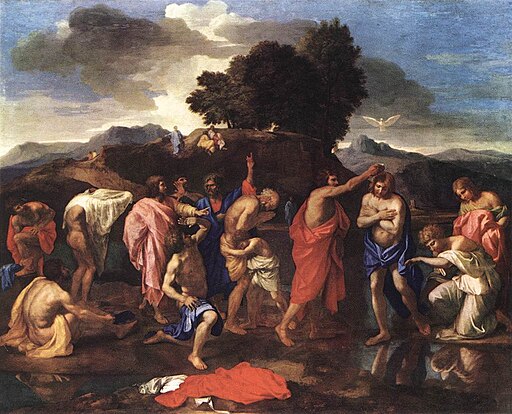
“The Jesus came from Galilee to John at the Jordan, to be baptised by him. John would have prevented him, saying, ‘I need to be baptised by you, and do you come to me?’ But Jesus answered him, ‘Let it be so now; for it is proper for us in this way to fulfill the righteousness.’ Then he consented. And when Jesus had been baptised, just as he came up from the water, suddenly, the heavens were opened to him and he saw the Spirit of God descending like a dove and alighting on him. And a voice from heaven said, ‘this is my Son, the Beloved, with whom I am well pleased.’”
REFLECTIONS:
In last, weeks’ Gospel reading, we heard about the magi who came to adore Jesus. They knelt down in front of him and offered their gifts of gold, frankincense, and myrrh. The Gospel of the new year carries us onward from with this timeless and beautiful image, while already foreshadowing the suffering that Jesus will experience at the hands of sinners, to the very first steps in his mission.
Growing up in Nazareth, learning his father’s trade, being well versed in his faith tradition, Jesus came to redeem the world from the chains of sin and death. Before beginning his mission, he was led by the Holy Spirit to see John, the last Old Testament prophet, to be baptised by him.
Following this event, for three years or so, Jesus would traverse Galilee and the neighboring areas, healing, teaching, and proclaiming the word of God. It is only after thirty-three years of his life that the plan to put him to death, which is plotted already from the day of his birth, would come to completion. Jesus died on the cross. But this was not the end of the story; it was just the beginning. Jesus rose from among the dead and appeared to the apostles. Like the shepherds and the magi, they fell to their knees and adored the Risen Lord. The Church grew and spread in every nation and in every land, without borders and without partiality (Acts 10:34). This is how it is today that believers everywhere can kneel and praise the Lord.
Within this circle of the fulfillment of God’s plan, the Gospel reading of today takes us to the place where Jesus was baptised; the river Jordan, 2000 years ago. John is standing at the shore. He is surrounded by his disciples, when Jesus approaches. The “Baptiser,” as John is known among the people of Israel and Judea, proclaims repentance for sinners to prepare the way for the coming Messiah. (1) John’s father, Zechariah was a priest in the temple (Luke 1:5-7). John preaches in the desert to be away from the temple of Jerusalem, where Herod’s corrupt descendants are still in power. (2) Like his father, he carries on the priestly ministry, however, he does so outside Jerusalem. He is there proclaiming the Word of God as it is given to him, instructing the people to repent and to prepare for the coming Messiah. Part of his ministry includes a symbolic dipping in the rivers of the Jordan. This element matches with what happens at the ritual baths at the Temple in Jerusalem. The “mikvah,” or mikveh, is a Jewish ritual bath that is filled with naturally occurring water, or living water, not from a tap from a spring, rain, river or the sea. Ritual pools for purification with submersion and prayers after the confession of sins, are used for ritual cleansing, for marking life transitions, and for preparing to present petitions in the temple. (3) There were several such pools in use at the temple in Jerusalem, but John avoided them on purpose not to taint himself with corruption. (4)
When he saw Jesus, John exclaimed, “Behold the Lamb of God, who takes away the sins of the world!” (John 1:29); “He is the one who comes after me, who is preferred before me, whose sandals I am not worthy to untie” (John 1:27). The scene got somewhat confusing from then on. John thought that Jesus will pass by. But Jesus approached closer, right down to the shore, right in the midst of the other people who were there waiting to be baptised. He stepped right into the mud and came “shoulder to shoulder with sinners.” (4) How is John to explain to his disciples what is happening?
According to Bishop Barron, we must go though “the door” of John the Baptist to understand the ministry of Jesus. (4) We must understand it from a psychological and spiritual point of view. (4)
John knows that the Messiah is sinless. He is therefore perplexed. He knows Jesus since his infancy. He knows that Jesus is destined for the task of redeeming the world. He asks Jesus, “What are you seeking?” and he hears Jesus’ reply, “Baptism.” He does not understand. Jesus has no sins. He needs no baptism. “He will baptise you with the Holy Spirit and fire,” John has said this just a few moments ago to his disciples, and now, Jesus stands in front of him, asking for baptism. How can this be? And John takes a step back, saying, “I need to be baptised by you, and do you come to me?” –he is incredulous. The request of Jesus does not fit into the “plan.” But Jesus, out of obedience to God and solidarity with sinners, repeats the request and explains: “Let it be so for now, for it is proper for us in this way to fulfill the righteousness.” And John concedes. He bows in front of God’s plan and request, even though he does not fully comprehend.
Theologians tell us that a sacrificial lamb in the Jewish tradition, a “spotless, blameless lamb,” was offered for the sins of the people. (4) Since the destruction of the Second temple in AD 70, prayer, repentance and good deeds have replaced such offerings. However, by choosing a lamb, and offering it, one placed one’s sins of the lamb as a “substitutionary sacrifice,” saying, “what happened to the lamb, should have happened to me because of my sins.” The lamb was a sin offering to God. (4)
By accepting to baptise Jesus, John conceded to Jesus’ request to be that lamb, the “Lamb of God,” who would take upon himself the sins of the world. Jesus offered himself to be that sacrifice for all the sinners and the sins of the world. (4)
Jesus was fully aware of his mission. He repeatedly told his apostles that the Son of Man will die for the forgiveness of sins and He will rise from the dead on the third day. During the Last Supper, he took the bead, broke it and gave it to his disciples saying, “Take and eat, this is my body which will be given up for you.” Similarly, after supper, he took the chalice, and after giving thanks to God, he handed it to his disciples, saying, “Take, drink, this is my blood that will be poured out for the forgiveness of sins.” (Matthew 26, Mark 14, Luke 22, 1 Corinthians 11). Jesus, both body and blood, accepted upon himself this mission of the “Lamb of God” who will redeem humanity. (4)
His whole life was about being close to sinners, healing them, and saving them. What we see during the Mass is the sacramental re-enactment of this sacrifice of the Lord, by which act He saves his people. (4) The tiny host and the wine mysteriously are his body and blood. (5) This mystery, that we do not fully understand, can be made at least a little bit easier to explain when we approach it from the lens of Jesus’ baptism. He took upon him the customs of our laws in order to accomplish the Divine will of the Father. Through coming down to the earth and being incarnate, He saved us from our sins.
Stepping into the mud, taking his place shoulder to shoulder with sinners, may have been an unexpected, and “embarrassing” act of humility on the part of Jesus in the eyes of John. (4) How much more “uncomfortable” sacrifices Jesus accepted and took upon himself for the sake of loving every human being.
When he was baptised, the heavens opened to Jesus, “…and he saw the Spirit of God descending like a dove and alighting on him.” (Matthew 3:16). The Holy Spirit in the form of a dove descended representing the Holy Spirit. The Father’s voice could be heard saying, “This is my Son, the Beloved, with whom I am well pleased.” (Matthew 3:17). God in three persons, Father, Son, and Holy Spirit, acted in unison at the Baptism of Jesus. The Father conformed His Sonship. The Holy Spirit confirmed that He was the Chosen One, the Messiah.
Today’s Gospel makes us wonder, “How do we remain open to God’s plans in our lives?” Do we stick to what we envisioned, or are we open to letting Him fashion us, guide us and lead us?
Jesus cooperated with the will of the Father out of His own free will. He did this out of love for the Father and out of love for humanity. What sacrifices are we willing to make out of love for someone?
The Baptism of Jesus reminds us of our own baptism. This day was the day of our birth into the Church, and into being a child of God. The water that was poured over our head, the candle that was lit, and the prayers, bestowed upon us a mission to help to bring the light of Christ into the world.
Sources:
- Verse by Verse Ministry International (2025). How did John the Baptist get his name? Retrieved from: https://versebyverseministry.org/bible-answers/how-did-john-the-baptist-get-his-name Accessed: January 6, 2026.
- Clendenin, D. B. (2001-2026). Deceptively Simple, Deeply Subversive: John the Baptist, Politics and Religion. Journey with Jesus, A weekly magazine for the Global Church. Retrieved from: https://www.journeywithjesus.net/essays/3637-20090706JJ#:~:text. Accessed; January 31, 2026.
- Britannica (2026). Mikvah. Retrieved from: https://www.britannica.com/topic/mikvah. Accessed; January 6, 2026.
- Barron, R. (2025). Why Was Jesus Baptised? – Bishop Barron’s Sunday Sermon. https://www.youtube.com/watch?v=-2h4qSb7cqQ Accessed: January 6, 2025.
- Catholic Culture (2026). Articles 1373-1375. Retrieved from: https://www.catholicculture.org/culture/library/catechism/index.cfm?recnum=4242. Accessed: January 6, 2026.