

John the Baptist asked for conversion of heart to welcome Jesus. Conversion is more than repentance or regret. It means a radical decision to love God and His Creation.
GOSPEL PASSAGE: Matthew 3:1-12
In those days John the Baptist appeared in the wilderness of Judea, proclaiming, ‘Repent, for the kingdom of heaven has come near.’ This is the one of whom the prophet Isaiah spoke when he said,
‘The voice of one crying out in the wilderness:
“Prepare the way of the Lord, make his paths straight.”’
Now John wore clothing of camel’s hair and a leather belt around his waist, and his food was locusts and wild honey. Then the people of Jerusalem and all Judea were going out to him, and all the region along the Jordan, and they were baptized by him in the river Jordan, confessing their sins.
But when he saw many Pharisees and Sadducees coming for baptism, he said to them, ‘You, brood of vipers! Who warned you to flee from the wrath to come? Bear fruit worthy of repentance. Do not presume to say to yourselves, “We have Abraham as our ancestor”; for I tell you, God is able from these stones to raise up children to Abraham.
Even now the axe is lying at the root of the trees; every tree therefor that does not bear good fruit is cut down and thrown into the fire.
I baptize you with water for repentance, but one who is more powerful that I is coming after me; I am not worthy to carry his sandals. He will baptize you with the Holy Spirit and fire. His winnowing fork is in his hand, and he will clear his threshing-floor and will gather his wheat into the granary; but the chaff he will burn with unquenchable fire.’
REFLECTIONS
Advent means coming. Advent is the time when we prepare ourselves to recall, honor and celebrate the birth of Jesus. Why is such preparation necessary? Could we not simply celebrate Christmas as we celebrate a birthday, any birthday?
I suppose for the celebration of any birthday, some preparation is required. A plan has to be made about when and how the family will gather and express their appreciation. It includes what presents will be bought, what songs may be sung, or what cake will be picked up from the bakery or prepared. But just like any ordinary birthday, which is not really about how fanciful the party is, but how we can convey our sincere gratitude and joy in thanksgiving for the life of our loved one, Christmas also calls for a thanksgiving that we are to observe in a particular way. The more so, because Jesus is not just an ordinary person like you and me.
Jesus lived two thousand years ago. Several texts coincide in detail about his place of birth, and his life spanning about thirty-three years. As we read in todays’ Gospel, his birth was foretold by the prophets, and heralded by a prophet named John the Baptist, “…In the fifteenth year of the reign on Emperor Tiberius, when Pontious Pilate was governor of Judea, and Herod was ruler of Galilee, and his brother, Philip, ruler of the region of Ituraea and Trachonitis, and Lysanias ruler of Abilene, during the high-priesthood of Annas and Caiphas.” (Luke 3:1-3).
Prophets are sent by God, speak on his behalf, and proclaim God’s will for the people. (1) In the Old Testament, prophets were often persecuted for their message, ostracized and persecuted for their boldness and truthfulness. Their message was “…not withing the compass of the natural faculties of the divine messenger,” and it required an unfolding, a manifestation, and an illumination to take place before communicating it through Divine authorization and protection. (1) The exhortations of these mystic leaders were never misleading, although the correct interpretation may have eluded the masses. (1) They were voices that taught, invited, challenged, and comforted according to Divine inspiration. John the Baptist was one of the lesser prophets in comparison to Elijah, Isaiah, Ezekiel, or Jeremiah. Nevertheless, he announced the imminent arrival of the Messiah.
John’s birth was miraculous. He was conceived as heralded by an angel of God to his father, Zechariah, of the priestly order of Abijah, and his mother, Elisabeth, a descendant of Aaron, in their old age (Luke 1:5). Elisabeth was a cousin of Mary, the mother of Jesus. Prior to this, Elisabeth was barren and already advanced in age. When Mary visited Elisabeth and she was in her sixth month of pregnancy, the pinnacle of the miracle was that “the child [John] leapt in [her] womb” upon hearing the greeting of the mother of the Lord, Mary, who was in her first trimester of pregnancy (Luke 1:40).
Led by the Spirit into the desert, John led an austere, religious life. He proclaimed repentance for the forgiveness of sins and baptized people in the River Jordan with water. He foretold of the coming of the Messiah. He identified the Messiah as Jesus, the Lamb of God, in whom there is no sin (Matthew 3:13-17).
John met Jesus at the River Jordan and baptized him. The Spirit of God descended on Jesus and a voice from heaven said, “This is my Son, the Beloved, with whom I am well pleased.” (Matthew 3:17). Witnessing Jesus’ baptism, some of John’s students, such as Andrew and John, started to follow Jesus. Jesus chose them to be among his twelve disciples (Matthew 4:18).
To many people, Jesus was a prophet, like the prophets before him. To Christians, Jesus is God. Catholics believe that Jesus is fully human and fully divine. (2) According to Catholic tradition, God is active in three persons: Father, Son, and Holy Spirit. They each have different nature. The Father is the first person of the Holy Trinity. He is the eternal source of all creation and the source of all life. He is distinct from, yet being one with the Son, Jesus Christ, and the Holy Spirit, who proceed from the Father. The Son, Jesus Christ, is “begotten, not made, consubstantial with the Father, through whom all things were made.” (3) He is fully God, sharing the same essence as the Father, described as “God from God, Light from Light, true God from True God.” (3) The Father, the Son, and the Holy Spirit exist in perfect unity and harmony.
When he saw Jesus, “John testified to him and cried out, ‘This was he of whom I said, “he who comes after me ranks ahead of me because he was before me’” (John 1:15). And, like the prophets before him, John was not mistaken. It pleased the Father to send Jesus into the world to fulfill the Old Testament prophecies. He shared everything with our humanity, except sin. He died on the cross as a final and ultimate sacrifice for the sins of humanity, to reconcile humanity with God the Father. In doing so, Jesus conquered sin and death. He rose from the dead and ascended into heaven. (3) He won ultimate victory over sin and death which opens the door for all humanity to have eternal life. After the End of Times, Jesus promised resurrection and life, not only in spirit, but in our heavenly bodies, just like the way he resurrected, to be with God forever. To be with God forever requires mercy, but also our choice and commitment. (4)
It was pleasing to the Father to send Jesus into the world to teach us about God’s laws through service and meekness, gentleness, and humility. Most of all, to teach us about God’s love. Jesus, conceived in his mother’s womb by the Holy Spirit, a tiny baby, an innocent child, who would grow up to forgive sins, to heal, and to give his life for the life of the world, is the Lord.
This is a great mystery, but reading the Sacred Scriptures helps to be able to picture the historical reality of Jesus’ life. John the Baptist prepared the way for his coming. He emphasized that to welcome Jesus, one needs to prepare with a sincere heart and complete transformation. Superficial presence is not enough. One needs to start with an inner transformation of the heart, a purification of oneself, the acknowledgement of one’s limitations, and shortcomings, and the intentional removal of the obstacles that take us away from God. John the Baptist said that we need to build of a “highway” for God to enter our lives (Matthew 3:3).
According to Christian belief, Jesus will return at the End of Times, this time, glorious and victorious. He is therefore the Messiah, the Chosen One, the Anointed one, God’s favorite. –“Sitting at the right hand of the Father, he will rule Heaven and the Earth.” (4). Advent is, therefore, also the waiting for this final return of the Messiah. Its rejoicing in the promise, present already from the beginning of time, and at the birth of Jesus, when God incarnate entered our history to proclaim the good news that our salvation is at hand.
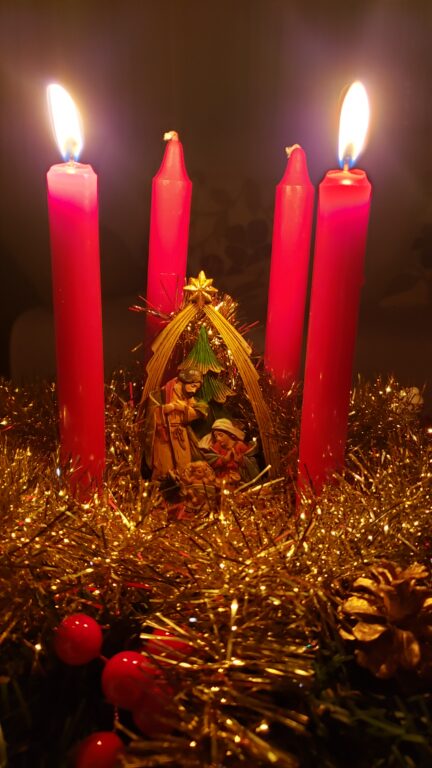
There are many ways of making Advent a special time of preparation and joyful celebration. We have the tradition of the Advent wreath, which consists of lighting four candles, one for each week of Advent. Each Sunday evening, an additional candle is lit. First, there is the candle of hope. We lit this one last Sunday. It’s followed by the candle of peace, which we light this Sunday. It is followed by the candle of joy, and finally, the candle of love. There are small prayers that accompany the lighting of each candle. We gather around the light, someone reads the prayer, the, we join in reciting some additional prayers, such as the “Our Father, and the “hail Mary,” to honor Jesus’ Holy Mother. Individual prayers can follow for our families and for the world. Beautiful Christmas Carols, traditional songs, can be practiced after prayers and sang on Christmas Eve.
During Advent, we try to go to church at least every Sunday. We prepare our hearts by asking God for forgiveness of our sins and reconciling in the spirit of love. We practice being charitable, which includes preparing a thoughtful gift for our loved ones, and donating to a charity, as our means allow.
The most beautiful preparation is inside our hearts. We know that God loves us always and forever. He loved us so much that He sent His Son, Jesus, into the world to teach us about the Father and to guide us by the power of the Holy Spirit.
Contemplating this mystery is the magic of Christmas.
We live with God and pray to him, sing to him and do good things out of love for Him. We praise Him.
This is how we prepare for Christmas beyond the delicious meals, the presents, and the family time during the holidays.
John the Baptist announces that the time of preparation is now. Today, his voice is like “The voice of one crying out in the wilderness: ‘Prepare the way of the Lord, make his paths straight’” (Matthew 3:3).
Sources:
- New Advent Ministries (2025). Prophecy, Prophet, and Prophetess. Retrieved from: www.newadvent.org. Accessed: December 4, 2025.
- Catechism of the Catholic Church. (2025). Article 464. True God and True Man. Retrieved from: https://www.catholicculture.org/culture/library/catechism/index.cfm?recnum=2158. Accessed: December 4, 2025.
- USCCB (2025). What We Believe. The Nicene Creed. Retrieved from: https://www.usccb.org/beliefs-and-teachings/what-we-believe Accessed: December 4, 2025.
- Catechism of the Catholic Church (2025). Paragraphs 1033-1037. Saint John the Baptist and Immaculate Conception Roman Catholic Parishes. Retrieved from: https://www.stjic.org/catechism-paragraph-1033-1037/#:~:text. Accessed: December 4, 2025.