
From self-love to self-transcendent love, Jesus expanded the traditional Law of Love to self-sacrificial love. Self-sacrificial love requires intentional agency and autonomous choice; it is distinct from passivity, submissiveness, or the forfeiture of personal boundaries.
GOSPEL PASSAGE: Matthew 22:34-40
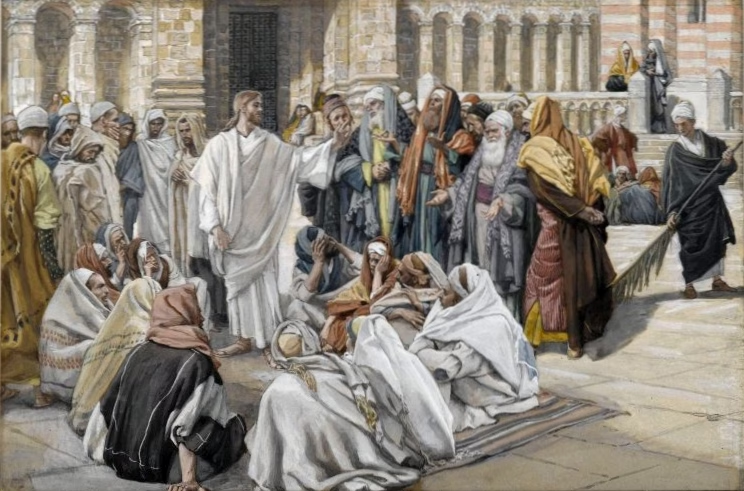
When the Pharisees heard that Jesus had silenced the Sadducees, they gathered together, and one of them, a scholar o the law, tested him by asking, “Teacher, which commandment in the law is the greatest?” He said to him, “You shall love the Lord, you God, with all your heart, with all your soul, and with all your mind. This is the first and the greatest commandment. The second is like it: you shall love your neighbor as yourself. The whole law and the prophets depend on these two commandments.”
GOSPEL REFLECTIONS:
Jesus had been repeatedly tested by the religious authorities of Jerusalem. When the Sadducees asked Him a question about the resurrection, He answered with clarity, affirming that the God of Abraham, the God of Isaac, and the God of Jacob is not the God of the dead—as these ancestors passed away long ago—but of the living (Matthew 22:32).
This was a very significant rebuttal because the Sadducees considered death to be final. (1) They did not believe in spirits, angels, or the afterlife, arguing that because there is no direct reference to the afterlife in the Torah, it is a modern invention that can be disregarded. (1) Their primary focus was on safeguarding religious practices through which one could ensure God’s favor in this life via material prosperity, health, and lineage. (1) Political and social power was therefore paramount to them as an indicator of God’s favor. (1) When Jesus presented to them words from the Torah—namely from Exodus 3:6, in which God reveals Himself to Moses as “I AM” (Exodus 3:14) and “I am the God of thy father, the God of Abraham, the God of Isaac, and the God of Jacob” (Exodus 3:6)—Jesus completely silenced the Sadducees, who withdrew and dared to ask Him no further questions.
After this, the Pharisees came forward because they also wanted to test Jesus on their own terms. They sent a religious expert to question Him about the most important commandment. The strategy was that if Jesus chose one law over any other, He could be labeled as either ignorant or a religious fanatic who favored one commandment at the expense of the rest.
This event is very similar to the one reported in Luke 10:25-28, in which a lawyer stood up to test Jesus, asking Him, “Teacher, what must I do to inherit eternal life?” This line of questioning is consistent with the Sadducees having been silenced on the topic of eternal life. Jesus masterfully turned the question back to the lawyer, saying, “What is written in the law? How do you read it?” The lawyer then answered by quoting the Shema from Deuteronomy 6:5, “Love the Lord your God,” and Leviticus 19:18, “Love your neighbor as yourself.” The lawyer gave the following answer: “Love the Lord God with all your heart and with all your strength and with all your mind and love your neighbor as yourself.” Jesus confirmed his answer by saying, “You have answered correctly. Do this and you will live.” Wishing to justify himself, the lawyer then asked, “And who is my neighbor?” to which Jesus replied with the parable of the Good Samaritan (Luke 10:25-37).
In Matthew’s account, however, Jesus is the one who answers with the passages from Deuteronomy and Leviticus: “’You shall love the Lord your God with all your heart, and with all your soul, and with all your mind.’ This is the greatest and first commandment. And the second is like unto it: ‘You shall love your neighbor as yourself.’ On these two commandments hang all the law and the prophets” (Matthew 22:37-40).
Either way—whether reaffirming what the lawyer readily concluded or directly stating the heart of the law—Jesus made a significant point about not choosing one commandment over another. Instead, He united the first and most important commandment (loving God) with the second commandment (loving one’s neighbor), making the two commandments of love one and inseparable. One cannot love God if one is not ready to love one’s neighbor. One cannot love one’s neighbor if one does not love God. Conversely, the more one loves God, the more one is able to love one’s neighbor, and the more one loves one’s neighbor, the more one loves God.
If the Pharisees intended to test Jesus to examine His religious manifesto and His understanding of the Scriptures, they received their answer. Jesus literally lived this principle as He headed toward the cross, using these final opportunities for discourse to reveal wisdom from the mind of God.
As a final act, while the Pharisees were still gathered around Him, He asked them a question: “What do you think of the Messiah? Whose son is he?” (Matthew 22:42). When they answered, “The Son of David” (Matthew 22:42), Jesus challenged them with an interpretation of the lines from Psalm 110:1 (found in the Ketuvim of the Jewish Tanakh): “The Lord said to my Lord, ‘Sit at my right hand, until I put your enemies under your feet.’” Jesus then asked, “If David calls him Lord, how can He be his son?” (Matthew 22:45).
In ancient Near Eastern patriarchal culture, authority flowed strictly downward through lineage, meaning a father or ancestor would never address his descendant as “Lord.” (2) By pointing out that David addresses the Messiah as his superior (Adoni), Jesus exposed the limitations of a purely political, earthly model of Davidic kingship, demonstrating that the Messiah must belong to an entirely divine category. (2)
From the Bible, we know that “…No one was able to give Him an answer, nor from that day did anyone dare to ask him any more questions” (Matthew 22:46). Providing an answer would have required reconciling the fact that Jesus was both the Son of David and the Son of God—not the God of the dead, but of the living. Far more than just an earthly king, He had to possess a divine nature.
In His humanity, as in His divinity, Jesus lived according to the supreme law: Love. He provided an example of how to live in accordance with the Law of Love.
As we can see, the Law of Love was rooted in Old Testament writings, but Jesus elevated it to a universal principle that ought to govern human behavior. In John 13:34-36, it is recorded that He said, “I give you a new law: You are to love each other. You must love each other as I have loved you. If you love each other, all men will know that you are My followers.”
Traditionally, there are two dimensions to this love: a vertical dimension (love for God), derived from Deuteronomy, which commands loving God with all one’s heart, soul, mind, and strength; and a horizontal dimension (love for others), derived from Leviticus 19:18, which commands loving one’s neighbor as oneself (3,4). “All the Law and the Prophets hang on these two commandments” (Matthew 22:40) because the law of love (both vertical and horizontal) is the prerequisite for all moral action.
During the Last Supper, Jesus expanded this law even further for His followers, elevating the standard from loving your neighbor “as yourself” to something much higher: “A new command I give you: Love one another. As I have loved you, so you must love one another” (John 13:34).
This shifted the benchmark of love from self-love to a sacrificial, Christ-like love. Thus, moving from self-love to self-transcendent love, Jesus expanded the traditional Law of Love into self-sacrificial love.
Since the concept of love has been mentioned several times in this reflection, it is worthwhile to spend a bit of time defining what is meant by the word.
Love is a metaphysical concept for which the English language has only a single word: love. The ancient Greeks differentiated among various types, depths, and motivations of love, such as philia, eros, and agape (5).
- Philia (akin to affectionate liking) describes a bond of shared interests, affection, companionship, and friendship (4). It is epitomized by the bond between David and Jonathan in the Bible—a spirit of camaraderie.
- Eros refers to passionate, romantic desire and emotional intensity, such as that found in the Song of Solomon. It is a conditional type of love based on attraction and a longing for physical and emotional connection with another person (4).
- Agape is the highest form of love—one that is not demanded, commanded, or forced, but arises from a natural inclination and a deliberate act of the will to seek the ultimate good of another person, regardless of reciprocity or personal cost (4). It does not depend on whether the other person deserves such love; rather, it is an unconditional, outward-directed appreciation of the essential worth of the other, accompanied by an aspiration to help them realize their highest potential. It is represented by God’s love for humanity and Jesus’s “Law of Love,” expressed in John 3:16 as: “For God so loved the world that he gave his only Son, so that everyone who believes in him may not perish but have eternal life.”
After His resurrection, Jesus asks Peter three times if he loves Him. Each time, Jesus uses a dynamic progression of language, prompting Peter’s affirmation to go beyond superficial inclination or affiliation toward a deep and intense commitment to serve God by shepherding the Church (John 21:15-17). The questions elicit his free, conscious decision and affirm his sincere intentions.
As we see from these examples, God’s sacrificial act springs from intentional agency and active will—qualities that are not equivalent to self-devaluation, self-subjugation, or the enabling of coercive and abusive behaviors that lead to destruction, lack of boundaries, and fearful compliance.
“My life,” said Jesus, “…no one takes it from me, but I lay it down of my own accord. I have authority to lay it down and authority to take it up again. This command I received from my Father” (John 10:18).
Thus, a vital point about love emerges; while love involves self-giving and self-emptying, it is the conscious and willing dedication of one’s resources for the benefit of a person or cause that gives sacrifice its meaning. As such, it leads to the full development, engagement, and sanctification of the person offering the gift.
Carl Jung referred to this state as “differentiated wholeness,” whereby one integrates psychological and physical boundaries with spiritual depth (6). Psychologically, an individual is connected to others through love while remaining firmly anchored in an awareness of their own dignity and identity. One does not love in order to gain fulfillment, but because one is already fulfilled. (6)
This aligns closely with Viktor Frankl’s existential analysis, which posits that self-transcendence—reaching beyond oneself toward a cause to serve or a person to love—is the ultimate essence of human existence. (5) For Frankl, true self-transcendence is impossible without authentic agency; it is not a neurotic loss of identity or passive self-effacement, but an intentional decision of a fully conscious self. (5) This is a high state of personal and spiritual maturity whereby one is not “fused” into a group to lose one’s identity; or isolated, where one cuts off connections with others to protect one’s identity, but rather one is able to balance the paradox of being interdependent and deeply connected; fully connected to a community, and to humanity, while being able to maintain one’s own unique identity, values, and boundaries. (5)
Psychotherapist David Benner wrote about embracing “wholeness” as a path to holiness—understanding oneself as differentiated aspects working in harmony within a greater whole, where everything is interconnected and where the dynamics of love gather all things into greater unity and consciousness (7). According to Benner, “wholeness and love are inseparable… in the words of Ilia Delio, ‘Our challenge today is to trust the power of love at the heart of love, to let ourselves be seized by love, to create and invent ways for love to evolve into global wholeness of unity, compassion, justice, and peacemaking.’ This is living wholeness and love” (8).
Jesus acted in the world and for the sake of the world while remaining consciously aware that He was not of the world. His deep grounding in both the fully human and the fully Divine allowed Him to confront the Sadducees and the Pharisees without compromising His identity, values, or mission. His love for them was fervent—even to the point of His passion and death, a death from which new life sprang.
Sources:
- Bible Hub (2004). Why did the Sadducees reject resurrection? Retrieved from: https://biblehub.com/q/Why_did_Sadducees_reject_resurrection_2.htm. Accessed: October 1, 2026.
- Keener, C. S. (2014). The IVP Bible background commentary: New Testament (2nd ed.). IVP Academic.
- Catholic Church (2000). Catechism of the Catholic Church. 2nd ed. Washington, DC: United States Catholic Conference, 2000. Articles 2055 and 1822. Electronic version: Catechism of the Catholic Church. The Holy See. Retrieved from: https://www.vatican.va/archive/ENG0015/_INDEX.HTM
- Pope Benedict XVI. (2005, December 25). Deus caritas est [Encyclical letter]. The Holy See. vatican.va
- Frankl, V. E. (1986-2019). On the Meaning of Love. The Doctor and the Soul. From Psychotherapy to Logotherapy. Penguin Random House. P. 132
- Reynolds, C. E. (2012). Relational Interdependent Self construal, and Spiritual Maturity as Predictors of Marital Satisfaction. Loma Linda University Electronic Theses, Dissertations and Projects. 94. Retrieved from: https://scholarsrepository.llu.edu/etd/94. Accessed: October 1, 2026.
- Benner, D. G. (2016). Perfection and the Harmonics of Wholeness. Perfection. Oneing, vol. 4, No. 1. Center for Action and Contemplation Publishing. Pages 62-63.
- Rohr, R. (2021). Wholeness as Holiness. Center for Action and Contemplation.