Rules, laws, state, and religion: freedom of conscience and the responsible formation of conscience are all part of today’s Gospel reading on Jesus’ encounter with the scholars of His day.
GOSPEL PASSAGE: Matthew 22:15-21
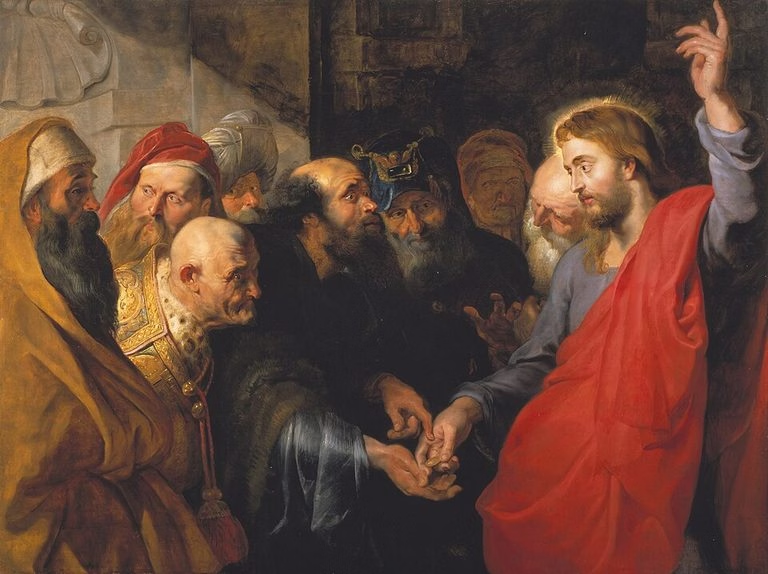
The Pharisees wet off and plotted how they might entrap Jesus in speech. They sent their disciples to him, with the Herodians, saying, “Teacher, we know that you are a truthful man and that you teach the way of God in accordance with the truth. And you are not concerned with anyone’s opinion, for you do not regard a person’s status. Tell us, then, what is your opinion: Is it lawful to pay the census tax to Caesar or not?” Knowing their malice, Jesus said, “Why are you testing me, you hypocrites? Show me the coin that pays the census tax.” Then they handed him a Roman coin. He said to them, “Whose image is this and whose inscription?” They replied, “Caesar’s.” At that he said to them, “Then pay to Caesar what belongs to Caesar and to God what belongs to God.”
GOSPEL REFLECTIONS:
Jesus was already in Jerusalem, close to the time of His death. The Pharisees, the scribes, and the elders were plotting against Him because they wanted to put Him to death. However, they did not dare to touch Him in front of the crowds because many people believed He was a prophet. Therefore, they were looking for a favorable occasion to trap Jesus into saying the wrong things so they could denounce Him—this time as someone stirring up the people against Roman authority.
The Pharisees, Sadducees, scribes, elders, and even King Herod himself had delicate ways of operating under Roman occupation. The Sadducees, who were the elite priestly order, collaborated with the Romans to appease them and maintain their own status. (1) The Pharisees were mostly concerned with the Law and the Torah; as scholars who were closer to the sentiments of the people, they regarded the Roman occupation with tension, resentment, and resignation. However, they were ready to side with the Sadducees when they perceived a threat to their institutions. (2) The Herodians were supporters of King Herod and his dynasty who worked alongside the Sadducees and Pharisees to maintain the puppet government and social order. (3)
What these three groups had in common was collaboration intended to suppress or crush any kind of religious fervor or messianic ideas that might provoke the Roman authorities and trigger a brutal crackdown on their religious institutions. (1, 2, 3) Therefore, they formed various coalitions and alliances against what they considered an unlikely, problematic, and dangerous movement to promote Jesus as a descendant of King David, the rightful King of Israel, a contender to the throne, a mighty prophet, or the Messiah. (3)
Thus, the Pharisees sent their students to Jesus. They began to flatter Him to make Him believe they were sincerely seeking His advice, saying: “Teacher, we know that you are sincere and teach the way of God in accordance with truth and show deference to no one; for you do not regard people with partiality.” (Matthew 22:16). This sounds like a compliment—and it is an acknowledgment that Jesus is a teacher of the people. Then they followed up with their trap: “Tell us then, what you think. Is it lawful to pay taxes to the emperor or not?” (Matthew 22:17).
The advice they sought concerned taxation—specifically, whether it was lawful to pay taxes to the Roman Emperor. Here, “lawful” did not mean legal under civic law, but rather whether it was permissible under religious law to pay taxes to an invading power. The entire question carried heavy undertones of stoking collaboration or denying support for the Romans—a complex mixture of power, religion, and politics.
Jesus saw through the trap and understood that it came from people who were already collaborating with the Romans. They were not there to seek advice; they were there to crack down on anyone who dared to openly disagree with their stance. Therefore, He called them “hypocrites.” (Matthew 22:18).
Instead of giving an abstract or hypothetical answer or quoting the law, He addressed the concrete reality of the coin used to pay the tax: “Whose head is this, and whose title?” He asked the students. They replied in unison, “The emperor’s.” Holding the coin, Jesus said: “Give therefore to the emperor the things that are the emperor’s, and to God the things that are God’s.” (Matthew 22:21). Amazed by His answer, they left Him and went away. (Matthew 22:22).
Jesus made the subtle point evident: politics and religion operate in different spheres. Legal obligations do not have to be disregarded by a religious person, but they do not override what belongs to the realm of faith. Priorities can be established, allowing a person to fulfill obligations to both the state and God without confusing the two.
A clear example of how challenging such situations can become when politics and religion intersect occurred during Pope Leo XIV’s apostolic visit to France. France is a presidential republic with a dual-executive system built around the cooperation of the President (the Head of State, elected for a five-year mandate) and the Prime Minister (the Head of Government, appointed by the President). (4) The current Head of State is Emmanuel Macron, who has been in office since 2017, and the current Prime Minister is Sébastien Lecornu, a former Armed Forces Minister appointed by Emmanuel Macron in September 2025. (5)
Since 1905, the French Constitution has upheld the Law on the Separation of the Churches and the State. This principle manifests in a few concrete ways: (1) upholding Freedom of Conscience, which allows every citizen to choose, change, and practice their faith privately without state oversight; (2) State Neutrality, which mandates that the state treat all citizens equally regardless of religious affiliation, without funding, recognizing, or subsidizing any religion; and (3) Neutrality of Public Services, which legally bars government employees (such as teachers, police officers, and administrators) from displaying religious symbols or attire while on duty, and prohibits public elementary and secondary school students from wearing conspicuous religious symbols. (6)
Since 2010, France has also enforced a ban on full-face veils in public spaces and prohibited religious oaths or explicit religious rhetoric in official public discourse. (7) On August 19, 2026, President Emmanuel Macron signed into law a bill on medical assistance in dying (MAID, or l’aide à mourir), allowing eligible patients to self-administer a lethal substance, with assistance from medical personnel permitted only if the patient is physically unable to do so. Prior to this, the 2016 Claeys-Leonetti law provided for deep and continuous sedation until death for terminally ill patients but did not permit the administration of lethal substances. (8)
Under these conditions, Pope Leo XIV accepted President Macron’s invitation to visit France for three days, from September 25 to September 28. The Pope was greeted by Emmanuel Macron and his wife, Brigitte, at the Élysée Palace in Paris—marking the first papal visit to France in 18 years. Thanking his hosts, the Pope remarked: “A Church that claims to be uninterested in temporal matters would not be fulfilling her vocation; and a President of the Republic who claims to be uninterested in the Church and in Catholics would be failing in his duty.” (9)
Escorted down the Avenue des Champs-Élysées, the Pope was cheered by thousands. He visited the UNESCO headquarters in Paris, where he delivered a speech on human dignity:
“While intelligence [referring to AI systems] is attributed to computational systems, we struggle to recognize the inalienable dignity of human persons whose lives are judged according to criterion of efficiency and when deemed no longer productive, they are rejected and discarded. This painful reality invites us to reflect on the fragility of human nature and on the dignity of every human person—a dignity that remains undiminished even in the most vulnerable circumstances, even unto death itself. The human being is certainly one who is born, but also one who dies. Our dignity is not destroyed by illness or suffering, nor is it dependent on our abilities. Rather, it calls for loving care at every stage of life. For the Christian faith, the mystery of the human person finds its fullest light in Christ, who in the very revelation of the Father and of His love fully reveals humanity to itself and brings to light its very high calling. In His light, every person appears to us as a creature willed and loved by God. This light helps us to grasp more deeply the meaning of our shared human experience.” (10, 11)
The Holy Father participated in a prayer vigil at Notre-Dame Cathedral and then traveled to Saint-Denis, where 80,000 young people welcomed him at the Stade de France. Pope Leo encouraged them to remain faithful and committed to their country’s future: “Thank you. Thank you for your courage. Thank you for your presence. Thank you for your faith. You are the saints of France!” (12)
The following day, Mass was celebrated at the Place de la Concorde before an estimated 800,000 pilgrims from across Europe, filling the length of the Champs-Élysées. The Pope then traveled to the Sanctuary of Our Lady of Lourdes, participating in a candlelit procession. Addressing the gathered pilgrims, he reaffirmed human dignity and critiqued MAID as a form of “false compassion,” emphasizing that vulnerable individuals need care and support to live with meaning and dignity: “It is impossible to consider giving death as normal, especially under the guise of false compassion. What is legal is not necessarily moral.” (13)
On Sunday, the Pope traveled to Metz, a city in Lorraine near the German border. He participated in the Robert Schuman Conference for Peace in Europe, followed by Mass at Saint-Étienne Cathedral. There, he called for welcoming migrants and refugees—not merely providing shelter but inviting them to share fully in community life like family, enabling them to realize their full potential. He urged European leaders to move away from the desire for domination toward dialogue, compromise, and a rejection of nationalism. President Macron and his wife joined the Pope for the final Mass and attended the farewell ceremony. Expressing his gratitude, President Macron referenced an ancient Yiddish idiom (“Happy as God in France”), stating that the joy and unity brought by Pope Leo’s visit would be remembered as being “Happy as God in Lorraine; Happy as Pope Leo in France.” (14)
When asked on his flight back to Rome whether he was getting too involved in politics, the Pope offered a nuanced response:
“I would say that regarding the Church’s understanding of the separation between church and politics—or church and state—I did not cross that line. But in a place like Lourdes, where people are searching for something much deeper and seeking to understand that their lives still have meaning amidst sickness, disability, or pain, the Church—because of Jesus Himself—wants to be close to them and affirm the intrinsic value of life. So, if that is considered politics, then I did it—not to interfere in French politics, but to teach what the Church truly believes.”
The successor of Saint Peter made it clear that standing up for universal human values inevitably touches on political matters. Responsible engagement in civic life can shape laws so that they reflect core moral principles. Even when legally permissible choices are codified through democratic processes, individuals retain the moral freedom to decide how to act. Although imperfect throughout its history, the Church aims to guide people toward moral actions and encourage thoughtful reflection on complex ethical issues. Doing so requires both freedom of conscience and its responsible formation.
Sources:
- Castleberry, S. (2021). Who were the Sadducees and What Was Their Deal? Lifeword Blog. May 17, 2021. Retrieved from: https://lifeword.org/blog/who-were-sadducees-and-what-was-their-deal/. Accessed: October 1, 2026.
- Perry, T. (2020). Who Were the Sadducees and Pharisees? January 31, 2020. The Friends of Israel Gospel Ministry. Retrieved from: https://www.foi.org/2020/01/31/who-were-the-sadducees-and-pharisees/. Accessed; October 1, 2026.
- Stam, K. (1985). Mark 3:6—Strange Bedfellows: Herodians and Pharisees. Christian Library. Retrieved from: https://www.christianstudylibrary.org/article/mark-36-%E2%80%93-strange-bedfellows-herodians-and-pharisees. Accessed: October 1, 2026.
- Shennan, J, H, et al. (2026). France. Government and Society. Britannica. Retrieved from: https://www.britannica.com/place/France/Justice. Accessed: September 30, 2026.
- Elysee (2026). The institutions. France. Retrieved from: https://www.elysee.fr/en/french-presidency/the-institutions. Accessed: September 30, 2026.
- Davis, S. M. (2022). France’s 1905 Law of Separation of Church and State. 02 November 2022. World History Encyclopedia. Retrieved from: https://www.worldhistory.org/article/2094/frances-1905-law-of-separation-of-church-and-state/. Accessed: September 30, 2026.
- Open Society Foundations (2026). S.A.S. vs. France. Criminal Penalty for Wearing a Full-Face Veil in Public Spaces. Retrieved from: https://www.justiceinitiative.org/litigation/sas-v-france. Accessed: September 30, 2026.
- Reuters (2026). French Parliament approves landmark assisted-dying bill. July 15, 2026. Reuters. Retrieved from: https://www.reuters.com/legal/litigation/french-parliament-votes-landmark-assisted-dying-bill-2026-07-15/. Accessed: September 30, 2026.
- Brockhaus, H. (2026). Pope Leo XIV, in France, says protection of life duty for everyone. EWTN. 25.09.26. Retrieved from: https://ewtnvatican.com/articles/pope-leo-xiv-in-france-says-protection-of-life-a-duty-for-everyone. Accessed: September 30, 2026.
- ROME REPORTS (2026). Pope Leo XIV’s Blunt Message at UNESCO: “Innocent people are being killed in the name of freedom.” Retrieved from: https://www.youtube.com/watch?v=aezjpDrFtyQ
- UNESCO (2026). At UNESCO, Pope Leo XIV addresses the world with a resounding message of peace and human dignity. Retrieved from: https://www.unesco.org/en/articles/unesco-pope-leo-xiv-addresses-world-resounding-message-peace-and-human-dignity. Accessed: September 30, 2026.
- McLellan, J. (2026). French Catholics believe they’re having a moment. Pope Leo seems to agree. National Catholic Reporter. Vatican. Vatican News. Retrieved from: https://www.ncronline.org/vatican/vatican-news/french-catholics-believe-theyre-having-moment-pope-leo-seems-agree. Accessed: September 30, 2026.
- Brockhaus, H. (2026). Killing the Sick is ‘false compassion,’ pope says in Lourdes. EWTN. 28.09.26. Retrieved from: https://ewtnvatican.com/articles/killing-the-sick-is-false-compassion-pope-says-in-lourdes. Accessed: September 30, 2026.
- Vatican News (2026). Pope Leo XIV bids farewell to France. Vatican News. Retrieved from: https://www.vaticannews.va/en/pope/news/2026-09/pope-leo-xiv-departure-metz-apostolic-journey-france.html. Accessed: September 30, 2026.
- Catholic World News (2026). Pope, at press conference, defends willingness to speak out in defense of life in France. September 29, 2026. Retrieved from: https://www.catholicculture.org/news/headlines/index.cfm?storyid=70805. Accessed: September 30, 2026.