
Jesus continued teaching through parables to illuminate the mystery of the Kingdom of Heaven. Today’s Gospel highlights the generosity of God’s mercy and the humble response each person is invited to offer in return.
GOSPEL PASSAGE: Matthew 22:1-14
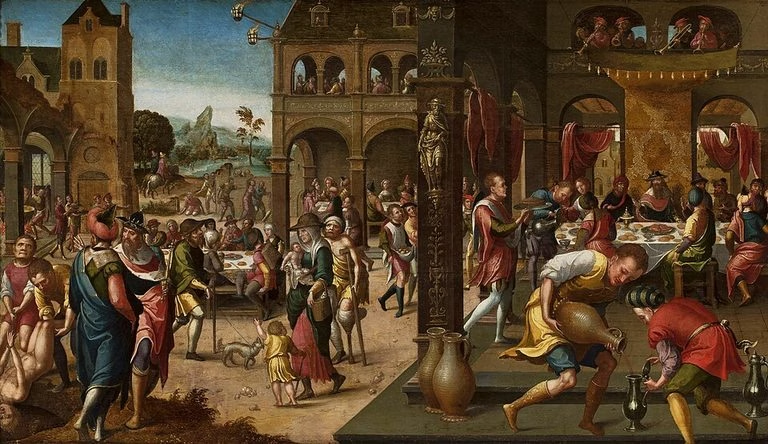
Once more Jesus spoke to them in parables, saying: “The kingdom of heaven may be compared to a king who gave a wedding banquet for his son. He sent his slaves to call those who had been invited to the wedding banquet, but they would not come. Again, he sent other slaves, saying, ‘Tell those who have been invited: Look, I have prepared my dinner, my oxen and my fat calves have been slaughtered, and everything is ready; come to the wedding banquet.’ But they made light of it and went away, one to his farm, another to his business, while the rest seized his slaves, maltreated them, and killed them. The king was enraged. He sent his troops, destroyed those murderers, and burned their city. Then he said to the slaves, ‘The wedding is ready, but those invited were not worthy. Go therefore into the main streets and invite everyone you find to the wedding banquet.’ Those slaves went out into the streets and gathered all whom they found, both good and bad; so, the wedding hall was filled with guests.
But when the king came in to see the guests, he noticed a man there who was not wearing a wedding robe, and he said to him, ‘Friend, how did you get in here without a wedding robe?’ And he was speechless. Then the king said to the attendants, ‘Bind him, hand and foot, and throw him out into the outer darkness, where there will be weeping and gnashing of teeth. For many are called, but few are chosen.’”
GOSPEL REFLECTIONS:
Jesus tells a parable comparing the kingdom of God to a banquet prepared by a king to welcome his guests. When the original invited guests refused to come, the king sent his servants through the entire city to invite whoever they could find.
Historically, the parable reflects that God spoke to His chosen people first, and later, to all the people of the world. From this parable, we learn that whether for Jews or for Gentiles, there is only one precondition to participation in the wedding banquet, which is to “wear a wedding garment.”
So, in trying to interpret this passage, we will focus on what this “wedding garment” may look like or be.
When we attend special events, we try to dress appropriately. There is different attire that we wear on weekdays when we are at home, at work, or when we prepare for an outing. Attending a wedding is certainly one of those occasions when we pay more attention to our appearance and make sure that our clothes reflect the festive occasion. When we attend a Mass or a church service, we also match our clothes accordingly.
Wearing a specific outfit may help us to identify people according to their professions. A baker may be dressed differently from a chef; a barber may be dressed differently from a nurse, and a teacher may be dressed differently from the students. Thus, clothes can give us clues about one’s role and position. In church-related roles, we can differentiate a priest from a deacon, and the acolyte from the bishop, simply based on what robes they wear. However, we know that clothes are not the way we ought to judge character.
Thus, there is a symbolic role to the type of clothes that one may wear, beyond the obvious practical considerations of one’s occupation. This symbolic connection between outward garments and inner virtue was something I learned early in childhood.
When I was little, there was a tradition in my family to prepare white paper garments to be presented to the Baby Jesus. About two weeks prior to Christmas Eve, my mother folded a sheet of paper in half and traced out a simple tunic-shaped garment with a half-O-shaped neckline. We carefully cut around the shape, then folded the paper into several segments. We made small cuts so that upon unrolling the paper, we ended up with V-shaped paper folds. When we did a good deed, such as helping out at home, making our bed, sweeping the floor, washing the dishes, or doing our homework, we were allowed to fold the paper upward, creating tiny decorations on the garment. There was a competition among my siblings to see who decorated little Jesus’ dress with the most folds. On Christmas Eve, we placed each dress under the Christmas tree, presenting it to the Baby Jesus filled with our good deeds as gifts. These were symbolic dresses, representing our good deeds as presents to God.
Examining the Bible, we find that Isaiah in 52:1 exhorts the Israelites to “put on their beautiful garments” to meet the Lord. This passage is followed by the description of the “suffering servant” in Isaiah 52:13–15:
“See, my servant shall prosper; he shall be exalted and lifted up and shall be very high. Just as there were many who were astonished at him—so marred was his appearance, beyond human semblance, and his form beyond that of mortals—so he shall startle many nations; kings shall shut their mouths because of him; for that which had not been told them they shall see, and that which they had not heard they shall contemplate.” (Isa 52:13-15).
The physical garment of Jesus which He wore during the crucifixion is called the Holy Tunic or Seamless Robe. (1) There are two pieces that are kept hidden away for preservation purposes and displayed only very rarely, if at all: the Argenteuil Tunic, housed in the Basilica of Saint Denis in Argenteuil, France, and The Trier Tunic, housed in the Cathedral of Trier, Germany. (2, 3) They are put on display every fifty years or once every century, respectively, to protect the fabric from disintegration. (2, 3)
We know that after the resurrection, Jesus’ clothes became dazzling white, unlike any white color that could be produced on earth (Matthew 17:1-13; Mark 9:2-13; Luke 9:28-36). The disciples saw a glimpse of it during His transfiguration (2 Peter 1:16-18). Other times, He appeared to the disciples in ordinary clothes that they could not recognize, until they identified Jesus during the breaking of the bread (Luke 24:13-35).
Beyond physical garments, Scripture repeatedly uses clothing as a metaphor for spiritual transformation. It becomes clear as we continue to read Isaiah that the wedding garment refers to “a garment of salvation” and being covered with the “robe of righteousness” (Isa 61:10). It does not refer to a certain type of material, but to the quality of the person’s actions. As Isaiah explains:
“For as the earth brings forth its shoots, and as a garden causes what is sown in it to spring up, so the Lord God will cause righteousness and praise to spring up before all the nations.” (Isa 61:11)
This quality is further explained in the New Testament, specifically in Colossians 3:12, where it is said to be a garment of “tender mercies, kindness, humility, meekness, and patience as spiritual clothing.” Saint Paul provides the following instructions for a righteous life:
“As God’s chosen ones, holy and beloved, clothe yourselves with compassion, kindness, humility, meekness, and patience. Bear with one another and, if anyone has a complaint against another, forgive each other; just as the Lord has forgiven you, so you also must forgive. Above all, clothe yourselves with love, which binds everything in perfect harmony. And let the peace of Christ rule in your hearts, to which indeed you were called in one body. And be thankful. Let the word of Christ dwell in you richly; teach and admonish each other in wisdom; and with gratitude in your hearts sing psalms, hymns and spiritual songs to God. And whatever you do, in word or deed, do everything in the name of the Lord Jesus, giving thanks to the Father through him.” (Colossians 3:12-17).
And in Romans 13:14, he directly refers to this garment as the act of putting on “the Lord Jesus Christ.” He urges the Romans in this way:
“Let us then lay aside the works of darkness and put on the armor of light; let us live honorably as in the day, not in reveling and drunkenness, not in debauchery and licentiousness, not in quarrelling and jealousy. Instead, put on the Lord Jesus Christ, and make no provision for the flesh, to gratify its desires.”
Clearly, Saint Paul is talking about the Gospel for all people as he says, “…I will confess you among the Gentiles, and sing praises to your name” (Romans 15:9), and again, with the words of the Psalmist, St. Paul repeats, “Let the people praise thee, O God; let all the people praise thee” (Psalm 67:3; 111:1; Romans 15:11).
Saint Paul is certain that “Those who have never been told of him shall see, and those who have never heard of him shall understand.” (Romans 15:21).
Finally, in Saint John’s Revelation, we read that the elect—those who washed their robes white in the blood of the Lamb—are those welcomed into the kingdom of God:
“Then one of the elders addressed me, saying, ‘Who are these, robed in white, and where have they come from?’ I said to him, ‘Sir, you are the one who knows.’ Then he said to me, ‘These are they who have come out of the great ordeal; they have washed their robes and made them white in the blood of the Lamb.
For this reason, they are before the throne of God, and worship him day and night within his temple, and the one who is seated on the throne will shelter them. They will hunger no more, and thirst no more; the sun will not strike them, nor any scorching heat; for the Lamb at the center of the throne will be their shepherd, and he will guide them to springs of the water of life, and God will wipe away every tear from their eyes.’” (Rev 7:13-17).
Revelation contains the final mystery of the heavenly banquet—that is, the culmination of the banquet of the Lamb, the invitation to sacramentally participate in the life and death of Jesus, and, having gone through the trials, to participate in His resurrection and merit eternal life.
The banquet is ready, says the Lord, and the invitation is sent out. Happy are those who do not pass it by.
Sources:
- National Catholic Register (2026). Relic of Christ’s Tunic to Be Displayed for Pope Leo in France. NCR September 21, 2026. Retrieved from: ncregister.com. Accessed: September 30, 2026.
- De Sury, C. (2026). Pope Leo XIV to Make Historic First Veneration of ‘Holy Tunic,’ Highlighting Christian Unity. OSV News. September 23, 2026. Retrieved from: osvnews.com. Accessed: September 30, 2026.
- Weber, C. (2012). Holy Robe goes on display in Germany. Christian Today. The Christian Post. 20 April 2012. Retrieved from: christiantoday.com. Accessed: September 30, 2026.