
Jesus used parables to teach about the kingdom of God. Each one reveals some aspect of this kindom.
GOSPEL PASSAGE: Matthew 21:33-43
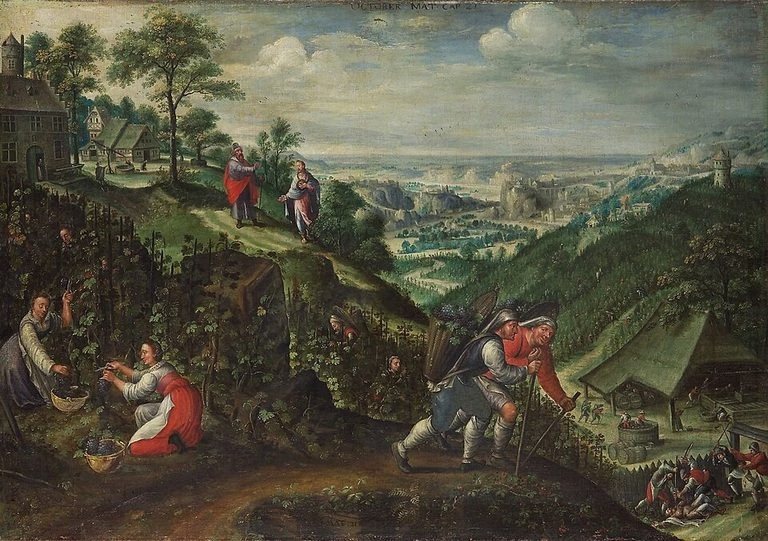
Jesus said to the chief priests and the elders of the people: “Hear another parable. There was landowner who planted a vineyard, put a hedge around it, dug a wine press in it, and built a tower. Then he leased it to tenants and went of a journey. When vintage time drew near, he sent his servants to the tenants to obtain his produce. But the tenants seized the servants and one the beat, another they killed, and the third one they stoned. Again, he sent out other servants, more numerous than the first ones, but they treated them in the same way. Finally, he sent his own son to them, thinking, ‘They will respect my son.’ But when the tenants saw the son, they said to one another, “This is the heir. Come, ket us kill him ad acquire his inheritance.’ They seized him, threw him out of the vineyard, and killed him. What will the owner of the vineyard do to those tenants when he comes?” They answered him, “He will put those wretched men to a wretched death and lease his vineyard to other tenants who will give him the produce at the proper time.” Jesus said to them, ‘Did you never read in the Scriptures:
The stone that the builders rejected has become the cornerstone;
By the Lord has this been done, and it is wonderful in our eyes?
Therefore, I say to you, the kingdom of God will be taken away from you and given to people that will produce its fruit.”
GOSPEL REFLECTIONS:
Jesus used three parables to teach about the kingdom of God, each shared in Jerusalem during His final days: the Parable of the Workers in the Vineyard (Matthew 20:1–16), the Parable of the Two Sons (Matthew 21:28–32), and the Parable of the Wicked Tenants (Matthew 21:33–46). Every parable is prophetic and reveals how to enter and build the kingdom.
The first parable, about the landowner who hired workers for his vineyard, taught a lesson about God’s great mercy, generosity, and our free response to it. The second parable concerned the owner’s two sons: one was initially disobedient but changed his mind, while the other promised to work in the vineyard but never did, breaking his word. This parable teaches about obedience, humility, keeping one’s word, and acting with integrity.
The third parable teaches something even more profound about Christ’s obedience to the Father, revealing a prophecy of His own death. His sacrifice—which began by taking on human form to live in the world—continued as He accepted His death, specifically a death on a cross. This is revealed in the Parable of the Wicked Tenants.
Jesus told this parable to the chief priests and the elders of Jerusalem, who did not yet understand that the message was directed at them. Drawing from history, Jesus established a parallel between the owner of the vineyard (God) and the tenants to whom he leased his land (His listeners). The owner traveled to a faraway country and sent his servants to collect the harvest that was due. However, the wicked tenants mistreated the owner’s servants: they beat one, killed another, and stoned a third (Matthew 21:35). In reality, God sent His servants, the prophets, to proclaim His message to the people, but they were mistreated, beaten, killed, or stoned. Prophets like Elijah and Elisha in the 9th century BC, Isaiah, Amos, Hosea, and Micah in the 8th and 7th centuries BC, and Ezekiel and Jeremiah in the 6th century BC are primary examples. (1) John the Baptist was a recent example to Jesus’ audience, yet they still did not understand these parallels.
So, Jesus continued: the owner then decided to send his own son to the vineyard, thinking, “They will respect my son” (Matthew 21:37). Instead, the tenants took the opportunity to seize him, throw him out of the vineyard, and kill him (Matthew 21:38).
Because the audience still did not grasp the message, Jesus posed a Socratic question to draw them into the storyline: “When the owner of the vineyard comes, what will he do to those tenants?” (Matthew 21:40). The audience readily replied: “He will put those wretches to a miserable death and lease the vineyard to other tenants who will give him the produce at harvest time” (Matthew 21:41).
Jesus then affirmed their sense of justice using lines from Scripture: “The stone that the builders rejected has become the cornerstone; this was the Lord’s doing, and it is amazing in our eyes” (Matthew 21:42).
At that moment, their eyes were opened, and they understood His meaning: He was equating Himself with God’s own Son, the Messiah. Jesus continued, “…Therefore I tell you, the kingdom of God will be taken away from you and given to a people that produces the fruits of the kingdom” (Matthew 21:43). These were harsh words, and the religious leaders grew furious. However, they did not dare to arrest Him then and there because they were afraid of the crowds, who regarded Jesus as a prophet (Matthew 21:46).
We could leave these words in the past, spoken to a small group of people, but that would not do justice to Jesus’ parable, which is meant for all of us. What message can we gather from the Parable of the Wicked Tenants?
The most obvious message is that we are not the owners. God is the owner, and we are the tenants. Everything God gives—what we have and what we are able to do with what we have—comes through God’s favor. Therefore, we should view ourselves as owning nothing, recognizing that whatever we have is a tool for doing good. Starting with our very lives, we must regard everything as a gift from God rather than taking it for granted.
Jesus’ life on earth was short. Even as He hung dying on the cross, He uttered statements drawn from the Seven Last Words of Christ. (2) First, He offered forgiveness to those crucifying Him and granted pardon to the thief begging for mercy. Second, He entrusted His mother to the care of St. John at the foot of the cross, ensuring intercession for the future challenges His followers would face. Third, He commended His spirit entirely into the hands of the Father, placing His whole mission under God’s care. This was Jesus’ great “yes” to the Father’s plan and His practical acceptance of His threefold sacrifice.
Through these words and actions, Jesus offered the ultimate example of humility, obedience, and gratitude for His mission. This is the central lesson of the Parable of the Wicked Tenants: everything belongs to God. The cornerstone—the foundational stone that bears the greatest weight—shows us that through all the vicissitudes of life, everything is a gift to be thankful for and responded to. We do not own the day or the night, our bodies, or our abilities; the only thing we truly possess is our will and the freedom to decide how to use what we have in the service of God.
When we understand this parable more deeply, we begin to appreciate that every day and every moment is a gift. When we hold on to nothing but God, we receive the strength needed to yield the fruit He intended from the beginning.
During Pope Leo XIV’s visit to France (September 25-28, 2026), young people greeted him with an Easter hymn titled “Resucitó,” composed by Kiko Argüello in 1967. (3) Francisco Jose Gómez Argüello Wirtz (aka Kiko Argüello) was a Spanish painter who experienced a profound spiritual conversion, went to live among the poor in the slums of Madrid, and later founded the Neocatechumenal Way. (4) The song has resurfaced frequently across Europe and the Americas, notably performed at World Youth Days in Lisbon (August 1–6, 2023) and Rome (July 29–August 3, 2025). (5,6) On September 27, 2026, it was sung by 800,000 young people gathered at the Place de la Concorde in Paris to welcome the Pope. (7)
The song consists of a few simple verses, translated into English as: “Death, where is death? Where is my death, where is its victory? The kingdom, raised to God the kingdom. Raised up to the kingdom, longing and living love. Joy, joy, my brothers; if today we love each other, it is because He is alive. With Him then, die and live with Him then.”
The refrain proclaims: “He is risen, He is risen, He is risen, hallelujah. Hallelujah, hallelujah, hallelujah, He is risen!” (3)
If we are ready to die with Him, He will raise us up to live with Him forever.
Sources:
- Peters, T. (2026). Matthew 21: 333-46. Year A. Bible Study by Father Tim Peters. Retrieved from: https://www.youtube.com/watch?v=MjURYUOBCyw. Accessed: September 28, 2026.
- Nuttmann, M. C. (2026). The Seven Last Words of Jesus. Artistic representations by Sister Marie Celeste Nuttmann. Sisters of Mercy of the Americas. Retrieved from: https://www.sistersofmercy.org/spirituality-and-faith/the-seven-last-words-of-jesus/. Accessed: September 29, 2026.
- Agrüello, K. (1973). Resucitó! Retrieved from: https://www.google.com/search?q=word+youth+day+in+lisbon+and+rome+kiko%27s+song+resucito. Accessed; September 28, 2026.
- Neocatechumenal Way (2026). Kiko Arguello. Retrieved from: https://neocatechumenaleiter.org/en/history/kiko-arguello/. Accessed: September 29, 2026.
- The Holy See (2023). Apostolic Journey of His Holiness Pope Francis to Portugal. Retrieved from: https://www.vatican.va/content/francesco/en/travels/2023/outside/documents/portogallo-gmg-2023.html. Accessed: September 28, 2026.
- Peregrinantes in Spem (2025). A million young people take part in a Jubilee celebration of faith which Rome will never forget. Retrieved from: https://www.iubilaeum2025.va/en/notizie/comunicati/2025/giubileo-1-mln-giovani-roma.html. Accessed: September 29, 2026.
- Beardsley, E., & Scott, S. (2026). Papal pilgrimage: Pope Leo fills Place de la Concorde for historic Mass in France. NPR September 26, 2026. Retrieved from: https://www.npr.org/2026/09/26/nx-s1-5980298/papal-pilgrimage-pope-leo-fills-place-de-la-concorde-for-historic-mass-in-france. Accessed: September 28, 2026.