

Life holds mysterious twisits and turns. The grace and providence of God provides spirtual strength and means to grow in virtue.
GOSPEL PASSAGE: Matthew 2:13-15, 19-23:
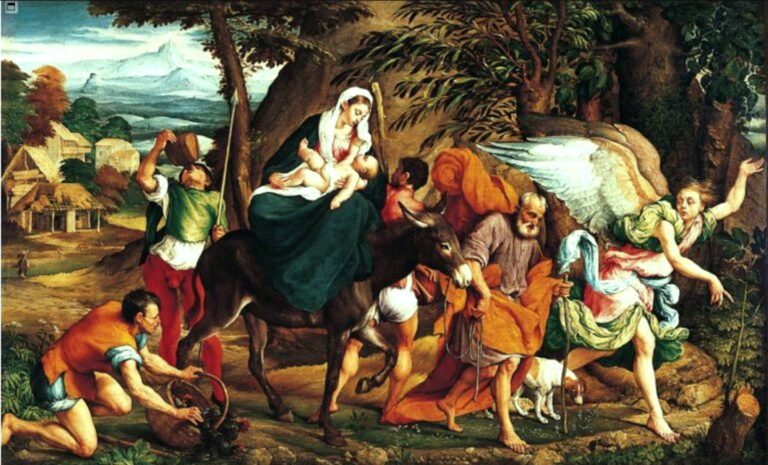
“When the magi had departed, behold, the angel of the Lord appeared to Joseph in a dream and said, “Rise, take the child and his mother, flee to Egypt and stay there until I tell you. Herod is going to search for the child to destroy him.” Joseph rose and took the child and his mother by night and departed for Egypt. He stayed there until the death of Herod, that what the Lord had said through the prophet may be fulfilled, Out of Egypt I called my son.
When Herod had died, behold, the angel of the Lord appeared in a dream to Joseph in Egypt and said, “Rise, take the child and his mother and go to the land of Israel, for those who sought the child’s life are now dead.” He rose, took the child and his mother, and went to the land of Israel. But when he heard that Archelaus was ruling over Judea in place of his father Herod, he was afraid to go back there. And, because he had been warned in a dream, he departed for the region of Gailee. He went and dwelt in a town called Nazareth, so that what had been spoken through the prophets might be fulfilled, “He shall be called a Nazorean.”
REFLECTIONS:
Today’s Gospel reading invites us to ponder God’s guiding presence. As we follow the journey of the Holy Family, we are invited to contemplate God’s grace and providence.
Grace is God’s undeserved favor of love, and mercy, freely given to us. (1) It justifies and sanctifies our souls and prepares us to welcome, and to act according to the will of God, to be able to participate in the life of God. It is a supernatural vocation to eternal life which “…surpasses the power of human intellect and will.” (1)
Providence is God’s care for His creation, “…From the least things to great events of the world and its history.” (2) It points to God’s “primacy and absolute sovereignty over the course of events.” (2) To carry out His plan, God in his greatness and goodness, grants human beings the dignity and the responsibility to participate and cooperate in His plan….and invites them to “trust God with filial trust in the providence of the heavenly Father,” while in the world, “in a state of journeying” towards ultimate perfection. (2)
The Gospel reading starts with the departure of the magi; “When the magi departed, behold, the Angel of the Lord appeared to Joseph in a dream…” (Matthew 2:13). T.S. Elliott wrote a wonderful poem about the trip of these there kings, the magi, who travelled from faraway lands in search of the newborn Messiah. They braved fields, and forests, hills and mountains, traveling by day, and later by night, through noisy cities and inhospitable villages. The journey itself was a pilgrimage, a quest, led by the light of a star on and ahead, while weighing them down was the physical and the psychological fatigue represented by a mocking ringing in the ear that maybe, just maybe, “this was all folly.” (3) The trip itself was like going to their death, only this was a birth they witnessed, a most miraculous birth of the Savior, the Prince of Peace. “I would do it again,” says the narrator, looking back, only, “I should be glad of another death,” a more peaceful one. (3) The magi, the there kings, were led by discernment from science and wisdom, the movement of the stars and pure faith in the promise of a New King. They were half sure, but wholehearted when they set out, when they met up and followed the star until they found Jesus outside Jerusalem, and they defied the orders of King Herod. There was a bit of serendipity, a bit of good luck, maybe, but definitely a good deal of grace, and God’s providence that helped them reach their objective.
A few days ago, on December 26th, we remembered the martyrdom of Saint Stephen, who was stoned to death by the unbelieving crowds outside the gates of Jerusalem, with the young Saul, the future Saint Paul in attendance. In his weekly audience, Pope Loe remarked that the death of Stephen marked his birth into eternal life. (4) His vision was fraternity amongst all people, not only his kinsmen, but, remarkably, first, amongst his kinsmen, who rejected the message of the Gospel and took his life. Stephen prayed for them. Like Jesus, he chose to be the light, Jesus’ light in which there is no hatred and no evil, only life, love, and forgiveness. That is how Saint Stephen was born into the light of eternal life. His life was a symbol of grace. His “birth into heaven” was a mark of God’s providence. (4)
As we continue to read the Gospel account of today, we continue a contemplation of life and death, choices and decisions, and ways of living. As soon as the magi left, and we know they left through a different road, avoiding informing King Herod in Jerusalem about the whereabouts of the Christ Child, the furious king summoned his sages. Upon finding out that the location that may have been the birthplace of a new king, he sent his soldiers to Bethlehem to kill every infant from the ages two and below. So, the angel warned Joseph in a dream, “Rise, take the child and his mother, flee to Egypt and stay there until I tell you. Herod is going to search for the child to destroy him.” (Matthew 2:13).
This macabre scene may remind us of the apocalyptic passages from Revelation 12, where Saint John in his vision saw a dragon ready to devour the newborn baby of the new Eve, Mary, the mother of Jesus, the new Adam, who was sent to restore the broken covenant between God and humanity. Jesus already in the first days of his life, was in mortal danger because of his provenance and the earthly power of the mighty who were afraid of losing their material kingdoms and powers to a spiritually far superior realm. To protect his dominance, King Herod resorted to the meaningless action of killing. He was killing innocent babies to uphold his own strength. How pitiful and wretched his actions appear in historical hindsight. Yet, his orders were as mortiferous as the fear mongering and war waging actions of the tyrants of every age, including those of today. Grace is lacking in their actions. They are an obstacle to God’s Providence.
While the magi found something precious and their lives changed because of it, Herod lost something that could have made his life dignified. Alas, his actions were purposeful but utterly devoid of meaning.
Against the backdrop of fear, uncertainty, danger, and snares, the Angel of the Lord appears to Jospeh again, in a dream. Like the time when he told Joseph to not to be afraid to take Mary as his wife, now he instructs him to take Mary and Jesus to flee to Egypt. Jospeh trusts the voice telling him to embark on a dangerous voyage that is as difficult as it is costly. He takes Mary and Jesus and in the cover of the night, they leave Bethlehem. Jesus, Mary and Jospeh, who already left Nazareth, and now Bethlehem, the city of David, become entirely homeless, in need of a shelter in Egypt. A new land, a new language, a new culture awaits the Holy Family. They probably find refuge with the Jewish diaspora who are in Egypt, and Joseph’s skills as a carpenter are surely transferable skills that help them to survive. We do not know much about the infancy of Jesus, but we are sure that his family kept the traditions while in emigration. Jesus grew in safety, until the appointed the time, when Herod died and the angel of the Lord appeared to Joseph again to let him know that it was safe for them to go back to Israel. However, hearing that Archelaus was still ruler of the north of Israel, they returned to the south through Judea, to the region of the Galilee, and their city, Nazareth.
After completing the symbolic journey to Egypt and back to Judea, Jesus, symbolically went through the same passage as the Israelites who wandered for forty years in the desert before being allowed into the Holy Land. The reference to being a “Nazorean” refers to a geographical location, a person from a small town called Nazareth, and related to the Old Testament reference in Isaih 11:1; where we encounter the Hebrew word, “netser,” the branch and shoot of Jese (the father of King David): “A shoot shall come out from the stock of Jesse, and a branch shall grow out of his roots. The Spirit of the Lord shall rest on him, the spirit of wisdom and understanding, the spirit of counsel and might, the spirit of knowledge and the fear of the Lord. His delight will be in the fear of the Lord.” Both physically and spiritually, Jesus of Nazareth fulfills the Biblical prophecies; “He shall be called a Nazorean” (Matthew 2:22; 5,6)
The first visitors of the Messiah were shepherds, who “…knew that they knew nothing.” (7) The second visitors were the magi who “…knew that they did not know everything.” (7) The third type of visitor, the evil king, who though he knew everything, has been avoided. The child Jesus grew up safely and he now dwelled amongst his people. Through this time, his parents obediently listened to the voice of the Lord sent to them through an angel…. “And the child grew and became strong; he was filled with wisdom, and the grace of God was on him” (Luke 2:40).
Like the story of the magi, which places us right in the midst of unconditional trust in God’s guidance and the perils of a dangerous journey, today’s Gospel reading places us right in the heart of the family who knows of the joys of God’s promises and the fear of human threats. Joseph’s courage becomes the testimony of quiet faith: he listens, trusts and obeys even when the instructions seem counterintuitive, startling, and inconvenient, and when the roads lead far from familiar territory and the comfort of home. Theologically, the Flight to Egypt echoes Isreal’s ancient journey, showing Jesus as the new and true Israel who will fulfill every promise spoken in the prophets. (8)
We see in the Holy Family’s journey a pattern that mirrors our lives. There are moments when we need to listen carefully to God’s guidance to discern it from the background noises. There are times when God directs us, and redirects us, and we do not fully understand why. There are times when danger or uncertainty pushes us into unfamiliar territory and we feel frightened and unsure. And, Like the Holy Family, we sometimes feel that we are walking in the dark, holding on only to the thread of God’s whispered instructions. But God does not abandon those who listen. His grace and providence accompany us if we request it, even though we may not see it clearly or right away.
“Life applications rise naturally from their experience. First, we take warnings seriously and we do not brush them aside. Second, we see that faith often demands motion, not just belief. Third, we discover that trust must persist even when God’s timing stretches longer than we hoped. Fourth, we are reminded that God protects us in ways we may not notice until much later.” (8)
Today’s Gospel invites us to go confidently in the company of Jesus, Mary, and Jospeh. We may not understand much. We may be painfully aware of the limits of our knowledge. But we can trust God who is omnipotent, omniscient, and omnipresent in our midst.
Prayer for Families Throughout the World
On the first week of Advent, 1986, during an Apostolic Pilgrimage to Bangladesh, Singapore, the Fiji Islands, New Zealand, Australia and the Seychelles, Saint Pope John Paul II reflected on the theme of “the family as the domestic church.” (9)
He explained that “…the meaning of this traditional Christian idea is that the home is the Church in miniature. The Church is the sacrament of God’s love. She is a communion of faith and life. She is a mother and teacher. She is at the service of the whole human family as it goes forward towards its ultimate destiny. In the same way the family is a community of life and love. It educates and leads its members to their full human maturity, and it serves the good of all along the road of life The family is the ‘first and vital cell of society.’ In its own way it is a living image and historical representation of the mystery of the Church. The future of the world and of the Church, therefore, passes through the family.” (9)
John Paul II, who was known for his love and support of families, offered the following Prayer for Families in the world: (10)
“Lord God, from You every family in Heaven and on earth takes its name.
Father, You are love and life. Through Your Son, Jesus Christ, born of woman, and through the Holy Spirit, the fountain of divine charity, grant that every family on earth may become for each successive generation a true shrine of life and love.
Grant that Your grace may guide the thoughts and actions of husbands and wives for the good of their families and of all the families in the world.
Grant that the young may find in the family solid support for their human dignity and for their growth in truth and love.
Grant that love, strengthened by the grace of the sacrament of marriage, may prove mightier than all the weaknesses and trials through which our families sometimes pass.
Through the intercession of the Holy Family of Nazareth, grant that the Church may fruitfully carry out her worldwide mission in the family and through the family.
We ask this of You, Who is life, truth and love with the Son and the Holy Spirit. Amen.”
Sources:
- Catholic Culture (2025). Catechism of the Catholic Church. Sections 1996-1998. Retrieved from: https://www.catholicculture.org/culture/library/catechism/index.cfm?recnum=5533 Accessed: December 27, 2025.
- Catholic Culture (2025). Catechism of the Catholic Church. Sections 302-324. Retrieved from: https://www.catholicculture.org/culture/library/catechism/index.cfm?recnum=1755. Accessed: December 27, 2025.
- Collected Poems 1909-1962 (Faber, 1974). T.S. Eliot. Journey of the Magi. Open Source. Retrieved from: https://poetryarchive.org/poem/journey-magi/ Accessed: December 27, 2025.
- Vatican News (2025). Pope at Angelus: Saint Stephen teaches us that martyrdom is a birth into the light. Retrieved from: https://www.vaticannews.va/en/pope/news/2025-12/pope-leo-xiv-angelus-saint-stephen-martyr-rebirth-26-dec-2025.html. Accessed; December 27, 2025.
- Kerkum, S. (2025). An Introduction Into Biblical Context (2/2). https://www.biblword.net/an-introduction-into-biblical-context-2-2/
- Bible Hub (2004-2025). Why cite a prophecy not in Scripture? https://www.biblword.net/an-introduction-into-biblical-context-2-2/
- Fulton Sheen, J. (1952-1957). The True Meaning of Christmas. Episode 112. Retrieved from: https://www.youtube.com/watch?v=y93RO1-8RaA. Accessed: December 27, 2025.
- The Word Today TV (2025). Finding Shelter in God’s Leading—A Reflection on Matthew 2:13-15, 19-23, December 28, 2025. Retrieved from: https://www.youtube.com/watch?v=n4LNsmRCcKs Accessed: December 27, 2025.
- The Holy See (2986). Apostolic Pilgrimage to Bangladesh, Singapore, Fiji Islands, New Zealand, Australia and Seychelles. Homily of John Paul II. Perth, Australia, 30 November 1986. Retrieved from: https://www.vatican.va/content/john-paul-ii/en/homilies/1986/documents/hf_jp-ii_hom_19861130_perth-australia.html Accessed: December 29, 2025.
- Kosloski, P. (2017). Prayer of St. John Paul II for all families. Retrieved from: https://aleteia.org/2017/12/31/prayer-of-st-john-paul-ii-for-all-families/ Accessed: December 29, 2025.