
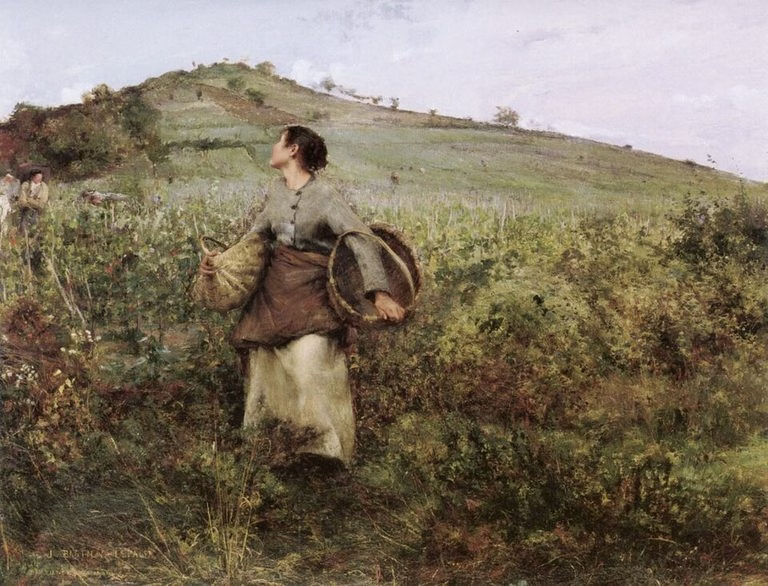
Everyone is invited to work in the vineyard, but not all are ready to accept the invitation. Freedom of will implies that we can say “yes” or “no” to God’s plan. Even though at times we may rebel against God’s ways or misunderstand His will, through His obedience to the Father, Jesus invites us to humble contemplation that can lead to conversion and self-surrender.
GOSPEL PASSAGE: Matthew 21:28-32
Jesus said to the chief priests and elders of the people; “What is your opinion? A man had two sons. He came to the first and said, ‘Son, go out and work in the vineyard today.’ He said in reply, “I will not,’ but afterwards he changed his mind and went. The man came to the other son and gave him the same order. He said in reply, ‘Yes, sir,’ but did not go. Which of the two did his father’s will?” They answered, “The first.” Jesu said to them, “Amen, I say to you, tax collectors and prostitutes are entering the kingdom of God before you. When John came to you in the way of righteousness, you did not believe him; but tax collectors and prostitutes did. Yet, even when you saw that, you did not later change your minds and believe him.”
GOSPEL REFLECTIONS:
In today’s Gospel, we see Jesus being attacked. His authority is challenged. Under these circumstances, He appeals to reason and logic to invite a change of heart.
The context of today’s Gospel reading is that Jesus is on the way to Jerusalem, to the cross. The trajectory starts in the North with Peter’s confession and continues toward the South to enter the city. (1) As Jesus enters the City of David, some people exultantly praise Him, while others are frightened, hostile, and skeptical.
In the courts of the Temple, Jesus drives out the money changers. He acts and talks with authority. Subsequently, the Elders and the Chief Priests question Him, and He unmasks their duplicity by questioning them about why they denied the authority of John the Baptist. John was considered a prophet by the people, but the Jewish religious leaders did not defend him from death at the hands of King Herod.
Likewise, a large number of people who side with the Chief Priests and the Elders do not receive Jesus. They remain indifferent to His message. Jesus does not seek to “convert” these people or to condemn them. Instead, He offers logical reasons why they should reconsider their position.
Even under such exceptionally difficult circumstances, Jesus seizes the moment to appeal to logic and wisdom. He stands out and stands up with a call from the Father to rethink, repent, and return, not because of being forced, but out of one’s own free will. He presents the parable of the two sons.
We can paraphrase this parable in a few lines: The owner of a vineyard had two sons. He went to the firstborn and invited him to go and work in the vineyard. This son was initially disobedient and refused, saying, “I will not,” but later changed his mind and went (Mathew 21:29). Next, the father approached the second son, and while his initial reply was, “I go, sir,” he did not go (Matthew 21:20).
Then Jesus posed a Socratic question: “Which of the two did the will of the father?” (Matthew 21:31). The answer was obvious, and all answered in unison: “The first.” (Matthew 21:31).
Jesus then used this answer to reveal the source of His authority based on a similar event that was very familiar to His listeners: “Truly I tell you, the tax collectors and the prostitutes are going into the Kingdom of God ahead of you. For John came to you in the way of righteousness and you did not believe him, but the tax collectors and prostitutes believed him; and even after you saw it, you did not change your minds and believe him.” (Matthew 21:31–32).
Going from the concrete reality that some who became followers of John the Baptist humbled themselves and sought forgiveness for their sins, after which John baptized them, Jesus makes a parallel to Himself. God can forgive the sins of those who ask for His mercy, but He will not force or coerce anyone. Shallow piety does not please Him. Lip service does not please Him. Even though one may start out with reservations, engaging in the right action testifies to the true intentions of a person in the eyes of God. Until the last breath, one can always have a second chance; one re-think, re-consider, and return to God.
If those who are considered the least among the children of Israel, such as the tax collectors and the prostitutes—who were considered the most abominable sinners at the time—are able to reach an insight to humble themselves and receive forgiveness of their sins and a chance for a new start, how much more is God’s mercy available to those who are not considered the “outcasts.” The only obstacle, says Jesus, is one’s own mental prison: a way of thinking and behaving that does not leave space for God to work in one’s life, such as when the invitation to work in the vineyard is discarded or ignored.
An interesting paradox, isn’t it? God’s invitation to work in the vineyard can only be accomplished through a “yes” to the invitation of God to work in our lives.
Drawing near to God the Father can only be done by welcoming His emissaries, such as the Son and the Holy Spirit. But to welcome the Son or the Holy Spirit, one needs to show basic readiness, willingness, and consent.
“Yes” is not the full revelation of God’s plan; it is just the prerequisite of a relationship with God that has a chance of developing, deepening, and leading to new insights and ways of living. This is what Jesus was asking from the Elders and Chief Priests: a basic predisposition toward welcoming the revelation of God.
The same “yes” is what God asks not just once, but every once in a while, every time, and any time. “Are you willing to open your eyes to what I am going to show you?” “Do you believe that I am at work even if ignored by the rest of your peers?” “Do you accept me as your most intimate companion through this particular struggle of your life?” “Do you want to follow me, regardless of what happens to you?” These are big questions because God does not want a secondary, tertiary, or minor role in our lives. To have a role, to have any role at all in our lives, He needs our “yes.” Even if timid; even if barely audible; even if fearful—or diffident—lacking confidence in our own ability or worth.
Consider the “yes” of the Virgin Mary, who is s role model when it comes to a trusting response to God’s plan. Her “yes” was not based on calculated knowledge of all facts or all possibilities. It was based on trust in God’s goodness, greatness, and glory. But what a life-changing “yes” to God’s invitation that was. Our entire history of salvation depended on the certainty that “…with God nothing will be impossible.” (2)
So, may our little “yeses” be part of a greater plan for something greater than we can ever imagine. And may they also be inspired by trust that God is always at work, even when unseen, unheard, or uninvited. He is the owner of the vineyard into which we are welcome—the kingdom of God.
Sources:
- Peters, T. (2026). 26th Sunday in Ordinary Time. Year A. Gospel-Matthew 21:28-32. https://www.google.com/search?q=matthew+21%3A28-32+father+tim+peters Accessed: September 23, 2026
- Catholic Culture (2026) Catechism of the Catholic Church, Article 494. Retrieved from: https://www.catholicculture.org/culture/library/catechism/cat_view.cfm?recnum. Accessed: September 23, 2026.