
On Palm Sunday, a week before the Easter Passover, Jesus’ followers—those whom He healed and those who listened to His teaching—recognized and honored Him as the Messiah, the Savior.
GOSPEL PASSAGE: Matthew 21:1-11
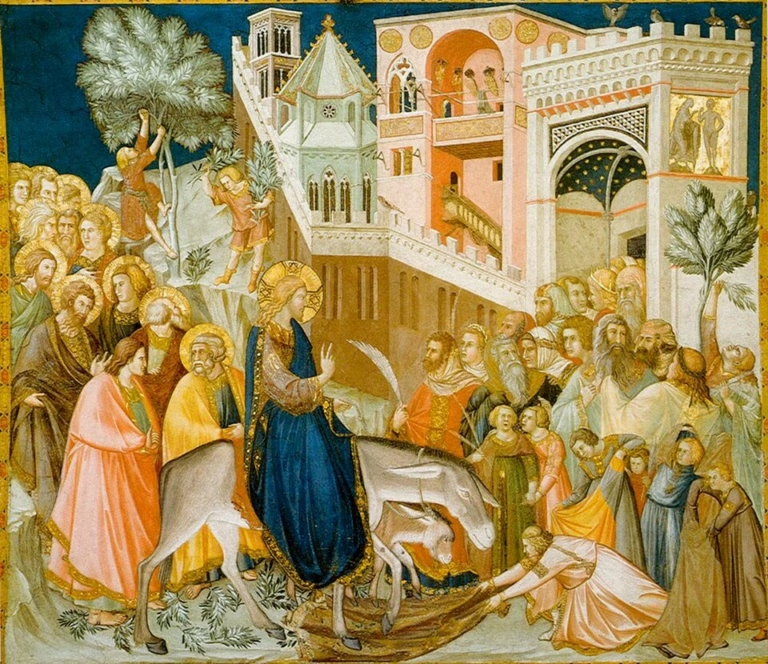
“When Jesus and the disciples drew near Jerusalem and came to Bethphage on the Mount of Olives, Jesus sent two disciples, saying to them, “Go into the village opposite you, and immediately you will find an ass tethered, and a colt with her. Untie them and bring them here to me. And if anyone should say anything to you, reply, ‘The Master has need of them.’ Then he will send them at once.” This happened so that what had been spoken through the prophet might be fulfilled:
Say to daughter Zion,
‘Behold your king comes to you,
Meek and riding on an ass,
And on a colt, the foal of a beast of burden.’
The disciples went and did as Jesus had ordered them. They brought the ass and the colt and they laid their cloaks over them, and he sat upon them. The very large crowd spread their cloaks on the road, while others cut branches from the trees and strewed them on the road. The crowds preceding him and those following kept crying out and saying:
“Hosanna to the Son of David;
Blessed is the one who comes in the name of the Lord;
Hosanna in the highest.”
And when they entered Jerusalem, the whole city was shaken and asked, “Who is this?” And the crowds replied, “This is Jesus the prophet, from Nazareth in Galilee.””
GOSPEL REFLECTIONS:
Less than two miles from Jerusalem, on the other side of the Mount of Olives, lies Bethphage, a village that Jesus passed by on His way to Jerusalem. (1) The Jewish festival of the Passover was near, and the people were wondering if He would come to Jerusalem, as was His custom, to go to the Temple to pray and to celebrate.
Jesus was familiar with Jerusalem. He visited the Temple at least once every year, but each time He went during His public ministry, He went there “in secret,” not wanting to attract any attention to Himself (John 7:1-14). Because of the healings and His teaching, He had attracted the jealousy and the ire of the Jewish authorities. Some of the Pharisees and the scribes were curious if He was going to participate in the celebrations, knowing that if He decided to go in public, His life would be in danger. The Jewish leaders were plotting to kill Him, but each time, He was firm: “My time has not yet fully come” (John 7:6, 8).
He was famous in the countryside, where He preached and healed the people, and He had many followers. Some people spoke of His miracles, others of His teachings. Some believed that He was a prophet, and some even claimed that He was the long-awaited Messiah who would deliver them from their enemies and establish His everlasting kingdom on earth.
“Who do the people say that I am?” Jesus asked His disciples in Caesarea Philippi, three years prior to this day. The disciples said that some believed Him to be John the Baptist, Elijah, Jeremiah, or one of the prophets. “But who do you say that I am?” inquired Jesus further (Matthew 16:13-16, Mark 8:27-29). It was then that Simon Peter fell to his knees and declared: “You are the Messiah, the Son of the Living God.” And Jesus blessed Peter with the words: “Blessed are you Simon, son of Jonah! For flesh and blood has not revealed this to you, but my Father in heaven” (Matthew 16:17). From this time on, Jesus started to prepare His disciples for having to go to Jerusalem, where He would suffer and be put to death. Jesus performed many signs and miracles, but He forbade them to tell anyone that He was the Messiah until this day, on which He was about to enter Jerusalem.
Bethphage was the last stop Jesus made before entering Jerusalem to fulfill the Father’s will. The name Bethphage is derived from the Aramaic “Beth Pagi,” which means the “House of Unripe Figs.” (1) Symbolically, this place name indicated that the Messiah would judge between the righteous and the unrighteous. From this point on, Jesus could see Jerusalem ahead of Him and consciously walk toward it, being open about His identity. (4)
The celebration that unfolded was in fulfillment of the Scriptures. On the Mount of Olives, where He retreated from the crowds and prayed while in Jerusalem, Jesus instructed two of His disciples to go into the nearby village. There, they would find two donkeys: the mother and its colt, a young donkey never before ridden. As the disciples entered the village, they found everything as Jesus had told them. They brought the mother donkey along to steady the colt while they placed their cloaks on it for Jesus to ride. The people who followed Jesus—a “very large crowd”—spread their cloaks on the road in front of Him in homage. Others “cut branches from the trees and spread them on the road” to make His path straight (Matthew 21:8).
The significance of the young donkey is derived from the tradition of King Solomon riding King David’s mule to Gihon to be anointed as King of Israel (1 Kings 1:38-48). King David was from the tribe of Judah, whom Jacob blessed with the words: “The sceptre shall not depart from Judah, nor the ruler’s staff from between his feet, until tribute comes to him, and the obedience of the peoples is his” (Genesis 49:10). Regarding the Messiah, the prophet Zechariah prophesied: “Say to daughter Zion, ‘Behold your king comes to you, meek and riding on an ass, and on a colt, the foal of a beast of burden’” (Zechariah 9:9).
Jesus, a descendant of King David on His stepfather Joseph’s side, was honored with a procession fit for a king. By riding a donkey, He fulfilled the Old Testament Messianic promises; He specifically arranged for the donkey to carry Him to fulfill this word. The donkey was a sign of peacefulness and humility. (4)
Jesus publicly received praise as King of Israel when the huge crowd following Him took Him in procession into the city. The people shouted with the words of King David, written in Psalm 148: “Praise the Lord! Praise the Lord from the Heavens!” They cried out: “Hosanna to the Son of David! Blessed is the One who comes in the name of the Lord! Hosanna in the highest heaven!” (Matthew 21:9). Hosanna is a Biblical expression of adoration, praise, and joy. It is derived from the Hebrew expression “Hoshiah-na,” meaning “save now” or “deliver us, we pray.” This cry was the highest recognition of Jesus as the Messiah. (4)
The Bible describes the most important prophets as possessing the quality of humility. Moses, for example, is described as “a very humble man, humbler than anyone else on the face of the earth” (Numbers 12:3). Moses interceded for the people when they had sinned (Numbers 14), and he did not defend himself against personal attacks, leaving his defense entirely to God. (2)
Likewise, Elijah is described as entirely obedient to God; “a man with a nature like ours: yet he prayed earnestly that it would not rain and for three years and six months it did not rain on the land. Then he prayed again, and the sky gave rain and the land produced its fruit” (James 5:17-18; 2). Both Moses and Elijah were assumed into heaven after their deaths. They are the prefiguration of Jesus, the humblest and most glorious warrior, who destroyed sin and death by offering His life as a ransom for the people. Jesus did not ride like warrior kings. He did not come with fancy armor or shiny jewels, but in the humblest attire, surrounded by the people of Israel who loved Him and believed in Him.
Some people recognized that He was the Son of David. Some claimed He was a prophet. Those who believed in Him proclaimed that He was the Messiah. Interwoven in the ups and downs of the jubilation, followed by Jesus’ passion and resurrection, was the Divine plan of salvation.
Step by step, He came closer to fulfilling God’s plan. Hour by hour, He continued to work with full dedication. “No one takes my life from me. I give my life of my own free will. I have the authority to give my life, and I have the authority to take it up again. This command I received from my Father,” said Jesus (John 10:18).
This week, we join in the celebration of Jesus’ kingship. We praise Him and adore Him as the Messiah, God’s chosen One, who will return in glory. We shout out to him: “Hosannah!” –Help us! –Save us now!
Sources:
- Bible Hub (2004-2026). Biblical Encyclopedia. Bethphage. Retrieved from: https://biblehub.com/topical/b/bethphage.htm#. Accessed: March 23, 2026.
- Pope Francis (2020). On the Prayer of Moses. Catholic Culture. Retrieved from: https://www.catholicculture.org/culture/library/view.cfm?recnum=12374. Accessed: March 26, 2026.
- Van Pelt, R. (2021). Humble Beginnings: Elijah. Retrieved from: https://hopethroughhardtimes.org/humble-beginnings-elijah. Accessed: March 23, 2026.
- Peters, T. (2026). Mattgew 21:1-11: Palm Sunday: Year A, Gospel Reflection, Fr. Tim Peters. Retrieved from: https://www.youtube.com/watch?v=x2-eqiRrhrQ. Accessed: March 26, 2026.