
Jesus continues to teach something very important about God’s qualities and the Kingdom of God. This week’s teaching points out abundance and generosity.
GOSPEL PASSAGE: Matthew 20:1-16a
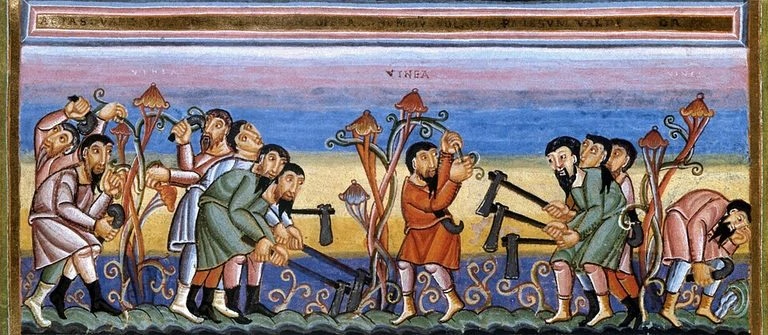
Jesus told his disciples this parable: “The kingdom of heaven is like a landowner who went out at dawn to hire laborers for his vineyard. Afte agreeing with them for the usual daily wage, he sent them into his vineyard. Going out about nine o’clock, the landowner saw others standing idle in the marketplace, and he said to them, ‘You too go into my vineyard, and I will give you what is just.’ So they went off. And he went out again around noon, and around there o’clock, and did likewise. Going out about five o’clock, the landowner found others standing around, and said to them, ‘Why do you stand here idle all day?’ They answered, ‘Because no one hired us.’ He said to them, ‘You too, go into my vineyard.” When it was evening, the owner of the vineyard said to his foreman, “Summon the laborers and give them their pay, beginning with the last and ending with the first.’ When those who had started about five o’clock came, each received the usual daily wage. So, when the first came, they thought that they would receive more, but all of them got the same wage. And on receiving it they grumbled against the landowner, saying, ‘These last ones worked only an hour, and you have made them equal to us, who bore the day’s burden and the heat.’ He said to one of them in reply, ‘My friend, I am not cheating you. Did you not agree with me for the usual daily wage? Take what is yours and go. What if I wish to give this last one the same as you? Or am I not free to do as I wish with my own money? Are you envious because I am generous? Thus, the last will be first, and the first will be last.’”
GOSPEL REFLECTION:
After comparing the kingdom of God with a vineyard, Jesus continues to teach something very important about God’s qualities and the Kingdom of God. While last week’s readings emphasized mercy and forgiveness, this week’s teaching points out abundance and generosity.
Jesus uses the familiar image of the vineyard. As he does so, we can picture Him passing by vineyards in the Holy Land. There is a lot of work to be done with tending each plant, pruning the vine and leaf buds, fertilizing, tying the canes to supporting wires, tilling and weeding, lifting and trellising, removing the old leaves, picking and sorting the fruit, until some of the fruit that is harvested is set aside, and some may be sold ripe, or dried, or fermented into a choice wine.
In the Bible, the image of the vines and the vineyard is always used in relation to the people of God. (1) In Isaiah 5:1-7, for example, we find the “Song of the Unfruitful Vineyard” bemoaning the “wild grapes” that resulted from gently tending the shoots—the wrongful actions of the house of Israel. Isaiah makes it clear that the “vineyard of the Lord of Hosts is the House of Israel, and the plants of Judah are his pleasant planting; he expected justice but saw bloodshed; righteousness but heard a cry!” Likewise, Ezekiel introduces the expression of the “useless vine wood” (Ezekiel 15:6) which does not bear any fruit and out of which nothing can be made and nothing good can come and is therefore only good for being “given to the fire for fuel.” Hosea 10:1-2 speaks of Israel as a “luxuriant vine that yields its fruit.” Alas, “…the more its fruit increased the more altars he built; as his country improved, he improved his pillars. Their heart is false; now they must bear their guilt. The LORD will break down their altars and destroy their pillars.” As for the owner of the vineyard, Psalm 80:8-9 makes it clear that it is the Lord: “You brought a vine out of Egypt; you drove out the nations and planted it. You cleared the ground for it; it took deep root and filled the land.”
In the New Testament, Jesus uses the metaphor of the vine and the branches not just in reference to the people of Israel, but of all nations, and among all nations, to all people who listen to the voice of God. Jesus says:
“I am the true vine, and my Father is the vine grower. He removes every branch in me that bears no fruit. Every branch that bears fruit he prunes to make it bear more fruit….Abide in me just as I abide in you. Just as the branch cannot bear fruit by itself unless it abides in the vine, neither can you unless you abide in me. I am the vine, you are the branches. Those who abide in me and I in them bear much fruit, because apart from me you can do nothing…My Father is glorified by this, that you bear much fruit and you become disciples. As the Father has loved me, so I have loved you; abide in my love.” (John 15:1-9).
Clearly, Jesus is referring to His followers, those who want to please the Father and who want to obey God’s commandments.
The vineyard is the world, the sacred ground that God placed available for each person to faithfully tend, like a laborer in the vineyard. There are challenges and difficulties working under the heat of the sun, but the work pleases God. The fruits of the good labor become the fruits of the Spirit which characterize the kingdom of God. These can be found in Galatians 5:22-23, and in order are the following:
- Love: selfless and unconditional care and goodwill towards all of God’s creation.
- Joy: a deeply grounded sense of gladness that has its roots in faith and persists regardless of the situation.
- Peace: a serenity that is rooted in belonging and harmony that calms anxiety and conflict.
- Patience: long-suffering endurance and steadfastness when facing difficult situations and difficult people.
- Kindness: a helpful, generous, and warm disposition toward others.
- Goodness: moral integrity, purity, righteousness, and dignity in doing what is right and honorable.
- Faithfulness: loyalty and reliability in the face of uncertainty and remaining true to one’s beliefs.
- Gentleness: meekness, humility, and dealing with others with consideration rather than harshly or roughly.
- Self-control: mastery over one’s desires, impulses, and passions. (2)
So, Jesus goes on with the parable: the owner of the vineyard went out early in the morning, at nine o’clock, at midday, and in the afternoon, until five o’clock in the evening, to invite workers into his vineyard. Some Bible scholars interpret this part of the example as God reaching out to humanity throughout history or calling people at certain times of their lives to return to Him and to truly get to know Him. (1) The workday is until 6 p.m. So, there are those who have been working in the vineyard conscientiously, keeping the word of the Lord, and those who have not yet known about the Lord and have not gotten invited, or they accepted the invitation later in their lives. In chronological times, we can think of the time of the day. However, Jesus is probably talking about God’s timing of revealing Himself and inviting us in personal ways to be active about His business—in this case, of “tending the vineyard.”
Now, there is a very important point that Jesus makes at the end of the parable: The workers all line up at the end of the day, ready to receive their daily wage. The owner starts with those who came in the last hour and hands them a full day’s wage. This is incredibly generous of Him, considering that these people were there only one hour, according to chronological time, and in the eyes of the other workers, do not “deserve” the same pay as them. Those who have been hired earlier, according to chronological time, expect to be paid more. However, the owner hands them the exact same payment as to those who came late, with the explanation that that is the standard, agreed-upon wage. And then those who feel “cheated” rebel: they grumble against the owner. They show their dissatisfaction because they think that the arrangement is unfair.
This part of the parable could be compared with the eldest son in the parable of the Prodigal Son (Luke 15:11-32). When the younger son returned home and the father ran ahead to greet him, organized a party for his reception, and restored to him his full dignity, the older son “refused to go into the house” and grumbled:
“Listen! For all these years I have been working like a slave for you, and I have never disobeyed your command; yet you have never given me even a young goat so that I might celebrate with my friends. But when this son of yours came back, who devoured your property with prostitutes, you killed the fatted calf for him!” (Luke 15:28-30).
So, who may be these workers who are grumbling against the owner? Those who have borne the heat of the day, those who “kept the commandments” such as the priests, the kings, or the Levites?
Listen to the rest of the Parable of the Prodigal Son and His Brother:
“Then the Father said to him, ‘Son, you are always with me, and all that is mine is yours. But we have to celebrate and rejoice because this brother of yours was dead and has come to life; he was lost and has been found.’” (Luke 15:31-32).
Jesus says that He came to find the “lost” sheep of Israel. (Luke 15:3-7; Matthew 18:12-14)—He came to “seek and to save the lost” (Luke 19:10; Matthew 18:12-14). He has come to expand the Kingdom of God to the entire world, and among the people, to all those who are poor, jobless, who are considered worthless, and who are vulnerable. —To all who were not wanted, whom “no one has hired,” and seek them out, call them, invite them, offer them the possibility of entering the Kingdom of God (Matthew 20:7).
This is the message of today’s Gospel: God’s infinite care and concern for every human being, and His great generosity toward all His workers in the vineyard. As with His example, Jesus always calls us to be like Him: to show generosity and to rejoice when there are signs of the fruits of the Kingdom of Heaven on earth. God is generous toward all in this life through the guidance of the Spirit. The fruits of the Spirit are the hallmarks of the ultimate reward in heaven.
We are united with the Spirit in prayer, and united in the mission to make God’s Kingdom flourish on earth. Let us pray to God and pray for each other that we can carry out our duties with strength from the Holy Spirit to accomplish the tasks that God has assigned for us in His vineyard—and that our labors may bear much fruit.
Sources:
- Peters, T. (2026). 25th Sunday in Ordinary Time. Matthew 20:1-16. Year A. Gospel reflections by Father Tim Peters. Retrieved from: https://www.google.com/search?q=father+tim+peters+gospel+reflections+matthew+20%3A+1-16&sca_esv
- Compassion International (2025). What is the Fruit of the Spirit? Retrieved from: Compassion.com