The central theme of today’s Gospel reading is compassion—a compassion that leads to forgiveness. Another word we could use is mercy, which is one of the attributes of God. Right away, we arrive at the heart of the message: God is merciful.
GOSPEL REFLECTIONS: Matthew 18:21-35
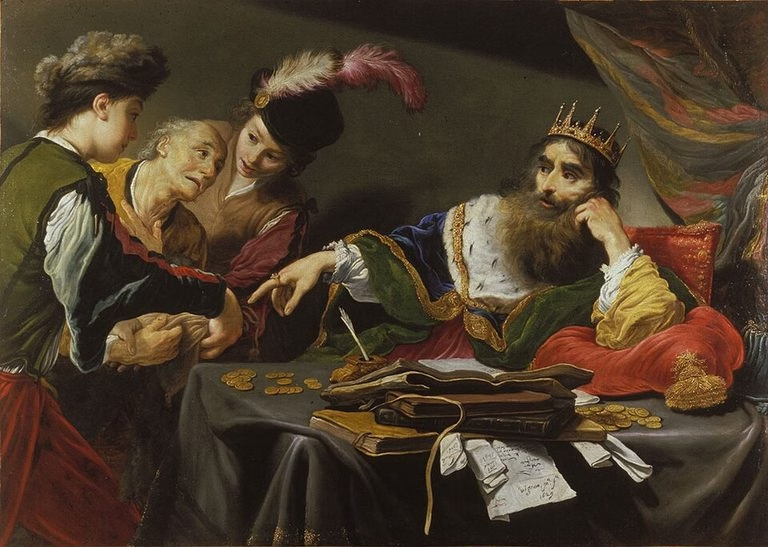
Peter approached Jesus and asked him, “Lord, if my brother sins against me, how often must I forgive?” As many as seven times?’ Jesus answered, “I say to you, not seven times but seventy-seven times. That is why the kingdom of heaven may be likened to a king who decided to settle accounts with his servants. When he began the accounting, a debtor was brough before him who owed him a huge amount. Since he had no way of paying it back, his master ordered him to be sold, along with his wife, his children, and all his property, in payment of the debt. At that, the servant fell down, did him homage and said, ‘Be patient with me, and I will pay you back in full. Moved with compassion, the master of that servant let him go and forgave him the loan. When the servant had left, he found one of his fellow servants who owed him a much smaller amount. He seized him and started to choke him, demanding, ‘Pay back what you owe.’ Falling to his knees, his fellow servant begged him, ‘Be patient with me, and I will pay you back.’ But he refused. Instead, he had the fellow servant put in prison until he paid back the debt. Now when his fellow servants saw what had happened, they were deeply disturbed, and went to their master and reported the whole affair. His master summoned him and said to him, ‘You wicked servant! I forgave your entire debt because you begged me to. Should you not have had pity on your fellows servant, as I had pity on you?’ Then in anger his mater handed him over to the torturers until he should pay back the whole debt. So will my heavenly Father do to you, unless each of you forgives your brother from your heart.”
GOSPEL REFLECTIONS:
Just as God is merciful, we ought to show compassion toward our neighbors, our brothers, and our sisters, forgiving them when they have offended us or fallen short and accumulated a “debt” with us—when they “owe us.”
What they “owe us” may not be material things, as the parable suggests, but an apology or something they failed to do, provide, or give. Alternatively, they may be indebted to us because they actively offended, harmed, or damaged us physically or emotionally. They may have caused disappointment or disillusionment by failing to meet moral or ethical standards, or by failing to live up to values we consider essential. In doing so, they have trespassed against these universal laws and, thereby, trespassed against us.
In this parable, Jesus refers to a “king” who was settling his accounts with his servants. This king represents God, who is in charge. It is in comparison to God’s mercy that human compassion and forgiveness are evaluated. Namely, just as the king is in charge, God is the one to whom we, as human beings, owe a debt. We owe this debt not only because God gave us our very lives, but even more so because of the sacrifice of Jesus, who opened the path to our salvation and eternal life.
Compared to this ultimate debt, the debts we owe to one another pale in significance. No amount of money could pay the ransom required for God to come down to earth, take our nature upon Himself, suffer at the hands of sinners for the sake of all sinners, and endure death on a cross until His resurrection. This was not done out of a practical “motive” or a prosperous scheme aimed at acquiring greater power or success. The underlying reason was not money, as in the parable, but something money merely symbolizes: grace.
In order to bestow grace, God redeemed humanity through His Son. God acted mercifully because God is love.
Through this teaching, Jesus demands no clever schemes or calculations. He asks us not to worry about whether we need to forgive seven or seventy-seven times, but rather to be overall loving and merciful, just as God is merciful.
This could be the end of our reflection, but a question naturally arises: How can we be merciful in our everyday lives? How can we be loving? Here, examples and possibilities abound.
If each of us thinks of just one random act of kindness we performed today, that is pleasing to God. However, being merciful goes beyond random acts of kindness. Have there been times when we were hurt and chose to forgive? This brings us to Peter’s question: “…If my brother sins against me, how often must I forgive?” (Matthew 18:21). Let us talk about forgiveness: what it is, and what it is not.
We could define forgiveness as an act of the will to transcend the urge for revenge or retribution. By overcoming these impulses, we find a kinder and more productive response to a hurt or injury caused by someone else. That hurt may be known to them, or they may be completely unaware of it; it may have happened recently or a long time ago.
In light of last week’s Gospel, when we communicate with those who have offended us—whether in private or before witnesses—accountability may not be possible to establish or communicate, and an apology may be impossible to obtain. Past hurts can be particularly traumatic and leave long-lasting scars, especially those that are difficult or impossible to discuss and settle.
Yet, there is a way to resolve these enduring hurts within ourselves. The only way to settle heinous crimes for which there is no human pardon—injuries that seem as though they “cannot be forgiven”—is to delineate our area of inner freedom from the perpetrator’s actions, choices, or lack thereof. It is not within our power to undo or correct what someone else has committed or omitted. The only area of freedom we possess is determining our response to what happened and how it affects us.
We can divide this into two realms: the realm of “fate”—the facts beyond our control—where we can name what happened, how it made us feel, what it made us think, and how it affects us to this day. Alongside this realm of facts lies the realm of freedom. This second realm opens up when we consider our choices in responding to what occurred.
Forgiveness that comes from the heart cannot be commanded, demanded, or prescribed. It is a free choice made through the human spirit to reclaim personal freedom and respond to an offense. Forgiveness says: “I am not in a position to be the final judge. I release what happened to the final judge and into His care.” In doing so, I forgive the other person and reclaim my freedom to be a whole, living, and loving human being—despite what was done to me. I refuse to let that harm define or shape me any longer. I reclaim my capacity to shape myself in the image and likeness of God, to walk in His ways, and to strive for perfection, including living a life morally pleasing to Him. Therefore, I let go of revenge, vindication, and anger—emotions that can consume us, control us, and lead us astray from God.
Forgiveness does not mean forgetfulness. It means we entrust our case to the hands of God, who will deal with those actions as He sees fit.
Forgiveness is the path to regaining the inner freedom to be merciful and to act as God envisions, trusting that everything shared with Him in prayer is heard. In this way, forgiveness grants us the freedom to be and become merciful human beings, just as God is merciful.
Forgiveness is not a passive path; it is an active, loving response to life’s injustices, hurts, and injuries caused by others. It is a compassionate response to a fellow human being who has failed and fallen short—something that has happened to all of us.
Being aware of our own shortcomings helps us develop a compassionate heart. This requires us to see others through the eyes of God—if only for a moment, or not just seven times, but seventy-seven times. There is no greater proof of love than showing mercy. This is the kind of love God asks us to manifest in the world: a love anchored in God’s love, held safe and protected within His living truth.
In Canada, we have a model of reconciliation developed in response to historical wrongs committed against the Indigenous People of this land. This process is called “Truth and Reconciliation” because it begins with acknowledging and taking responsibility for the actions that harmed our brothers and sisters—such as systemic assimilation and the abuse that occurred in institutional settings like Residential Schools, which were operated by religious groups under the auspices of the Canadian Government from the 1830s until 1997. (1) It involves ongoing efforts to document what happened during this period, how these events affected Indigenous families and communities, and the lasting impact this history continues to have today. (1) The Truth and Reconciliation Commission’s historical findings are followed by 94 “Calls to Action,” which offer recommendations to address past harms and make amends in the hope of fostering reconciliation and collaboration with Canada’s Indigenous communities. (2)
Sometimes, compassion and mercy are lacking. In those moments, it is vital to document the truth: the facts, the numbers, the circumstances, and the consequences, while listening to the lived experiences of those who were wronged. When human justice falters, God’s justice endures, offering universal precepts such as the principles to do no harm, to respect nature, and to honor the dignity of every person. While it may not always be possible to avoid every harm, we must always strive to minimize harm for everyone involved.
Because we are all fallible human beings, our path toward perfection must involve an examination of conscience, sincere repentance, and reconciliation with God, from whom we ultimately distance ourselves through sin. Even if no one else listens, He is always ready to forgive us and welcome us back onto the path of life.
Around the world—throughout the Jewish diaspora and in Israel—this weekend marks the Jewish High Holiday of Rosh Hashannah, the Jewish New Year and the beginning of the High Holy Days. (3) It initiates the Ten Days of Repentance and Return, which culminate in Yom Kippur. During this time, individuals are invited to reflect on their mistakes over the past year, seek forgiveness from others, and commit to becoming better versions of themselves in the year ahead. (3) According to Jewish belief, Rosh Hashannah is the day God acts as judge over all humanity, deciding who will be sealed in the Book of Life for a good year. (3) The sound of the Shofar, the ram’s horn, is used to rouse people from their spiritual slumber, urging everyone to turn away from distractions and return to a righteous path. Sweet foods, such as apples dipped in honey and challah (a sweet bread), are eaten to symbolize hope for a restored relationship with God and a sweet, prosperous New Year—a fresh start to remember the invitation to be who you already are: a beloved child of God, created in His image and likeness, and welcomed to participate in the Divine Restoration of the world. (4)
How often can we grant one another a fresh start to remember that we were created in the image and likeness of God? Seven times? No—seventy-seven times!
Sources:
- National Centre for Truth and Reconciliation (2026). NTCR Official Site. University of Manitoba. Retrieved from: ntcr.ca. Accessed: September 10, 2026.
- Reconciliation Education (2025). What Are the Truth and Reconciliation Commission’s 94 Calls to Action and How Are We Working Toward Achieving Then Today? Retrieved from: https://www.reconciliationeducation.ca/what-are-truth-and-reconciliation-commission-94-calls-to-action#1. Accessed: September 10, 2026.
- Chabad.org (1993-2026). What Is Rosh Hashanah? The Jewish New Year. Retrieved from: https://www.chabad.org/library/article_cdo/aid/4762/jewish/What-Is-Rosh-Hashanah.htm. Accessed: September 10, 2026.
- Biblical Studies Press (1996, 2019). Rosh Hashannah: How the Jewish New Year Connects to Jesus. An Invitation to Who You Already Are.