
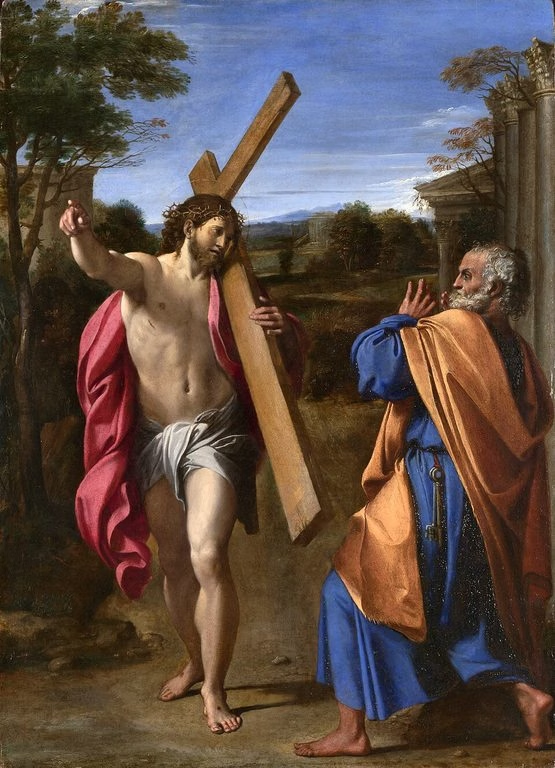
In today’s Gospel reading, Jesus reveals that the Messiah achieves victory not through seeking political power, status, or success, but through radical self-giving, suffering and resurrection. Jesus invites His disciples–and us–to decide where we are going (“Quo vadis?”); Are we to pursue the ephemeral things of this life, or take up our cross, and discover our true identity by following Him through life’s trials toward eternal glory.
GOSPEL PASSAGE: Matthew 16:21-27
Jesus began to show his disciples that he must go to Jerusalem and suffer greatly from the elders, the chief priests, and the scribes, and be killed and on the third day be raised. Then Peter took Jesus aside and began to rebuke him, “God forbid, Lord! No such thing shall ever happen to you.” He turned and said to Peter, “Get behind me, Satan! You are an obstacle to me. You are thinking not as God does, but as human beings do.”
Then, Jesus said to his disciples, “Whoever wishes to come after me must deny himself, take up his cross, and follow me. For whoever wishes to save their life will lose it, but whoever loses his life for my sake will find it. What profit would there be for one to gain the whole world and forfeit his life? Or what can one give in exchange for his life? For the Son of Man will come with his angels in his Father’s glory, and then he will repay all according to his conduct.”
GOSPEL REFLECTIONS:
Today’s Gospel reading goes hand in hand with last week’s verses. The disciples worshipped Jesus as the Messiah, but they still had a lot to learn about His identity, which they did not yet fully understand. In fact, they were convinced they understood that Jesus was the Messiah because He conformed to certain Scriptures describing the Messiah as a glorious King, the Shepherd of Israel. In Deuteronomy, for example, we find this description: “All the peoples of the earth shall see that you are called by the name of the Lord, and they shall be afraid of you” (Deuteronomy 28:10). Based on Jesus’ actions and the miracles they had witnessed, they had good reason to believe that Jesus, the Messiah, would fulfill the lines we find in Isaiah (60:6–11): “A multitude of camels shall cover you, the young camels of Midian and Ephah; all those from Sheba shall come. They shall bring gold and frankincense…” They recalled the words of Psalm 72, “May he have dominion from sea to sea…” and they rejoiced. But Jesus ordered them “…not to tell anyone that he was the Messiah” (Matthew 16:20).
Why did Jesus tell them not to tell anyone that He was the Messiah? It was because He wanted the disciples to understand His identity, which was so much more than these select promises of the Scriptures. His “time has not yet come” to glorify the Father (John 2:4; 7:6; 7:30; 8:20); He had to accomplish everything that the Father entrusted to Him. Through this entire trajectory, His followers would come to clearly see the confrontation between the “old world”—what the rulers of the world proposed—and the “new world”—what Jesus proclaimed as God’s plan for the Kingdom of God. (1) They would come to appreciate that the two worlds stand in direct opposition to each other. Jesus knew this and did not want to mislead the disciples. He wanted to offer them the full truth about His mission and His life right from the very beginning of their journey with Him. His life was based on complete self-giving and was a reflection of the love of God. He invited the disciples to join Him.
So, Jesus “…began to show his disciples that he must go to Jerusalem…” (Matthew 16:21). Jerusalem was the center of political and religious power for the “old world.” It was the seat of the temple, the center of Israel’s governance and spiritual life. It would have been natural for a new king who would rule Israel forever to go to Jerusalem… and yet, there was more to His intention than showing Himself to the political and religious authorities to claim the throne.
Jesus gave them an entirely shocking reason—shocking to the disciples—as to why He must go to Jerusalem: it was “…to undergo great suffering at the hands of the elders and chief priests and scribes, and be killed, and on the third day be raised” (Matthew 16:21). The only way Jesus could accomplish the mission the Father entrusted to Him was to go to Jerusalem, and He was entirely set on it. But to the disciples’ minds and human reasoning, His explanation made no sense. How could the Messiah undergo suffering at the hands of the elders, the Pharisees, and the scribes? How could the Messiah be put to death? How could He be raised to life? Based on their partial understanding of the identity and mission of the Messiah, they were greatly scandalized and confused.
Such was their astonishment that “Peter took Jesus aside and began to rebuke him” with strong words, as if he were expelling evil thoughts from Jesus’ mind, saying, “God forbid it, Lord! This must never happen to you” (Matthew 16:22).
This is what the disciples missed and what Jesus started to show them very plainly: the contrast between what the world offers and what the Kingdom of God requires is as stark as the difference between day and night, or black and white. Jerusalem was the center of power from which came dominance, corruption, violence, and abuses of all sorts. These stood in direct opposition to the values of the Kingdom of God—a kingdom ruled by God, who is mercy and love. While the old ways lead to suffering and death, the Kingdom of God is the source of love and eternal life. (1)
Naturally, as Jesus said, there would be a conflict between Himself—the perfect reflection of the love of the Father—and the elders, the Pharisees, and the scribes, who represented power and dominance. But why specifically these three groups—the elders, the chief priests, and the scribes? Let’s consider them one by one:
- The Elders’ role in Jerusalem was to uphold tradition. Their prestige was based on riches and success. According to the elders, there was nothing wrong with seeking and obtaining power and status in society; in fact, it was seen as a sign of God’s blessing. Blessed were those who occupied the first places in the synagogues and at banquets, because they were praised by the community and enjoyed high status—a sign that God favors the rich and the successful. But Jesus and the apostles understood that for someone to occupy the first places, others had to be pushed to the margins. This was a society based on animosity, rivalry, and vanity, making it the exact opposite of what Jesus stood for. It was the difference between a wolf and a lamb. Faced with wolves, Jesus knew that a lamb would stand little chance, but He still assured the disciples that God favors the lambs. (1)
- The Chief Priests in Jerusalem were the guardians of religion, but they had strayed from a true spiritual connection with God. They offered sacrifices, incense, and offerings while expecting God’s favor in return. This was a relationship with God that was almost business-like—fully transactional. People paid money to the treasury, bought sacrificial offerings, and received a prayer in exchange. The more money they gave, the more prayers could be offered, increasing the chances that God would grant their requests. Jesus’ teaching was radically the opposite: God’s love is given freely and abundantly to His sons and daughters; it is entirely gratuitous. (1)
- The Scribes were custodians of the Word of God according to their own interpretations. While the prophets spoke of a God of love, the scribes presented a disfigured, rigorous, and punishing image of God. Therefore, Jesus knew that when met with gentleness and love, they would want to punish Him and even kill Him. (1)
Jesus said plainly to His disciples that these religious and political figures would kill Him, but death would not have the last word. He would be raised from the dead “on the third day” (Matthew 16:21)—meaning very soon after dying. What Jesus offered the disciples was the invitation to follow Him on this path of radical self-giving, trusting not in temporary pleasures, but in eternal happiness in the Kingdom of God. What an immense amount of trust this required from the disciples, and what an immense amount of faith it requires from us to follow Jesus on this path as well.
Jesus understood this perfectly. Just a few hours prior, He had said to Peter, “You of little faith, why did you doubt?” (Matthew 14:31). And then, “Blessed are you, Simon son of Jonah! For flesh and blood has not revealed this to you, but my Father in heaven” (Matthew 16:17). Thus, Peter, relying on human reasoning, is likely to fail; but Peter, strengthened by the Holy Spirit, is capable of making a declaration pleasing to God. And now, here was Jesus telling the disciples that He would give His life as a ransom for sinners—that He would die and rise again on the third day.
Faith is believing in something we cannot see or verify, accepting it based on trust. Jesus wanted to kindle the disciples’ faith, just as He wants to kindle our trust today. So, He lays out clearly where He wants to take us and what it will take. (1)
But Peter disagrees: “How can a just man end up badly? How can bad things happen to you, a good person?” And what about all the prophecies—like the one about the glory of Israel, which Peter knows by heart—that say, “His dominion shall be from sea to sea… and his enemies shall lick the dust” (Psalm 72:8–9)? Peter felt Jesus must be wrong to ignore this, so he takes Jesus aside and rebukes Him—telling Him off.
Jesus, with His face set toward Jerusalem, turns back toward Peter, who is holding Him back as if to say, “I already know where I have to go, and whoever slows me down or sows doubt is the adversary. The adversary takes you down paths of death.” So, Jesus has stern words for Peter: “Get behind me, Satan! You are a stumbling block to me; for you are setting your mind not on divine things but on human things” (Matthew 16:23).
Consider the terrifying swiftness of this shift. Just moments before, Jesus declared Peter to be the Petros—the solid Rock upon which He would build His Church. Now, because Peter relies on human logic and recoils from the cross, Jesus calls him Satan and a skandalon—a tripping hazard in the path of God’s plan. This dramatic turn reveals how quickly human pride can transform a foundational rock into a stumbling block when we attempt to steer God’s mission away from the reality of the cross. (2)
Jesus then makes an open declaration to them all: “If any want to become my followers, let them deny themselves and take up their cross and follow me” (Matthew 16:24). We must remember the visceral terror this phrase held for the disciples. In the Roman world, the cross was not a gold piece of jewelry or a symbol of hope; it was an instrument of state terror designed for maximum violence and public degradation. To carry a cross meant a condemned criminal was forced to carry their own wooden beam of execution through the mocking crowds, stripped of all dignity. (2)
By using this image, Jesus made it brutally clear that following Him meant a complete death to self-preservation and social status. What Jesus proposes is not an imposition, a violent command, or a demand. It is an invitation to face the world as it is, accept the crosses that come because of the world’s imperfections, and carry those crosses in the way Jesus demonstrates without anger, resentment, retaliation, or vindication, placing everything in the hands of God.
However, this is not easy. Therefore, Jesus is not impatient, annoyed, or angry with Peter; He is passionate and immediately uses the opportunity to teach the disciples how to live in a way that pleases God—not because God is selfish, but because God ultimately wants what is best for us. He loves us and wants us to be happy in this life and in the life to come. To be happy, one needs a source and a reason for joy. Jesus tells us not to lose sight of this, but to keep our eyes fixed on Him and advance toward Him.
This is especially important during our trials when we are confronted with the passing things of this world. Jesus wants to prepare the apostles for the persecutions they will face, for Church history that will be full of challenges, and for our personal life stories in which there will be trials and tribulations.
In light of His upcoming suffering and how He shoulders it, He wants to increase the disciples’ faith so that, through their example, we can see how God prepares us for our own trials.
He clearly states the conditions of discipleship: “If any want to become my followers, let them deny themselves and take up their cross and follow me” (Matthew 16:24). These are the three conditions: deny oneself, pick up the cross, and follow Jesus. This is the life of faith in the world, where conflicts, misunderstandings, judgments, and humiliations exist.
Jesus presented four rational arguments in favor of following Him and facing suffering in such a way that we feel the hand of God leading us through every situation. When we reach crucial moments and look back, we can see that God has been preparing us throughout our lives to face those specific moments:
- “For those who want to save their life will lose it, and those who lose their life for my sake will find it” (Matthew 16:25). This argument encourages us to aim for what is meaningful. Denying oneself for the sake of a task greater than oneself—or for the sake of something or someone else—is not pain, but a source of joy. Aiming merely for unending fun, pleasure, or status will not produce joy. While the world encourages us to think about ourselves and our own advantages, God calls us to “forget about yourself” and think about what makes your brother and sister happy. In doing so, your true nature will manifest itself in love. This argument is paradoxical because it proposes that for something to last, it must be given away. What is given away lovingly is untouched by death. What remains in love is one’s true identity, which is discovered by living a life of faith. (1)
- “For what will it profit them if they gain the whole world, but forfeit their life?” (Matthew 16:26). This argument encourages us to act according to moral and universal values. Life is short. Seeking self-actualization, power, or success without moral and ethical principles can be achieved, but in the end, it is not worth pursuing something ephemeral that eventually fizzles away. (1)
- “Or what will they give in return for their life?” (Matthew 16:26). There are prizes and rewards in this world, but human life is priceless. Our lifetime, whether long or short, is an opportunity to truly live and to love. (1)
- “For the Son of Man is to come with his angels in the glory of his Father, and then he will repay everyone for what has been done” (Matthew 16:27). This argument points to the end of time, when the Messiah will return and every person will be judged according to their actions. Their actions will be evaluated by how much they reflect the nature of God and how closely they resemble Christ, who is the perfect model of faithfulness. (1)
Jesus lays it bare that there will be both joyful times and difficult times in life. By inviting us to follow Him, He prepares the apostles for both. He tells them to learn from Him because He shows them the face of God—not as an abstract or distant entity, but as one who is approachable and available. He shows them the closeness of God, who on earth will also face humiliation, suffering, and death. But as He promises, that will not be the final word: there will be a resurrection. He passionately lays out both the glory and the suffering. He offers His closeness and His example to follow. He goes ahead into suffering to redeem the world, giving a perfect example to follow—not as a harsh requirement, but out of love, promising to always be there. He promises a new relationship that is permanent, constant, and passionate. This is the love story of God that Jesus offers, and we are invited to enter into it. Jesus promises that when we do, God will remain near through all our trials and tribulations. (1,2)
This is the life of a faithful Christian: to discover the cross, accept the difficulties, suffering, and misunderstandings we wrestle with daily, and learn to slowly embrace that cross. (2) This is a very difficult task—one where we constantly need Jesus’ help and the guidance of the Holy Spirit.
According to Fr. Tim Peters:
“We live in a world where many people are searching for their identity. They are trying to find out who they are. And the answer to that question is [that] we can only find out who we are when we follow Christ. When we die to ourselves, when we lose our life for His sake and we give our life entirely to Him, that’s when we discover who we are. As we follow Christ and serve Him as disciples… only in Him can we discover the answer to that question.” (2)
It is no coincidence that immediately following this profound discourse on self-denial and the cross, Jesus leads Peter, James, and John up a high mountain to witness His Transfiguration (Matthew 17:1–8). There, His face shines like the sun, and His clothes become dazzling white. Before asking them to endure the shadow of Calvary, Jesus grants them a glimpse of His divine glory. He shows them the light of the Resurrection ahead of time so that when the darkness of suffering falls, their faith will not fail. The cross is mandatory, but glory is the ultimate promise.
The phrase “Quo vadis?” originates from the Latin tradition regarding Saint Peter’s encounters with the risen Christ on the Appian Way. (3) According to the apocryphal Acts of Peter (written around the 2nd century AD), Peter was on his way out of Rome to escape the crucifixions carried out by the Roman government when Jesus appeared to him. In surprise, Peter asked, “Quo vadis, Domine?” (“Where are you going, Lord?”). Jesus replied, “Romam eo iterum crucifigi” (“I am going to Rome to be crucified again”). Peter gained courage and returned to Rome, where he was martyred—at his own request—upside down. The Church of Domine Quo Vadis in Rome is built where, according to tradition, this meeting between Peter and Jesus took place. (4)
Today, we use the question “Quo vadis?” idiomatically to inquire about someone’s purpose or intentions. “Returning to Rome” is likewise used idiomatically to refer to willingly and knowingly returning to a place or situation where challenges or suffering will arise. (5)
Perhaps in these two concepts, we can sum up the entire life of faith.
Sources:
- Rossa, A. (2023). Matthew 16:21-27-22 Sunday of Ordinary Time-Year A-English Embedded. Pastoral Bible Foundation. Retrieved from: https://www.google.com/search?sca_esv=d32330bac7b5b78b&sxsrf Accessed: August 24, 2026.
- Peters, T. (2026). Matthew 16:21-27: 22nd Sunday in Ordinary Time, Year A, Sunday Gospel Reflection, Fr. Tim Peters. Retrieved from: https://www.youtube.com/watch?v=nKXDAiaRCKM. Accessed: August 24, 2026.
- James, M. R. (1924). “The Acts of Peter.” The Apocryphal New Testament. Oxford. Clarendon Press. (Based on the Old Latin Codex Vercellensis Evangeliorum, preserved in the cathedral library of Vercelli, Piedmont, Italy, allegedly written under the direction of bishop Eusebius of Vercelli, in the late fourth century.)
- Chiesa “Domine Quo Vadis” (2026). Santa Maria “In Palmis.” Church website. Retrieved from: http://www.dominequovadis.com/en/home-2/ Accessed: August 24, 2026.
- Chronister, M. (2021). “Quo Vadis? St. Peter’s Call to Martyrdom in Rome. Catholic Exchange. Retrieved from: https://catholicexchange.com/quo-vadis-st-peters-call-to-martyrdom-in-rome/. Accessed: August 24, 2026.