

Through vivid parables drawn from daily life—from hidden treasures and fine pearls to catches of fish—Jesus illustrates that belonging to the Kingdom of Heaven is worth every sacrifice, transforming even our daily struggles into meaningful acts of faith. Ultimately, living a virtuous life, embracing unavoidable suffering with trust, and offering ourselves in service to God yields a lasting treasure that far surpasses any earthly hardship.
GOSPEL REFLECTIONS: Matthew 13:44-52
Jesus said to his disciples: “The kingdom of heaven is like a treasure buried in a field, which a person finds and hides again, and out of joy goes and sells all that he has and buys that field. Again, the kingdom of heaven is like a merchant searching for fine pearls. When he finds a pearl of great price, he goes and sells all that he has and buys it.
Again, the kingdom of heaven is like a net thrown into the sea, which collects fish of every kind. When it is full, they haul it ashore and sit down to put what is good into buckets. What is bad they throw away. Thus it will be at the end of the age. The angels will go out and separate the wicked from the righteous and throw them into a fiery furnace, where there will be wailing and gnashing of teeth.
“Do you understand all these things?” They answered, “Yes.” And he replied, “Then every scribe who has been instructed in the kingdom of heaven is like the head of a household who brings from his storeroom both the new and the old.”
GOSPEL REFLECTIONS:
There are in total seven parables with which Jesus instructs His listeners about the Kingdom of Heaven. (1) And, while He speaks about the Kingdom of Heaven, the parables are drawn from everyday life. With such mundane metaphors, Jesus teaches us how to live so that we can be part of the Kingdom of Heaven here on earth, all within the promise of eternal life with God. The parables seem simple and are invariably taken from Jesus’ immediate surroundings: the sower and the seed, the wheat and the weeds, the mustard seed and the yeast, and, in today’s Gospel reading, the parables of the hidden treasure in a field, the merchant and the pearl, and the fishing net.
There are a few locations where we could find these objects: (1) close to the sea, where the fishermen clean, mend, and cast their nets; (2) in the home, where most of the cooking and food preparation takes place; (3) further up in the hills, where there are fields, meadows, and fertile land for crops to grow; and (4) in the city, where there is a busy marketplace.
Parables are especially accessible because each of us can relate to them from our own experience, allowing us to enter the story and understand what Jesus is talking about—especially if we take the time to ponder them. But to those who were close and loyal, such as the disciples, Jesus explained the deeper meaning of the parables, ensuring they understood how they were meant to teach.
Thus, there are two ways of understanding the parables, neither of which excludes the other. One is by relating the metaphor to our own experience and discerning what its meaning may be for us in our particular situation. The other way is asking Jesus to explain the parable, which comes to us in the form of a deeper, more intimate understanding gained through a systematic study of the Church’s teachings and relevant documents. Ultimately, a good interpretation incorporates both personal understanding—the naïve, intuitive, natural wisdom of the heart—and scholarly understanding—the refined, logical, and reason-based reflection complemented by the faith teachings of the Church.
The images of the treasure in the field, the precious pearl and the merchant, and the fishing net could all be found around Capernaum, where Jesus taught His disciples and where large crowds gathered to listen to Him. I suggest we visit these places in our imagination and see what we can gather from pondering these metaphors.
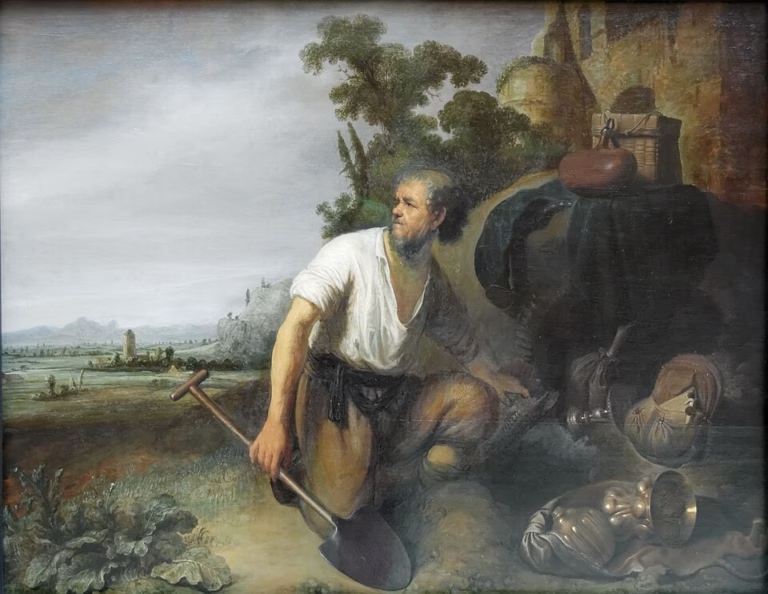
The fields are found just beyond where Jesus is standing, covered with wildflowers, shrubs, and rocks. There are many places where one might discover treasure in such terrain, especially in historical regions where great civilizations have left their mark. Imagine, says Jesus, that a man stumbles across such a treasure—a hoard of gold, an old artifact, ancient weapons, or luxurious jewelry. Finding the treasure, he covers it back up, and with joy at his discovery, goes and sells everything he has to buy that land, coming into possession of something far greater in value than what he originally owned. This is, of course, a profitable trade. Trading all he currently possesses for this field with the treasure in it is worth every sacrifice, as he ends up with far more than what he let go of.
So, this parable tells us that once we discover the value of belonging to the Kingdom of Heaven, it will be worth whatever sacrifices we must make for it. Concretely, this metaphor tells us that the Kingdom of Heaven is worth striving for and sacrificing for. Indirectly, it also reveals that every effort we make to get closer to it is not in vain, because its worth far surpasses whatever earthly goods we can gather. We do not need to feel anxious about what it will take to enter the Kingdom of Heaven when we know that the reward at the end far surpasses the pain and suffering it took to get there.
Indirectly, we also understand that belonging to the Kingdom of Heaven requires something on our part; it is not a convenient or easy journey. It is a matter of belief, faith, and trust that lets us know it is worth struggling for. When we put everything we have into it—our possessions, our hearts, and our whole lives—that is when we truly have a chance of belonging to it.
To make that effort, however, we must see a compelling reason. There has to be something so meaningful that it helps us overcome suffering and makes the struggle worthwhile. Faith and reason go hand in hand. We must believe Jesus’ words about the Kingdom of Heaven as the seat of ultimate bliss in the presence of God, and reasonably follow the steps required to lead a virtuous life pleasing to God. This is not the easiest or most convenient path, nor is it free from suffering. But it is our fundamental trust that it is worth every effort that gives us the momentum, impetus, and will to press on. I am reminded of Viktor Frankl quoting Nietzsche, who said, “He who has a why to live can bear almost any how.” (2) Frankl taught that when we are faced with unavoidable suffering, illness, or loss—when we can no longer change a situation—we are challenged to change ourselves. This strong reason—believing that God’s Kingdom is worth striving for—is what gives us the strength to transform that suffering into something of ultimate value.
Saints throughout history have certainly sacrificed a great deal for the Kingdom of Heaven. Think of Saint Francis, for example, who gave away all his possessions to rebuild an old church and later establish the Franciscan order. Saint Elizabeth of Hungary led a simple life, using her resources to feed the poor. The saints gave of their time and resources and found that they gained something precious and invaluable in return. They felt happy and content, even if outwardly they led austere lives or experienced poverty. And the disciples left behind everything they had, eventually giving their lives to proclaim the Gospel (all being martyred, except Saint John the Evangelist).
The second metaphor is of a merchant in search of fine pearls. For this metaphor, we leave the field behind and enter the busy city. Here we see workshops and stalls with all kinds of merchandise, bustling with buyers and sellers. Merchants display their items so customers can easily find them. Customers move from stall to stall, examining the goods on offer and looking for the best item at the best price.
Occasionally, someone is looking for a rare item. For such treasures, merchants go to trusted sources recommended through private contacts. Special items are not available in large quantities; they are unique and rare. Therefore, they are not openly displayed, lest a thief snatch or steal them. Rare and precious items are sold privately and in confidence, with the price carefully negotiated. Their rarity makes them exclusive, one of a kind, driving the price up.
Such is the precious pearl. If one wants to find a precious pearl, one must first become an expert in pearls—knowing their weight, size, shape, color, and source. Since my grandfather was a jeweler, I have some insight into how private sales are arranged. The first thing distinct about rare items is that they are not advertised to the general public. Knowledge of their existence is shared by word of mouth through trusted individuals. It is like a private network where only those thought to be truly interested and capable of purchasing are notified. The sale is conducted discreetly and confidentially.
This parable tells us that in order to find something rare, precious, and unique, one needs to be knowledgeable in one’s field. More than that, one must be on the lookout for information and word of mouth, actively exploring what is available to verify the quality of the precious stone.
It is worth noticing how grace works in both of these images: sometimes God’s Kingdom surprises us when we least expect it—like finding a treasure hidden in a dusty field—and sometimes it responds to our quiet, disciplined search for the pearl. Whether stumbled upon or sought out, Jesus is showing us that the Kingdom of Heaven is a discrete, hidden reality that must be valued above all else. In order to belong to it, we must constantly seek.
Once we find it, we discover the key to belonging. We may then want to sell all that we have and live only for it—to embrace it entirely. In other words, once we discover the Kingdom of Heaven, we become single-minded, living in ways that please God.
The last parable is that of the fishing net. To appreciate this parable, we return to the shores of the Sea of Galilee, where the disciples are preparing their nets. Notice that pulling in a full net is rarely a solo task—the fishermen on Galilee worked in boats together, supporting one another. After a day of fishing, their nets are tangled with all sorts of sea creatures and plants pulled from the bottom of the lake. There are larger fish, which the fishermen gather into buckets to sell, and smaller fish, which are separated as they are worth less. Finally, there are crabs and seaweed, which they do not keep and toss back into the lake. Thus, the fishermen separate what they know will sell at the market or serve as food from what is useless to them.
This parable brings home the same point as Jesus’ parable of the wheat and the weeds: just as a farmer knows how to differentiate the two and will separate what goes into the barn from what is burned in the fire, so fishermen separate the good fish from the seaweed that is of no use. With this parable, Jesus brings us to the culmination of the image of the Kingdom of Heaven: the vision of the Final Judgment. He assures the disciples that there will be an end time, after which the Messiah, the Son of God, Christ the King, will return to the earth, and His angels will separate those who belong to the Kingdom of Heaven from those who do not.
People’s actions and character—what they have done or left undone—will be revealed, and there will be no secrets. The Kingdom of Heaven will belong to those who lived virtuous lives and contributed through their actions to the upholding of the Kingdom. This includes those who suffered and, through their exceptional virtue, gained grace and favor in the eyes of God by uniting their suffering with that of Christ. Now, they will also participate in Christ’s glory. These are the innocent victims, the martyrs, and all who died trusting God. On the final day, God will bring justice and restore everlasting peace, fulfilling the prophecies of the Old and New Testaments to the last letter.
“Do you understand all this?” Jesus asked His apostles.
And they answered, “Yes.”
This was not just a statement about understanding the parables, but an understanding of what Jesus meant by all of them—a testament and affirmation of faith. The apostles’ “yes” was a confirmation that they believed Jesus was the Messiah, that through Him God’s revelation to humanity was unfolding, and that redemption would be fulfilled in Him. When they said “yes,” it was their “Amen.” They accepted Jesus’ words through faith.
“Then every scribe who has been instructed in the kingdom of heaven is like the head of a household who brings from his storeroom both the new and the old,” Jesus said (Matthew 13:52). This means that the knowledge and revelation given to the apostles came from God and referred to the Old and New Testaments, which complement each other. Everything is tied together; one may emphasize one aspect or another of the Kingdom of God, but in the end, all these illustrations reveal different facets of divine truth. These revelations serve to strengthen faith at various times and in different ways, guiding the faithful as they seek to live for Christ and lead lives pleasing to God. This happens every day through heroic acts of picking up one’s cross, loving others, and humbly serving God whenever the opportunity arises.
Jesus also shows us that no life event is void of meaning. If we make ourselves available to the task, He will help us discover something about the Kingdom of God that makes every effort and struggle worthwhile. One just needs to look and see, for each and every day holds something to discover about Jesus or the Kingdom of Heaven that is like a hidden treasure. The secret is that we must go to places—even scary, dark, or sad places—with Christ. Or better yet, we must let Christ walk with us, inviting Him into these spaces so that surprises can open up and treasures can be found.
Every day can be a field ahead with a treasure waiting to be discovered. What we accomplish while seeking that treasure can be a jewel we contribute, yielding a large catch of fish in the net.
But you may ask, “Jesus, what is my ‘large fish’ in the net when I am poor or when I have to suffer?”
He might say, “The large fish is the most difficult part of your day.” How you manage the hardest moment decides whether it becomes a “fish” or “seaweed.” If you have been patient or kind to someone, you have caught a fish. If you have been grumpy, you got seaweed. The next time you feel grumpy, you deal with it, move on, and keep fishing. You choose patience, and you catch a fish. Sometimes you catch small fish—many small fish—and that is okay, too. And sometimes you catch nothing but seaweed. What do you do then? Thank God for the seaweed that feeds the fish and keep on fishing.
And you ask, “I have been fishing and fishing, but I feel tired and do not know where my reward is.” When our own strength or memory fails, and our arms grow weary from pulling empty nets, we lean on the faith and presence of our brothers and sisters in Christ, and we listen to His voice.
Jesus might say, “Anything you have done for my sake and in the hope of the Kingdom will be remembered.” Why? Because it is like the treasure in the field. Someone dug a hole and placed a treasure in the ground, and sometime later, someone else came along and discovered it. Even if that treasure has not yet been found by human eyes, it will be revealed one day. And if not by someone on earth, God Himself will gather up that treasure, because it is part of the Kingdom of Heaven. Physical strength or the lack of it, memory or the loss of it—none of this diminishes the treasure that is offered back to God.
The greatest treasure we can offer to God is ourselves: our love, our time, and our service. This we can do at all times and in all circumstances. While earthly riches fade, offering God a faithful heart and living a life of generosity are treasures stored in heaven. That is what the greatest saints have done: contemplated the gifts of God with gratitude and offered themselves entirely in His service.
May we have the eyes to see the hidden treasures scattered across our path today—even in the hard places—and the courage to keep casting our nets.
Sources
- Peters, T. (2026). Matthew 13:44-52: 17th Sunday in Ordinary Time, Year A, Sunday Gospel Reflection, Fr. Tim Peters. Retrieved from: https://www.youtube.com/watch?v=XNOFian4C6U Accessed: July 21, 2026.
- Frankl, V. E. (2014). Man’s Search for Meaning. Boston, MA : Beacon Press. Foreword. Page IX.