

Jesus walks with us when we face the challenges of life. Even St. John the Baptist needed reasurance from Jesus that He is the Saviour, and his massage of hope, peace, joy, and love will prevail over evil. In today’s Gospel, Jesus gives evidence that He is the Messiah. As his message was a consolation to John, it also helps us today. God is always active and at work. Even when that is least obvious is a situation.
GOSPEL PASSAGE: Matthew 11:2-11
“When John heard in prison what the Messiah was doing, he sent word by his disciples and said to him, “Are you the one who is to come, or are we to wait for another?’ Jesus answered them, ‘Go and tell John what you hear and see: the blind receive their sight, the lame walk, the lepers are cleansed, the deaf hear, the dead are raised, and the poor have good news brought to them. And blessed is anyone who takes no offence at me.’
As they went away, Jesus began to speak to the crowd about John: ‘What did you go out into the wilderness to look at? A reed shaken by the wind? What then did you go out to see? Someone dressed in fine robes? Look, those who wear soft robes are in royal palaces. What then did you go out to see? A prophet? Yes, I tell you, and more than a prophet. This is the one about whom it is written,
‘See, I am sending my messenger ahead of you, who will prepare the way before you.’
Truly I tell you, among those born of women no one has arisen greater than John the Baptist; yet the least in the kingdom of heaven is greater than he.’”
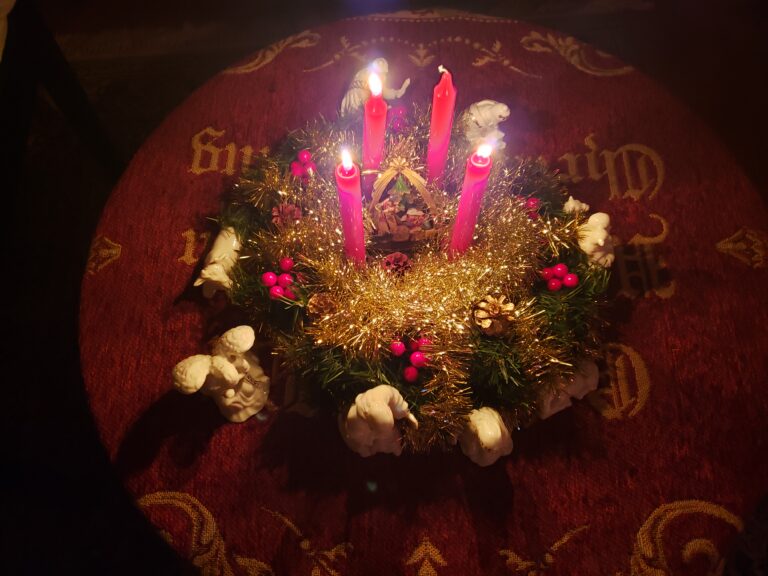
Advent Wreath, Third Candle of Joy
REFLECTIONS:
Today, we celebrate Gaudete Sunday, the Sunday of Joy. As we light the third candle on our Advent wreath, we notice that there are three candles out of four glowing with light. This means we are more than halfway through our preparation for Christmas. To be precise, there are only ten days left. The final part of the countdown begins: Ten, nine, eight, seven, six, five, …and so on. But before we reach zero, there is an important message waiting for us to decipher. It has to do with the ways of proclaiming God’s Word.
We have a beautiful reading about John the Baptist, one of the last Old Testament prophets, who prepared the way for the coming of the Messiah. When we think of the Messiah, we think of the “Light of the World”, and we think of the “Word.” Jesus is the Light and He is the Logos, the Diving Word, wrote Saint John (John 1;1). As John the Baptist pointed at Jesus as the light and the Divine Logos, so we see the fulfillment of our hope, that we will welcome the infant Jesus at Christmas, and, as children of God, we will inherit the Kingdom of God. Wait a minute. Welcome Jesus as our Messiah. Welcome the idea of ourselves as children of God. How do these two hopes coincide? Let’s read today’s Gospel and reflect on the meaning of the verses.
The Gospel narrative of today was recorded by St. Matthew. As you recall, Matthew was a tax collector before Jesus called him to be one of His disciples (Matthew 9:9-13, Mark 2:14-17, Luke 5:27-32). This particular event that he recorded in today’s Gospel took place shortly after Jesus started to instruct his disciples and went with them to their cities to teach there. (Matthew 11:1). There were signs and miraculous healings that accompanied His presence. We read about these later in the Gospel narrative.
Early on in Jesus’ ministry–which as you may recall, was initiated after He spent forty days and nights in the desert praying and withstanding the temptation of the devil, and after being baptized by water by John the Baptist in the River Jordan, during which Jesus accepted His ministry that the Father has conferred on Him—John the Baptist had been arrested at the order of Herod Antipas and thrown into prison. The reason was that John the Baptist had openly criticized the king for corruption and for immorality. (Matthew 14, Mark 6, Luke 9). Herod Antipas had married the wife of his brother, Herodias, and was living in an illegitimate relationship with her, causing public scandal and upheaval. John the Baptist pointed this out and called on the king to repent. As we know from the Bible, Herod kept John in prison because he feared him, and because he wanted to learn from him, but was finally persuaded to have him beheaded during a drunken orgy whereby he granted the wish of Salome, the daughter of Herodias.
So, in today’s Gospel we read about John still in prison, not knowing what is going to happen to him, but surely, it is obvious he had been apprehended on account of grave accusations and his life in danger. His followers are allowed to visit him and to bring messages to him, so he is informed about Jesus and his ministry. John recalls that he baptized Jesus and pointed to Him as “The Lamb of God” (John 1:29). As a very human request, John asks his disciples to bring him one last ray of hope that his mission had been fulfilled, and it has been successful. As if pleading, he inquires, “Are you the one who is to come, or are we to wait for another?” (Matthew 11:3).
With this question, John is appealing to Jesus for the promise—the Kingdom of God. He is standing at the threshold of death and life after death–the Old and the New Covenant. (1) Having gone the full extent possible in the span of the Old Testament, and looking into the future with hope, yet not yet being able to reach it, John is pleading for a sign from Jesus. He is asking, ‘Are you really the Messiah?” “Is the promise really true, or have I been mistaken, wronged, or misunderstood?” “Are you really the Anointed One, or should we wait for another?” There is an urgency in his voice, given that he is in prison and his ministry ruined, his life in danger.
If we remember that the message entrusted to prophets comes from God and often surpasses the faculties of the average person, we see that John was a true prophet. Was this really from God this message that he received concerning the declaration he made about Jesus? Was Jesus really the Son of God? After all, He was John’s cousin….
From his narrow prison, John sent out one last message of prayer—a request—for reassurance. And Jesus sent an answer in a code that John could perfectly understand.
Jesus replied with the words of the Prophet Isiah: “The blind receive their sight, the lame walk, the lepers and cleansed, the deaf hear, and the dead are raised, and the poor have the good news brought to them.” (Matthew 11:5). These are no longer just empty words or visionary statements; the disciples have evidence based on experience that these events accompany the ministry of Jesus.
In Isiah 35:5, we encounter reference this promise: “Then the eyes of the blind shall be opened, and the ears of the deaf unstopped; the lame shall leap like a deer, and the tongue of the speechless sing for joy….” The signs accompanying the coming of the Messiah will be miraculous, like “streams [of water] flowing in the desert” (Iseah 35:6). The prophets Elijah and Elisah are known to have raised the dead. (1) Isiah 61 speaks of the Messiah as a King and a Priest, when the poor will have the good news preached to them, saying “The spirit of the Lord God is upon me; he has sent me to bring good news to the oppressed, to bind up the broken hearted, to proclaim liberty to the captives, and release to the prisoners; to proclaim the year of the Lord’s favor…” (Isaiah 61:1). With these three pieces of evidence, the words of Isiah, the deeds of Elijah and Elisha, and the words of Isaiah regarding the victorious servant King, Jesus reassures John the Baptist: “I am He.”
These words are the full and complete affirmation of John’s ministry. He has not been wrong, although he had been wronged. He had not been a fool, although it had been attempted to make him look like a fool. He had not been mistaken. Although tragic mistakes had ended his life prematurely.
Jesus assured John that the time of waiting was over. Jesus is the Messiah. With this final confirmation, John can look out into the fields surrounding his cell and know that while he is imprisoned, out there, the work of the Lord is unstoppable, and it is already fruitful.
Matthew continues the account with what else Jesus said after he had replied to John. He used the Socratic method to ask the crowds about the subject of John. “Who did you go out to see, and why?” Jesus confirms that John was a prophet but more than a prophet because he prepared the way for the coming of the Messiah. Jesus uttered the highest praise ever to be said about any human being: “Truly, I tell you, among those born of women no one has arisen greater than John the Baptist.” (Matthew 11:11). And then Jesus said something very unexpected that seemed to contradict the previous statement: “…yet the least in the kingdom of heaven is greater than he.” (Matthew 11:11).
Now it is our turn to ask the Socratic question: What does Jesus mean by stating that even the least in the kingdom of heaven is greater than John? To understand this statement, we need to research the writings of the Church Fathers. Saint Thomas Aquinas quoted St. Jerome, one of the earliest Desert Fathers, who wrote, “We understand it simply, that every saint who is already with the Lord is greater than he who yet stands in the battle; for it is one thing to have gained the crown of victory, another to be yet fighting in the field.” (3)
So, now we understand why it is said that John stands at the threshold of the Old and New Covenants. (2) The Old Covenant is necessary for the New Covenant to commence. The Old is pointing to the New, and the New commences with the death and resurrection of Christ. When Jesus died, he opened the door of salvation to all humanity. He opened the door to the kingdom of God. Through the grace of God, which outpoured and was granted at the moment of Jesus’ death and resurrection, opened the possibility of entering an everlasting kingdom.
The Catechism states, “The Paschal mystery has two aspects: by his death, Christ liberates us from sin; by his Resurrection, he opens for us the way to a new life. This new life is above all justification that reinstates us in God’s grace, so that as Christ was raised from the dead by the glory of the Father, we too might walk in newness of life.” Justification consists in both victory over the death caused by sin and a new participation in grace.” (4)
Entering the Kingdom of God is not just a matter of our own will power but of the grace and strength of God’s Spirit which will descend on God’s children. (4) John baptised with water, but Jesus baptizes with the Holy Spirit.
As we set out saying that John always points at the Messiah, we can now understand why John is the last of the Old Prophets; he is yet to die without the grace of the Church and the sacraments, but in the sure hope and knowledge of God’s everlasting Kingdom as Jesus’ promise.
According to Pope Francis, John the Baptist is a model of radical humility, self-emptying, the “voice” pointing to the other. He is a prophet of hope, who accomplishes his mission through desert austerity, intense listening, ultimate faithfulness. He always leads to Jesus and prioritizes the Word over the self. (5)
The gesture of John pointing to Jesus is the “mission of the faithful: John was the lamp, but not the light. He was the voice, but not the Word. He was a Baptizer with water who pointed to the Baptiser with the Holy Spirit. John is therefore the momentary, pointing to the definitive. (5)
The significance of today’s Gospel reading is to prepare ourselves to join Christ on a mission. If we have ben baptised and received conformation, we are Children of God and aided by the Holy Spirt. With the help of John the Baptist, we can be witnesses of the Truth, and the Light. Learning from him, we can selflessly point to the Word and the Light of the World.
Sources:
- Peters, T. (2025). Matthew 11:2-11: The 3rd Sunday of Advent: Gospel Reflection, Year A, Fr. Tim Peters. Retrieved from: https://www.youtube.com/watch?v=Ug4FCLkzDMo. Accessed: December 8, 2025.
- Ray, S. K. (2000-2025). Why was John the Baptist said to be the Least? Defenders of the Catholic Faith. Retrieved from: https://catholicconvert.com/why-was-john-the-baptist-said-to-be-the-least/ Accessed: December 8, 2025.
- Thomas Aquinas (1841-2013) Catena Aurea: Commentary on the Four Gospels, Collected out of the Works of the Fathers: St. Matthew, ed. John Henry Newman, vol. 1, Oxford: John Henry Parker, 1841, 413. Cosimo Classics.
- Catholic Catechism (2025). Section 654. Paragraph 2. On the Third Day he Rose from the Dead. Retrieved from: https://www.vatican.va/content/catechism/en/part_one/section_two/chapter_two/article_5/paragraph_2_on_the_third_day_he_rose_from_the_dead. Accessed: December 8, 2025.
- Pope Francis (2016). The pointing finger. Morning Meditation in the Chapel of Sanctae Marthae. Friday, 16 December 2016. Retrieved from: www.osservatoreromano.va. Accessed: December 8, 2025.