

The message of today’s Gospel is that God cares intimately, passionately, and immediately about each one of us. With our permission, his touch can console what is wounded and hurt inside.
GOSPEL PASSAGE: Luke 7:11-17
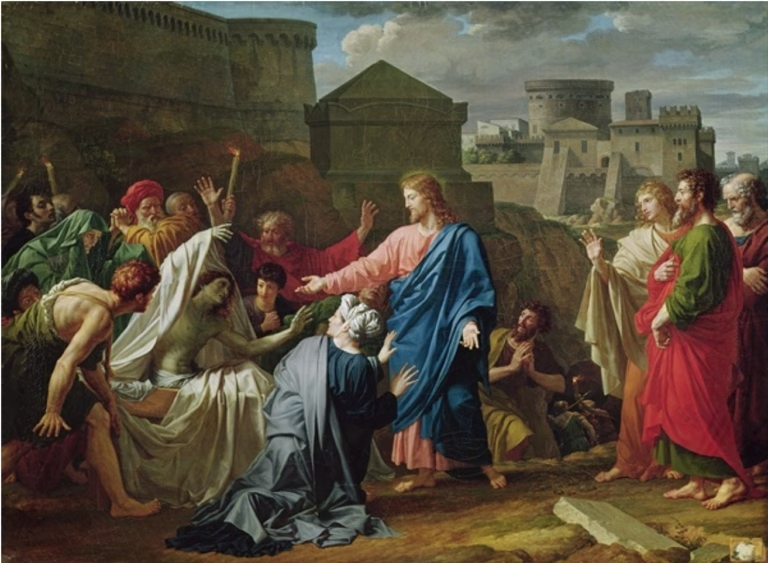
Jesus went to a town called Nain, and his disciples and a large crowd went with him. As he approached the gate of the town, a man who had died was being carried out. He was his mother’s only son, and she was a widow; and there was a large crowd from the town. When the Lord saw her, he has compassion for her and said to her, “Do not weep.”
Then he came forward and touched the pallet, and the bearers stood still. And Jesus said, “Young man, I say to you, rise!” The dead man sat up and began to speak, and Jesus gave him to his mother. Fear seized all of them; and they glorified God, saying, “A Great Prophet has risen among us!” and “God has looked favorably on his people!” This word about Jesus spread throughout Judea and all the surrounding country.
REFLECTIONS
The heart of today’s Gospel is God’s love and compassion. Jesus is visiting a small town, called Nain. This village in Galilee is located about seven kilometers south of Mount Tabor and fourteen kilometers from Nazareth, Jesus’ hometown. (1) As he enters this village, close to the gate, he witnesses a sad sight. There is a large funeral procession heading from the town toward the outskirts, where a burial is about to take place. On a pallet–a flat, open wooden structure–he can see the body of a young man, lying motionless. He is dead and the pellet is being carried by a few men, presumably, relatives of the deceased person. Everyone looks dejected and sorrowful. As the disciples make way for the procession, and they find out from the crowd that this man was his mother’s only son, and she is a widow. With the death of her only son, the widow’s joy and security are gone. She is now alone and downcast. Noone cries out, and no one begs Jesus for help. He can see the widow, who is closely following the pallet, moving at the rhythm of it. Her face is drenched in tears.
Upon seeing the pain of the mother, Jesus is moved by compassion. He is seized by great zeal. “Do not weep,” he tells her. The procession is interrupted; the men look up. The widow wipes a tear. Jesus steps closer to the pallet and touches it. He does not touch the body of the dead man, he touches the wood on which he lies, and with a loud voice, he says to him, so that all can hear loud and clear, “Young man, I say to you, rise!” Everyone is stunned and stands in frozen silence. What is a commandment to the deaf ears of the dead? However, the body of the dead begins to move. To everyone’s amazement, he sits up, and he begins to speak. The pallet is lowered, and he stands on his own two feet. The people stand there, bewildered, not believing their eyes. Jesus leads the young man by the hand to his mother. By this time, fear and terror sizes the crowd. They are witnessing a supernatural event. The young man who was dead, is now alive. What was lost, is found. What has been taken away has been restored. The young man is sound and well.
The crowd glorifies God, saying, “A Great Prophet has risen among us!” and “God has looked favorably upon his people!” They understand that only God could have intervened to make this miracle happen. For human beings, it is impossible. They think that Jesus is a prophet through whom God granted this supernatural healing. They are right because it is through Jesus’ intercession to the Father and the Holy Spirit that God performs this miracle. Miracles accompany Jesus’ identity as God and Savior. Through this miracle, God grants grace to this widow who loves his son so much. God knows her heart and restores her son to life to show that God’s mercy and love are infinite, immediate, powerful, and healing. Miracles, such as this lively scene, also confirm Jesus’ authority over life and death. At the gate, the threshold between what was and what is to be, Jesus orders the young man to stand up. Death does not have the last word, for God is Lord of life and death. His intention is life, and everlasting life. This young man had a mission to accomplish, and God wants him ready for the task. There is one more reason why this compassionate act of God is significant: In the act of raising the young man from the dead, God provides a powerful sign of prefiguration for the life and death of Jesus: After his death on the cross, Jesus will rise again. And with Jesus, all who are believers of God, will rise to everlasting life.
Today’s Gospel gives a powerful message of hope. God is Lord of life and death. He does not intend death and pain. He promises his healing power that can restore our souls from languishing in anguish over the transitoriness of life. With his compassionate, merciful, and passionate love, he wants us to live and have a life to the fullest. And if anything, such as illness, accidents or old age may appear to rob us from having completed the full course of our lives, God offers eternal life in the world to come.
The message of today’s Gospel is that God cares intimately, passionately, and immediately about each one of us. With our permission, his touch can heal what has been wounded and hurts inside.
Jesus in the eucharist nourishes our spirit. The “Eucharist” in Greek eucharistia means “Thanksgiving.” (2) And why should we be thankful?
In a videotaped speech in 1966, Archbishop J. Fulton Sheen, referred to the teaching of the Second Vatican Council, according to which “…There are four ways in which God is eminently present in this world. First, in the Mass, and especially in the Blessed Sacrament, also called the Eucharist. Secondly, in the words of the Sacred Scriptures. The third form of the presence of God is in the poor. And the fourth Presence of our Blessed Lord is in our common prayer….” (3)
“Now not all of these presences are equal,” continued the archbishop, “…the most intimate presence is in the Eucharist, which is both a sacrifice and a sacrament. The Mass is the reenactment of Calvary. It is like a great drama. A drama is performed for the purging of the soul. The great drama of the Calvary…. It would be a great pity if this was kept for those who were at the foot of the cross…but our Lord makes this provision for those who were not at the foot of the cross, to be able to witness this sacrifice. But it is not with blood. No, not at all. It is when the priest will take the bread and will say ‘This is my body.’ And then, separately, he will take the wine, and say, ‘This is my blood.’ That separate consecration of the bread and wine is like a mystical sword separating blood from body which is the way how Christ died. And when die with Christ, we apply the merits of it to us, so we can be assured of the resurrection…. Next, we come to the sacrament. You see, every sacrifice has a sacrament. A sacrament feeds you, but before they became a sacrament to give you life, they had to die. The plant was plucked from the earth, subjected to fire, the fruit plucked from a tree. In nature there is always a sacrifice and then a sacrament and the sacrament is life. The sacrament is also found in the presence of our Lord in the tabernacle. When you enter a church, you enter the house of God. If you had lived at the time of Christ, you would have seen a human being, man, like other man. But if you had the eyes of faith, your eyes would have pierced the flesh, and you would have seen our Lord. And if you had faith, your eyes would have pierced the bread, and you would have seen divinity. When you enter a church and pray in front of the tabernacle, your eyes pierce the bread, and you see our Lord. This is the closest we will get to our Lord on Earth.” (3)
The archbishop used Mother Theresa’s example to describe how the Lord is mysteriously present in the poor: When we get used to spending time with our Lord, we get accustomed to seeing the poor and their wounds, then through a similar extension–through the eyes of faith–as see the wounds of Christ. When we touch the wounds of Christ is when we start to love the other and not be afraid of their afflictions. (3)
On All Souls’ Day, we remember with tender love those of our family, friends, and relatives, and all those who have passed before us, and those who died in the hope of eternal life, and we commend them to the merciful care of God.
By facing death with faith, we place our hope in eternal life.
For us, death means life, through the eyes of faith, and faith offers of hope in the tragedies of life.
Sources:
- Custodia Terre Sanctae (2022). Nain. Holy Land. Retrieved from: https://www.seetheholyland.net/nain/ Accessed: October 29, 2025.
- Word on Fire (2022). The Eucharist as Thanksgiving. Retrieved from: www.wordonfire.org. Accessed: October 29, 2025.
- Archbishop Fulton Sheen (2021). Life is worth living. Episode 30. The Eucharist. Retrieved from: https://youtu.be/HkqH9xD932Y?si=3dxLgBFX9x1zmDG4. Accessed: October 29, 2025.