

On the way to Emmaus, the two disciples emerged from being confused and defeated to hopeful and joyous, burning with zeal to transmit the Good News about the Risen Lord to their companions. Like them, our lives can be totally and completely changed when we encounter the risen Lord in contemplation, through the Scriptures, and in the Holy Eucharist.
GOSPEL PASSAGE: Luke 24:13-35
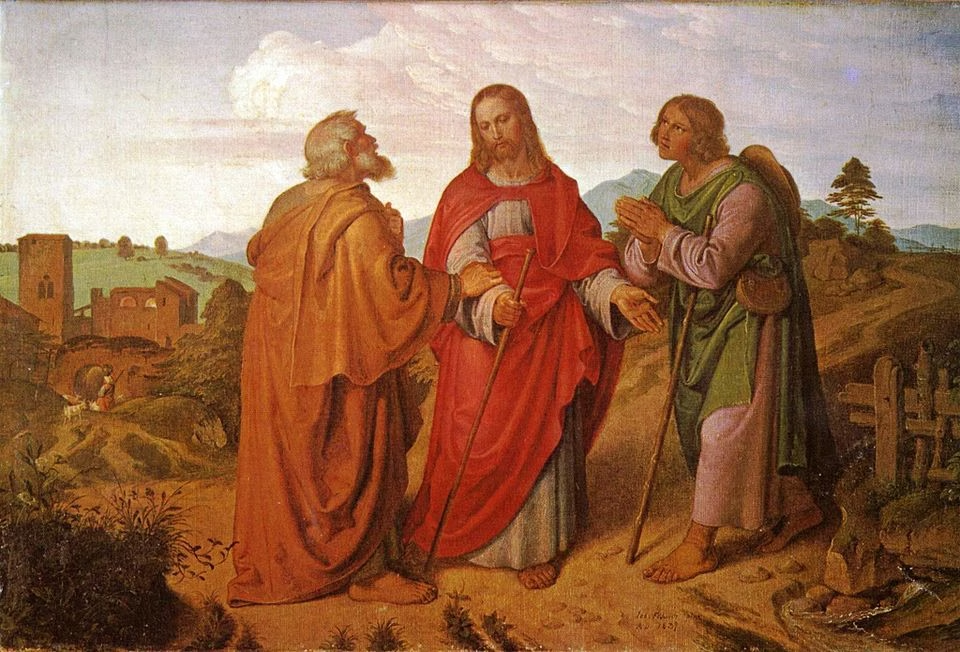
That very day, the first day of the week, two of Jesus’ disciples were going to a village seven miles from Jerusalem called Emmaus, and they were conversing about all the things that had occurred. And it happened that while they were conversing and debating, Jesus himself drew near and walked with them, but their eyes were prevented from recognizing him. He asked them, ‘What are you discussing as you walk along?” They stopped, looking downcast. One of them, named Cleopas, said to him in reply, “Are you the only visitor to Jerusalem who does not know of the things that have taken place there in these days?” And he replied to them, “What sort of things?” They said to him, “The things that happened to Jesus the Nazarene, who was prophet mighty in deed and word before God and all the people, how our chief priests and rulers both handed him over to a sentence of death and crucified him. But we were hoping that he would be the one to redeem Israel; and besides all this, this is now the third day since this took place. Some women form our group, however, have astounded us: they were at the tomb early in the morning and did not find his body; they came back and reported that they has indeed seen a vision of angels who announced that he was alive. Then some of those with us went to the tomb and found things just as the women had described, but him they did not see.” And he said to them, “Oh, how foolish you are! How slow of heart to believe all that the prophets spoke! Was it not necessary that the Christ should suffer these things and enter into his glory?” Then beginning with Moses and all the prophets, he interpreted to them what referred to him in all the Scriptures.
As they approached the village to which they were going, he gave the impression that he was going on farther. But they urged him, “Stay with us, for it is nearly evening and the day is almost over.” So he went in to stay with them. And it happened that, while he was with them at the table, he took bread, said the blessing, broke it, and gave it to them. With that their eyes were opened and they recognized him, but he vanished from their sight. Then they said to each other, “Were not our hearts burning within us while he spoke to us on the way and opened the Scriptures to us?” So they set out at once and returned to Jerusalem where they found gathered together the eleven and those with them who were saying, “The Lord has truly been raised and has appeared to Simon!” Then the two recounted what had taken place on the way and how he was made known to them in the breaking of bread.
GOSPEL REFLECTIONS:
It’s easy to get discouraged when things are difficult, when the evidence is inconclusive, circumstantial, or tenuous at best. One option is to give up and walk away from things that are uncorroborated or suggestive, but not strictly factual. This happened to two of the disciples—Cleopas and another disciple from Jesus’ circle—who did not yet understand what had happened. The failure, the futility, and the horror of the Cross was too fresh in their minds to entertain the possibility that all this had a glorious ending. Jesus’ words and His promise that He will rise from the dead still seemed nebulous, uncertain, and confusing. The disciples were on their way home from Jerusalem, all the while painstakingly reviewing the traumatic events that surrounded Jesus’ death and the deafening grief and silence that followed it. They wrestled with confusing claims that angels heralded His resurrection to some women from their group who visited the tomb at dawn. They were heading back to Emmaus, back to their homes, back to some sort of safety and stability.
On the road, they encountered a mysterious “stranger” who changed everything. He turned their doubts into joy and certainty. The disciples of Emmaus made a complete U-turn upon recognizing Jesus, who was walking with them, revealed to them the meaning of the Scriptures, and made Himself known to them in the breaking of the bread.
This is how it happened:
Two disciples went from Jerusalem down to Emmaus on the same day that Jesus resurrected from the dead. That morning, three days after Jesus’ death and the first day of the week, Easter Sunday, Mary of Magdala and several women went to Jesus’ tomb at dawn and found it empty (Luke 24:3). They encountered two angels who told them that Jesus is not among the dead but is risen: “Why do you look for the living among the dead? He is not here but has risen.” (Luke 24:5). They ran to tell the disciples what they had seen, but the disciples did not really believe them. Peter and John ran to the tomb and ascertained that what the women claimed was in fact true; the burial cloths were left in the tomb, but Jesus’ body was missing (John 20:7). Then they started to believe that maybe what He had been saying earlier about His resurrection could have really taken place. But they had no certainty.
Thus, the story of the disciples of Emmaus begins by illustrating what happens before there is tangible proof of Jesus’ resurrection. This can happen to us as well when we are not entirely certain that Jesus’ promises are true. The experience is confusion and doubt. The two disciples were sad by what they had witnessed a few days earlier, dejected and confused. They tried to make sense of what may have taken place. By midday, two of them, Cleopas and another unnamed disciple, were returning to their own places of living, leaving the rest of the disciples behind in Jerusalem. They were debating and arguing on the road, not knowing what to think, while the distance between them and the others back in Jerusalem increased with every step.
All of a sudden, another man drew near them and started to accompany them on the road. Without thinking too much about His identity, they accepted His presence and kept their pace. They were traveling on the road together for some time when the newcomer asked them, “What are you discussing with each other while you walk along?” (Luke 24:17). They stopped in astonishment and, assuming the man was not from Jerusalem or from the area, they looked sad and speechless. Instead of answering, Cleopas turned to the man and said to him, “Are you the only stranger in Jerusalem that does not know the things that have taken place there these days?” (Luke 24:18).
Golgotha was just outside Jerusalem, and so every pilgrim and traveler would have passed by the road on the way to the city or on the way out. The most important news was the crucifixion of Jesus, who had a triumphant entry into Jerusalem a few days prior to that. How was it possible not to have heard about what happened to Jesus, who was recognized as a prophet among the people? But, to their surprise, the man continued to naively question them: “What things?” (Luke 24:19).
To Jesus’ questions, the disciples started to pour out their hearts. They told Him about Jesus of Nazareth, who was a “…prophet mighty in deed and word before God and all the people, and how [the] chief priests and leaders handed him over to be condemned to death and crucified him. But [they] had hoped that he was the one to redeem Israel. And besides all this, it [has been] three days since these things took place. Moreover, some women [of their] group astounded [them]. They were at the tomb early this morning and they had indeed seen a vision of angels who said that he was alive. Some of those who were with [them] went to the tomb and found it just as the women had said, but they did not see him.” (Luke 24:19-24).
Jesus let them talk, and He listened. He listened to their words, the sadness in their voices, and the confusing evidence that bewildered them and made them think that it was best to return to their homes in Emmaus.
The location of Emmaus is debated by Bible scholars. One location seven miles away from Jerusalem is the town of Abu Gosh. The disciples were headed that way, with their new companion walking with them; but they still did not “see” who He was.
Then, Jesus exclaimed, “Oh, how foolish you are, and how slow of heart…to believe all that the prophets have declared!” (Luke 24:25). Jesus did not scold them; He just stated the obvious: they were heading the wrong way; they were looking in the wrong direction; they were on the wrong path, doubting and missing what the prophets had revealed about the Christ.
Then, beginning with Moses and going through all the Scriptures, He explained to them the passages that applied to Him and to the suffering and the resurrection of the Messiah. While He was talking, their hearts were on fire because He opened to them the meaning of the Scriptures in the light of the evidence—the suffering and the resurrection of the Christ. They could “see” how what they were describing was exactly unfolding as foretold by the prophets and revealed in the life, death, and resurrection of Jesus.
As they walked and talked, they reached Emmaus, and the disciples were planning to spend the night there. Jesus, meanwhile, walked ahead as if to go on. So, they implored Him strongly to stay with them with the words, “Stay with us because it is almost evening and the day is now nearly over.” (Luke 24:29). The disciples accepted Jesus in His concealed form; they experienced His presence as reassuring and desirable. They wanted to keep listening to Him and being with Him. They invited Him to rest with them in Emmaus before continuing His journey at daybreak.
He accepted this invitation. As they were sitting at the table, Jesus took bread, said a blessing, broke it, and gave it to them. This image gave an exact flashback to the Last Supper and the institution of the Eucharist (Luke 24:30). Their eyes opened, and they recognized Jesus in the breaking of the bread. But as soon as they recognized Him, He vanished from their sight. Jesus vanished because He was no longer bound by time and space. He was risen and was with them. He was with them, as He promised, in the breaking of the bread. He was with them until the end of the earth.
With glowing hearts, the disciples picked up their belongings. At that same hour, they got ready and returned to Jerusalem to tell the others about what they had seen. Upon their return, they found the eleven gathered, and they also told them with great joy that the Lord had appeared to them (Luke 24:34-35).
Luke’s Gospel finishes with the confirmation that as soon as the disciples of Emmaus joined the others in Jerusalem, Jesus appeared in their midst. They were filled with great fear, so He asked to be given a piece of broiled fish, which He ate in their presence. After this, He opened to them the Scriptures and instructed them to proclaim repentance and forgiveness of sins in His name. He told them to remain in Jerusalem until the coming of the Holy Spirit but led them out of their closed quarters all the way to Bethany—which we know was about two kilometers from Jerusalem—where He blessed them and was carried up to Heaven. The disciples returned to Jerusalem where they praised God in the temple and awaited the coming of the Holy Spirit (Luke 24:36-48).
From doubt, uncertainty, fear, and confusion, which was based on facts, Jesus used those elements to explain the plan of God. According to Teresa of Avila, “God writes straight with crooked lines.” Even when life seems complex, chaotic, messy, unpredictable, or moving in the wrong direction, God can use those occasions to accomplish something unexpected, good, and orderly. Likewise, hardships, accidents, and sinful actions of others do not render a life useless but can be redeemed by God.
Jesus listened to the disciples, met them where they were, accompanied them, and opened to them the meaning of the Scriptures so that they could see that those obstacles and humanly irreconcilable pieces they were wrestling with were part of God’s greater plan. After this understanding, Jesus showed Himself to them in the breaking of the bread, and they could, ever so briefly, see Him.
The road to Emmaus and back to Jerusalem is a story of desperation and the road leading to the Lord. Through contemplation of the events which make us doubt, God can mercifully relate those to the Scriptures. He abides with us and comes with us in the Eucharist. When we see Jesus, joy and peace return. Despair changes to promise. Faith guards the promise and cherishes it. Then we can walk out with our heads held high because Jesus walks with us, and He is the promise of eternal life.
From desolation, we can reach consolation because He lives, and we can feel His closeness when we read the Scriptures and encounter Him in the Eucharist. He holds the promise of the final victory, which is not just a looking away from our troubles or a cheap consolation, but—through our troubles that are shared with the Lord—a faithful encounter and journey with Him with the conviction that “He is risen; risen indeed!” (Luke 24:34, Matthew 28:6).
Sources:
- Peters, T. (2026). Luke 24: 13-35: 3rd Sunday of Eater, Sunday Gospel Reflection by Fr. Tim Peters. Retrieved from: https://www.youtube.com/watch?v=orBm0FDfa6o. Accessed: April 16, 2026.
- Hornsey, D. (2026). Goe Writes Straight with Crooked Lines. Missionary Society of St. Columban. Retrieved from: https://columban.org/newsletter/god-writes-straight-crooked-lines#. Accessed: April 16, 2026.