

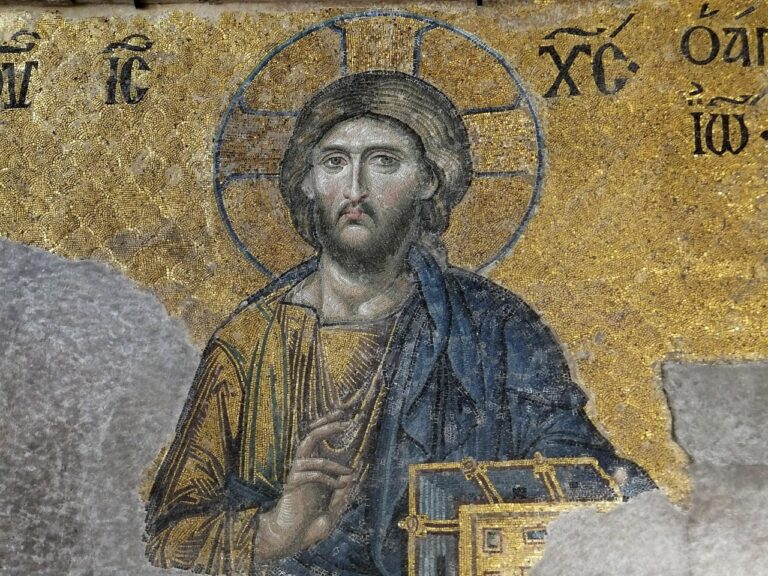
Jesus is the King of the Universe, which means that ultimately, Divine justice and goodness will reign over all Creation.
GOSPEL PASSAGE: Luke 23:35-43
The leaders scoffed at Jesus saying, “he saved others; let him save himself if he is the Christ of God, his chosen one!” The soldiers also mocked Jesus, coming up and offering him sour wine, and saying, “If you are the King of the Jews, save yourself!” There was also an inscription over him, “This is the King of the Jews.”
One of the criminals who were hanged there kept deriding him and saying, “Are you not the Christ? Save yourself and us!”
But the other rebuked him saying, “Do you not fear God, since you are under the same sentence of condemnation? And we indeed have been condemned justly, for we are getting what we deserve for our deeds, but this man has done nothing wrong.” Then he said, “Jesus, remember me when you come into your kingdom.” Jesus replied, “Truly I tell you, today you will be with me in Paradise.”
REFLECTIONS
The previous weeks, Jesus was talking about the temple of his body and his second coming in glory. Presently, we find ourselves in front of the crucified Lord. What is the significance of this passage on the Day of Christ the King? The image is gruesome. Jesus, as a man, dying on the cross while people of different rank stand by and comment. The leaders taunt and mock him. The soldiers who crucified him follow suit. The Roman Prefect of Judea, Pontious Pilate, orders to have a sign posted over him, saying, “This is the King of the Jews.” Even one of the criminals who shares the same method of execution of dying on the cross, scolds Jesus: “Are you not the Christ? Save yourself and us!” The humiliation and the derision could not get more bizarre. Jesus hangs on the cross, gradually losing his strength, and slowly losing his life. On the one hand, he is lost.
However, we are confronted with another type of response, coming from the criminal hanging on a cross on the other side of Jesus. This one rebukes the other and says to him, “Do you not fear God, since you are under the same sentence of condemnation?” And this man admits his sins to Jesus: “…Indeed we have been condemned justly, for we are getting what we deserve for our deed, but this man has done nothing wrong.” And this sinful man, turning to Jesus, concludes his confession with a supplication: “Jesus, remember me when you come into your kingdom.” This man, the simple, sinful man, hanging on the cross, and slowly dying, holds on to a minute of terminal lucidity to retroactively ask for forgiveness for his sins and mercy to enter the kingdom of God. Jesus responds to him, “Today, you will be with me in Paradise.” On the other hand, Jesus grants eternal life with him in Paradise.
The meaning of Paradise is Eden. (1) In the garden of Eden, the first humans did not know suffering or pain. They were in the presence of God. Paradise is a concept or state of place of perfect happiness, and complete union with God. It is a place reserved for the righteous. It is a state of unending union with God. (2) Jesus can only make this promise if he has authority to grant forgiveness of sins. That is, if Jesus is Lord and God.
Jesus’ death on the cross indicates the type of kingship he represents. It is not the glory of those who are politically powerful, physically able, and least not those who pronounce themselves wise and sinless. Jesus is a servant king. As he said, he came into the world, not to be served, but to serve and to lay down his life for sinners: “My life, no one takes it from me, but I lay it down on my own accord. I have authority to lay it down and authority to take it up again” (John 10:18). Paradise awaits those who place themselves in the hands of God because on their own merit, they know that they do not deserve to enter.
Jesus’ death, as gruesome it is in its physical detail, presents the reality of God at work. Just when things seem to be ending, when human effort is insufficient, God takes over. Through the power of the Holy Spirit, God provides joy, certitude, and steadfastness. Beyond what is visible, touchable and measurable, God is always at present. He is in control of our lives and what happens after we die. The Father who created us, had a perfect design. This perfect design comes to fulfillment between suffering and joy; the wood of the cross and the heavenly vision of life in Paradise.
As the liturgical year ends this week, we will close our reflections with a prayer that helps us to continue to journey with Jesus from the cross into eternal life. This Prayer for the Propagation of the Flame of Love was approved by Pope Paul VI in November 1973. It received Imprimatur by Cardinal Péter Erdő, Archbishop of Esztergom and Budapest, Hungary, in 2009. Since then, the payer is available to the universal Church. (4) According to the message from Our Lady to Elisabeth Kindelmann, a Hungarian mystic, The Flame of Love is the abundance of graces granted to the Mother of our Lord by the Father through the sacred wounds of Jesus. This exceptional grace for modern times is a way to achieve union with Jesus, combat evil, and achieve salvation for all humanity (4)
“My adorable Jesus, may our feet journey together. May our hands gather in unity. May our hearts beat in unison. May our souls be in harmony. May our thoughts be as one. May our ears listen to the silence together. May our glances profoundly penetrate each other, may our lips pray together to gain mercy from the Eternal father. Amen.” (3)
Sources:
- Merriam Webster (2025). Paradise definition. Retrieved from: https://www.merriam-webster.com/dictionary/paradise. Accessed; November 20, 2025.
- Camille. A. (2022). What Catholics get wrong about heaven. Retrieved from: U.S. Catholic. https://uscatholic.org/articles/202212/what-catholics-get-wrong-about-heaven/ Accessed: November 20, 2025.
- Kindelmann, E. (2020). The Flame of Love: The Spiritual Diary of Elisabeth Kindelmann. The Unity Prayer Given by Jesus to Elizabeth Kindelman. The book is available from: https://www.amazon.ca/Flame-Love-Spiritual-Elizabeth-Kindelmann/dp/194770110X and www.QueenofPeaceMedia.com. The prayer is made available from www.theflameoflove.og (Canada).
- McDermott, T. (2023). The Flame of Love: The Spiritual Diary of Elizabeth Kindelmann. Catholic Insight. Retrieved from: https://catholicinsight.com/2023/04/05/the-flame-of-love-the-spiritual-diary-of-elizabeth-kindelmann/ Accessed: November 20, 2025.