

Jesus’ healing of the man born blind challenges the traditional belief that suffering is a direct punishment for sin, shifting the focus from human blame to the manifestation of God’s grace. Through this miracle, Jesus reveals Himself as the “Light of the World,” contrasting the physical sight granted to the beggar with the spiritual blindness of the prideful religious authorities.
GOSPEL PASSAGE: John 9:1-41
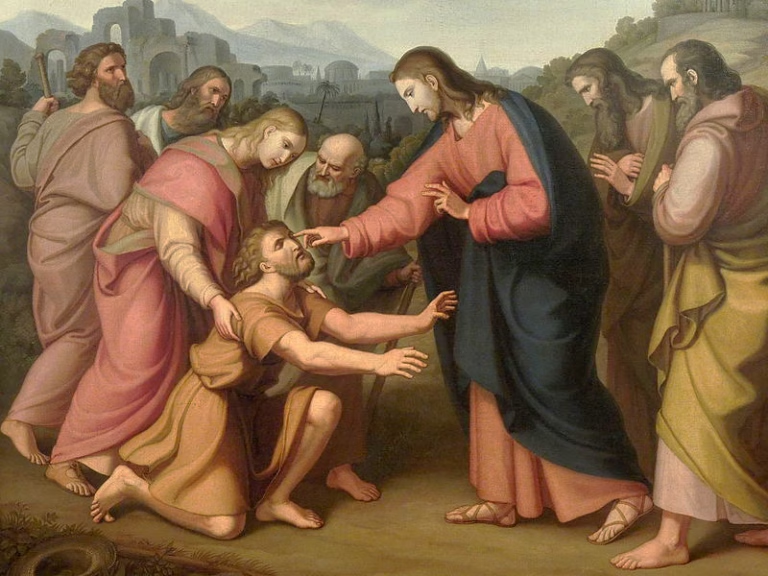
“As Jesus passed by, he saw a man blind from birth. His disciples asked him, ‘Rabbi, who sinned, this man or his parents, that he was born blind?’ Jesus answered, “Neither he, not his parents sinned; it is so that the works of God might be made visible through him. We have to do the works of the one who sent me while it is day. Night is coming when no one can work. While I am in the world, I am the light of the world.” When he said this, he spat on the ground and made clay with the saliva and smeared the clay on his eyes and said to him, “Go wash in the Pool of Siloam”–which means Sent–. So he went and washed and came back able to see.
His neighbors and those who had seen him earlier as a beggar said, “Isn’t this the one who used to sit sand beg?” Some said, “It is,” but others said, “No, he just looks like him.” He said, “I am.” So, they said to him, “How were your eyes opened?” He replied, “The man called Jesus made clay and anointed my eyes and told me, ‘Go to Siloam and wash.’ So, I went there and washed and was able to see..” And they said to him, “Where is he?” He said, “I don’t know.”
They brought the one who was once blind to the Pharisees. Now Jesus had made clay and opened his eyes on the Sabbath. So, then the Pharisees also asked him how he was able to see. He said to them, “He put clay on my eyes, and I washed, and now I can see.” So, some of the Pharisees said, “This man is not from God, because he does bot keep the sabbath.” But others said, “How can a sinful man do such signs?” And there was a division among them. So, they said to the blind man again, “What do you say about him, since he opened your eyes?” He said, “He is a prophet.”
Now the Jews did not believe that he has been blind and gained his sight until they summoned the parents of the one who had gained his sight. They asked them, “Is this your son, who you say was born blind? How does he now see?” His parents answered and said, “We know that this is our son and that he was born blind. We do not know how he sees now, not do we know who opened his eyes. Ask him, he is of age; he can speak for himself.” His parents said this because they were afraid of the Jews, for the Jews had already agreed that if anyone acknowledged him as the Christ, he would be expelled from the synagogue. For this reason, his parents said, “He is of age; question him.”
So, a second time they called the man who had been blind and said to him, “Give God praise! We know that this man is a sinner.” He replied, “If this man is a sinner, I don’t know. One thing I do know is that I was blind and now I see.” So, they said to him, “What did he do to you? How did he open your eyes?” He answered them, “I told you already and you did not listen. Why do you want to hear it again? Do you want to become his disciples, too?” They ridiculed him and said, “You are that man’s disciple; we are disciples of Moses! We know that God spoke to Moses, but we do not know where this one is from.” The man answered and said to them, “This is what is so amazing, that you do not know where he is from, yet he opened my eyes. We know that God does not listen to sinners, but if one is devout and does his will, he listens to him. It is unheard of that anyone ever opened the eyes of a person born blind. If this man were not from God, he would not be able to do anything.”
They answered and said to him, “You were born totally in sin, and are you trying to teach us?” Then they threw him out.
When Jesus heard that they threw him out, he found him and said, “Do you believe in the Son of Man?” He answered and said, “Who is he, sir, that I may believe in him?” Jesus said to him, “You have seen him, the one speaking with you is he.” He said, “I do believe, Lord,” and he worshipped him.
Then Jesus said, “I came into this world for judgement, so that those who do not see might see, and those who do see might become blind.”
Some of the Pharisees who were with him heard this and said to him, “Surely we are not also blind, are we?” Jesus said to them, “If you were blind, you would have no sin; but now you are saying, “We see,’ so your sin remains.””
REFLECTIONS:
In today’s Gospel reading, we are invited to ponder the meaning of two terms: being blind and being sinful. Blindness is a physical condition, which cannot be cured. It can result from an injury to the eye or the nerves that process visual information, or the brain regions that are responsible for processing the input they receive through the optical nerve. Like many illnesses, this condition can be present from birth, in which case it is not curable with any form of medical intervention. Reversing such blindness, which made a person not be able to see since birth, would be a medically unexplainable phenomenon. This is what we call a miracle—an extraordinary, sensible event that surpasses the laws of nature and is attributed to divine intervention. (1)
Being sinful is the condition of having acted in way contrary to the laws of God, and a rupture in our relationship with God, our neighbors and ourselves. There are two types of sins; mortal sins, which are serious transgressions of God’s laws, committed knowingly and with internal consent, and venial sins, which wound our relationship with God because they represent failures in following the moral law. (2) Since the time of Moses, the Jewish people believed that following the Mosaic law will bring prosperity and blessings, and rejecting it will bring curses such as sicknesses, plague and exile. Because of these reasons, if someone was suffering from a disease, such as blindness, epilepsy, or leprosy, it was common to assume that there must have been a prior “disobedience”, and the illness is a “punishment.” The Book of Job was written specifically to debate this traditional view of equating sinfulness with illness and illness with sinfulness and shifting from the cause of the illness to the purpose of discovering what God can do exactly because of, or through an affliction. (3)
There were several signs and miracles that accompanied Jesus’ ministry. Through these miracles, the grace of God accompanied His mission and manifested itself. God showed powerful signs and miracles as a way of authenticating and validating Jesus’s mission as the Messiah and the Son of God. There were many miracles and signs that accompanied the actions of the prophets, but none as powerful and well known as those performed by Jesus. We can think, for example, of the miraculous feeding of the five thousand, or Jesus walking on the water, or Jesus healing the blind man. This particular miracle was followed by the raising of Lazarus from the dead, which was Jesus’s last miracle before His crucifixion.
Restoring of the sight of the blind man reminds us of the healing of Naaman, the commander of the Syrian army, who was afflicted with leprosy. We read about him in 2 Kings Chapter 5. He was a powerful commander who was healed by the prophet Elisha, who asked Naaman to go and immerse himself seven times in the Jordan River. Upon doing so, his skin became radiant and clean, and he was restored to full health.
In the tradition of the prophets, Jesus and His disciples encounter a blind man begging on the streets of Jerusalem. Jesus was there on the occasion of a Jewish festival, and He already had a discussion with the Pharisees about His identity as the Son of Man, or the Messiah, which they denied. When Jesus stated, “Before Abraham was, I am,” the Pharisees picked up stones and were going to stone Him. He hid from them and went out of the temple. The blind man sat close to the temple, close to the religious authorities, who saw Jesus but did not recognize Him. He could not see Jesus, nor the disciples, so the disciples raised the question: “Rabbi, who sinned, this man, or his parents, that he was born blind?” This question came naturally, since at the time, and as it happens often nowadays, when we see someone afflicted with an illness, the first question that comes to mind is, “What is the reason of the suffering of this individual?” Is it that they have done something wrongly, or their parents, or someone else to contribute to this illness? The question echoes a quest as old as humanity to understand the reason of suffering. In the book of Job, for example, Job’s friends were blaming him or his ancestors, or some other sin that he may have committed for his calamity (Job 4-25).
Instead of dwelling on the “why” question that would assign blame to someone, Jesus immediately re-oriented His disciples to what can be done and the solution: “Neither this man nor his parents sinned; he was born blind so that God’s works might be revealed in him” (John 9:3). So, Jesus immediately explains that no personal or collective sin contributes to an illness that one has from birth or that one is afflicted with without having done anything to bring it onto oneself, “deserve it,” or to perpetuate it. Incurable illness, says Jesus, such as this blindness was, exists “…so that God’s works may be revealed in him” (John 9:3).
Jesus makes a statement about Himself, which is one of the seven statements that He makes during His ministry: “I am the light of the world” (John 9:5). The other statements are: “I am the bread of life; I am the gate for the sheep; I am the good shepherd; I am the resurrection and life; I am the way, the truth and the life” and “I am the true vine and you are the branches”—can all be found in John’s Gospel. (4) So, here we focus on the statement “I am the light of the world” which Jesus uses to underline His mission: He is the one who can heal spiritual blindness, the problem of living in darkness because of sinfulness and pride. This miracle, through which He will restore the sight of the blind man, will be a symbolic explanation for God’s power to heal people from their sins and to lead them out of darkness into light.
Even though Jesus declares the blind man innocent, He spits on the ground, forms mud with His saliva and places it on the eyes of the blind man, telling him to go and wash himself in the pool of Siloam. Washing with water as purification is a foreshadowing of the institution of the sacraments that Jesus institutes for reconciliation. (4)
The blind man knows nothing about Jesus; he only hears His voice, and feels His hands touch his eyes with mud. He obeys the instructions to go to the pool of Siloam, which means, the one who is Sent (John 9:7). As he washes his eyes, his sight is restored and, in the rest of the Gospel account, he becomes one of the Sent.
All this takes place during a Sabbath, when Jewish law prohibits work. So, the Pharisees summon the man and ask him to testify about what exactly happened. They want to know in detail who it was who healed him and how. But the man knows not much, other than that he followed the instructions of someone who told him to wash his eyes in the pool of Siloam and now he can see. Incredulous, the Pharisees keep questioning him, since they know that miraculous healings cannot be attributed to anyone other than who receives such graces from God. So, they are perplexed. Especially, when they find out that this person who the man says healed him is Jesus. They already rejected Jesus as inauthentic. How come He now performs a miracle? So, there is a division between them. In order to avoid the discrepancy between this testimony and their actions of having rejected and nearly stoned Jesus earlier, they come up with a new strategy: they declare to the man that Jesus must be a sinner and that He operates with evil forces. The man points out that their reasoning is illogical. They become furious and throw him out of the temple.
Jesus met the man at this second low point in his life. First, he was blind and relied on begging. This was a low point. Now, he can see, but he is made an outcast; he is thrown out of the temple. Jesus identified Himself to the man, who worships Him. He was once blind and did not know Jesus but now can see and can recognize Jesus for who He is. Jesus then made this statement about His mission: “I came into this world for judgement, so that those who do not see may see, and those who see may become blind” (John 9:39).
Some of the Pharisees standing by questioned Him: “Surely, we are not blind, are we?” and Jesus replied, “If you were blind, you would not have sin. But now that you say, ‘We see,’ your sin remains” (John 9:41). Jesus was referring to spiritual blindness, that is brought on by sin and pride, and which cannot be lifted unless one chooses to renounce one’s sin and pride. While one has freedom to do so, one retains responsibility. If one had no capacity and no freedom, one had no responsibility.
The theme of sin, freedom and responsibility are topics for Lent, during which we are invited to examine our actions. Those of us who are able, and have capacity to see their mistakes or shortcomings, can seek reconciliation so that their sins may be forgiven. Those who are not able and have no capacity are exempt. They are exempt because they have an illness. Healing can be brought about through medical or other means. But an incurable illness is not a sign of sin. According to Jesus, it is an opportunity for God’s grace to be manifested. So, this time is a time of grace. For those who can seek reconciliation, it is a sign of God’s light and love. For those who cannot receive the sacrament of reconciliation, it is a time of special grace.
God draws especially near us in times of low points. He can change our hearts and minds when we cannot see clearly, and He shows us His gentle ways of love and care. Like the man whose sight was restored and testified for Jesus, and became Sent, Jesus sends us into the world to transmit His light and love.
Sources:
- Catholic World Mission (2025). Miracles and the Catholic Tradition. Retrieved from: https://www.catholicworldmission.org/post/miracles-and-the-catholic-tradition. Accessed: March 10, 2026.
- Cooper, J. M. (2025). What are the different kinds of sin? OSV News Question Corner. The Message. Southwestern Indiana’s Catholic Community Newspaper. Retrieved from: https://evdiomessage.org/what-are-the-different-kinds-of-sin/#:~:text. Accessed: March 10, 2025.
- Nunez, J. P. (2019). God, Evil, and the Book of Job. Catholic Stand. Retrieved from: https://catholicstand.com/god-evil-and-the-book-of-job/. Accessed: March 10, 2026.
- Peters, T. (2026). John 9:1-41: The 4th Sunday of Lent, Year A, Gospel Reflection. Retrieved from: https://www.youtube.com/watch?v=9d4vnes3dXs. Accessed: March 11, 2026.