

Jesus seeks justice in the world. He is no afraid of the truth and to condemn all that goes against God’s infinite love for Creation. Respect for Holy Places extends to God’s Creation. Truth and justice are prerequisites for reconciliation.
GOSPEL PASSAGE: John 2:13-22
“The Passover of the Jews was near, and Jesus went up to Jerusalem. In the temple, he found people selling cattle, sheep and doves, and the money changers seated at their tables.
Making a whip of cords, he drove all of the out of the temple, both the sheep and the cattle. He also poured out the coins of the money changers and overturned their tables. He told those who were selling the doves, “Take these things out of here! Stop making my Father’s house a marketplace!”
His disciples remembered that it was written, “Zeal for your house will consume me.” The Jews then said to him, “What sign can you show us for doing this?” Jesus answered them, “Destroy this temple, and in three days, I will raise it up.”
They then said, “This temple has been under construction for forty-six years, and will you raise it up in three days?” But Jesus was speaking about the temple of his body. After he was raised from the dead, his disciples remembered that he had said this; and they believed the Scripture and the word that Jesus had spoken.
REFLECTIONS
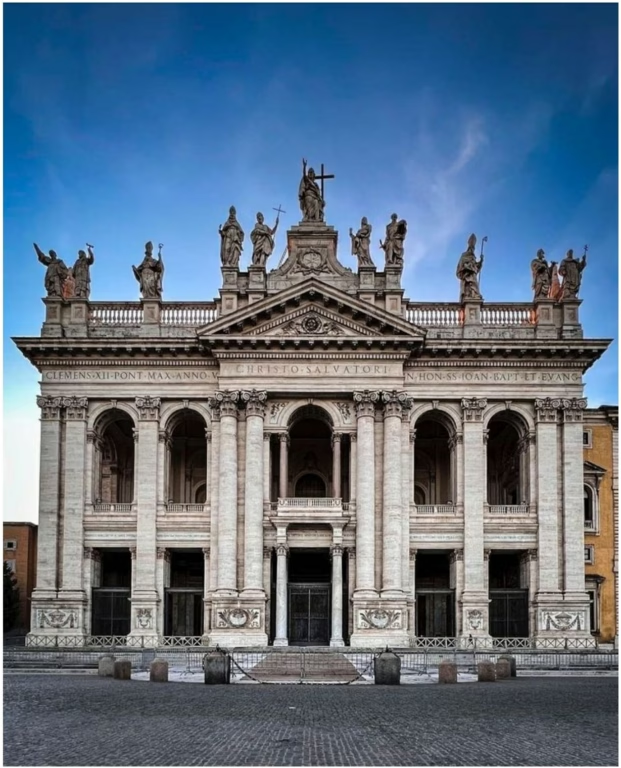
The Gospel reading of the day was chosen specifically on the occasion of the dedication of the Lateran Basilica, one of the four largest and most significant basilicas in Rome. Close to the Pope’s current residence we find Saint Peter’s Basilica in Vatican City. There is also The Basilica of Saint Paul Outside the Walls, and the Basilica of Saint Mary Major, where Pope Francis has been buried. The fourth is the Archbasilica Cathedral, the home parish and the seat of the Pope, also known as the Cathedral of the Most Holy Savior and of Saints John the Baptist and John the Evangelist in the Lateran, or Saint John the Lateran, or the Lateran Basilica for short. (1) Although the Pope usually celebrates Mass at Saint Peter’s Basilica, Saint John Lateran is the official cathedral of Rome and the mother church of the entire world. (1)
The history of the church building is as old as it is fascinating. In the year 64, during the tumultuous and cruel reign of the Roman Emperor Nero, the Christians were blamed for a devastating fire that started in the city of Rome. As a vengeance, Nero ordered a fierce persecution of the Christians. Saints Peter and Paul had been executed in this year and their remains eventually found permanent home under what is today the Basilica of Saint Peter and The Basilica of Saint Paul, respectively. (2)
In 65, Counsel-designate Plautius Lateranus participated in a plot to kill Nero. (1) When Nero learned of the plot, he ordered the execution of Plautius Lateranus. His palace and all his possessions have been confiscated. During the next 250 years, the palace was used by Roman Emperors for various purposes. (1) In 312, under the rule of Emperor Constantine, the palace was returned to Pope Militades who began a construction of a Basilica at this site. The building was named the “House of God” by Pope Sylvester, who dedicated it to “Christ the Savior” in 324. (1) This was the first and most important Catholic diocese at that time. It was richly decorated with gold and silver and protected by the Roman Emperor. During the Middle Ages, the Popes moved to Avignon, and then back to Rome. In the meanwhile, the cathedral fell into disrepair and was damaged by fire. This is why a new palace was built for the returning Pope on Vatican Hill, next to Saint Peter’s Basilica. (1)
As we celebrate the dedication of this important Cathedral, we ponder our holy places when we come together to encounter God. We remember our parishes, church communities, cathedrals, basilicas and other sacred sites.
In today’s Gospel, Jesus teaches us that the most important place where we encounter God is not a physical building but our souls. Going up to the temple in Jerusalem, Jesus saw a gruesome desecration of the outer chamber of this sacred space. Merchants have brought in cattle, sheep and doves to sell to people who have been buying these animals to offer them as a sacrifice for their sins. We recall that Jesus’ parents offered “two turtledoves or two young pigeons” in the temple for the purification and consecration rituals after his presentation in the Temple (Luke 2:21-40). This was the sacrifice required by the Law of Moses for families who could not afford to buy a more expensive animal, such as a lamb (Leviticus 12:8). It was not surprising that there were herds of animals mixed with the money changers who took opportunity to take advantage of the high volume of pilgrims during the High Festivities, such as the Passover. It appears that the Pharisees and the Scribes tolerated them inside the atrium, closer to the High Altar of the Holy of Holies, where only designated priests were allowed because they were part of the scheme of receiving part of the offerings and directly benefitted from a portion of the profits. The House of God was thus defiled by a mixture of interests, such as greed and avarice, least of which was to promote holiness.
Seeing the corruption, Jesus was consumed by rage. Not just indignation, but anger and zeal for the House of God took over his entire being. He found some cords, made them into a whip and with loud shouts and gestures, chased out the herds of animals. He ordered the keepers of the birds to get the birds out of there, and he overturned the tables of the money changers, pouring the coins on the ground and scattering their belongings. This was Jesus’ human side full of emotion for the love of God, fury for the shame of perverting the purpose of the house of the Lord from being a place of worship and prayer to that of rowdy trade and transactions. This was Jesus divine side as well with the intention of righting the wrong, purifying what has been defiled and making everything new. But the people, and the people in authority did not understand him. When they confronted him about his actions, they fully realized that this was Jesus, whom some people claimed was a miracle-maker, and some, that he was a prophet. Doubting and incredulous, they asked him for a sign. And Jesus replied with a sign that would be obvious to the faithful after his resurrection: “Destroy this temple, and in there days I will raise it up.” (John 2:19) Bu they did not understand that he was referring to the temple of his body and to his resurrection, three days after his death, and they mocked him: You are barely over thirty years old. This temple has been in construction for forty-six tears, longer than you were alive, and you think you can rebuild it in three days? They made Jesus look like a complete fool. But those that believed in him recorded his words and remembered them after his resurrection.
We may be reminded of the phrase, “burnt offerings he does not desire” (Psalm 51:16, Hebrews 10:5-7, Isaiah 1:11), which state that God did not take pleasure or desire in sacrifices and burnt offerings that were made according to the Law. He called his faithful to obey beyond mere obedience to the law; surpass it with love for the correct action and a virtuous life. God desires righteousness, mercy, and a contrite heart over a mere ritualistic sacrifice. (3) The verses also hint to the ultimate sacrifice of Jesus on the cross for the redemption of sins, and uniting our unavoidable sufferings with His, in a mysterious way. (4)
This example shows us that God cares for our sanctuaries. He cares for His creation, and cares for the most holy place where we encounter Him: our souls. He will not let it get corrupted. He will save it and defend it. This is our hope: After our death, Jesus will welcome us into the heavenly kingdom, and at the end of the time, restore us with our uncorrupted heavenly bodies for eternity. God cares for what is His. He keeps it, tends it, and guards it. Nothing that belongs to him will ever see corruption, for he is the God of the living.
Today’s Psalm (46), says it so beautifully:
“God is our refuge and strength,
a very present help in trouble.
Therefore, we will not fear, through the earth should change,
through the mountains shake in the heart of the sea.
There is a river whose streams make glad the city of God,
the holy habitation of the Most High.
God is in the midst of the city; it shall not be moved;
God will help it when the morning dawns.
The Lord of Hosts is with us;
the God of Jacob is our refuge.
Come, behold the works of the Lord;
See what awesome things he has brought on the earth.” (5)
Sources:
- My Catholic Life (2025). Feast of the Dedication of the Lateran Basilica, Rome. Retrieved from: www.mycatholic.life. Accessed: November 4, 2025.
- Melbourne Catholic (2021). The Tombs of Peter and Paul. Retrieved from: https://melbournectaholic.org. Accessed: November 4, 2025.
- Catechism of the Catholic Church (2025). Articles 1804 -1829. Human Virtues and Theological Virtues. Retrieved from: www.catholicculture.org. Accessed: November 4, 2025.
- Pope Francis (2024). Dilexit Nos. Encyclical Letter of the Holy Father Francis on the Human and Divine Love of the Heart of Jesus Christ. Retrieved from: www.vatican.ca. Accessed: November 4, 2025.
- Living with Christ (2025). Sunday Missal 2024-2025. Montreal: Novalis.