

On Easter Sunday, we reach the pinnacle of the Good News of the Gospel message. Jesus’ resurrection is the fulfillment of God’s victory over evil, death, and sin. It fulfills the Scriptural prophecies and anchors Jesus’ identity as the Messiah. However, while Jesus’ public ministry was witnessed by his contemporaries, the moment of His Resurrection was an act of God beyond what eyes have seen or ears have heard. It happened in the most private and secluded circumstances, shrouded in glorious mystery. What is available to us today is the testimony of the witnesses who have seen the empty tomb and who encountered the risen Lord—His disciples.
GOSPEL PASSSAGE: John 20:1-9
On the first day of the week, Mary of Magdala came to the tomb early in the morning, while it was still dark, and saw the stone removed from the tomb. So, she ran and went to Simon Peter and to the other disciple whom Jesus loved, and told them, ‘They have taken the Lord from the tomb, and we don’t know where they put him.’ So, Peter and the other disciple went out and came to the tomb. They both ran, but the other disciple ran faster than Peter and arrived at the tomb first; he bent down and saw the burial cloths there, but did not go in. When Simon Peter arrived after him, he went into the tomb and saw the burial cloths there, and the cloth that had covered his head, not with the burial cloths but rolled up in a separate place. Then the other disciple also went in, the one who arrived at the tomb first, and he saw and believed. For they did not yet understand the Scripture that he had to rise from the dead.
GOSPEL REFLECTIONS:
The Synoptic Gospels record that Jesus’ resurrection happened at the very end of the seventh day, the night of the Passover, three days after Jesus died on the cross and was laid to rest in a tomb near the hill of Golgotha. The significance of this “eighth day” can be appreciated in light of Creation; just as God rested on the Sabbath, the seventh day (Genesis 2:2-3), this eighth day represents a new creation. (1) It is a new dawn of hope and faith that seals the promise of Christ: “Destroy this body and in there days I will raise it up” (John 2:19). It hold the New Covenant of God: “I am the resurrection and the life. The one who believes in me will live, even though they die; and whoever lives by believing in me will never die” (John 11:25).
This revelation is physically anchored in Jerusalem. Since the fourth century, the Church of the Holy Sepulcher in Jerusalem has stood over the tomb of Jesus. Its construction began during the reign of the Emperor Constantine around 325-326 AD following his mother, Saint Helena’s pilgrimage to Jerusalem and identification of the site. (2) Two thousand years ago, this area was located just outside the city walls. It used to be a limestone hillside into which tombs of wealthy Jews, such as that of Joseph of Arimathea, were carved. The tombs faced to the east. Next to them was a garden with olive trees and grapevines. The tomb oversaw the hill of Calvary and Jerusalem’s Western City Walls. (3) The distance between the garden and the Temple was only a few hundred meters, with the Temple dominating the Jerusalem skyline. (4)
According to John, “At the place where Jesus was crucified, there was garden, and in the garden a new tomb, in which no one had ever been laid. Because it was the Jewish day of Preparation and since the tomb was nearby, they laid Jesus there.” (John 19:38-42). His body was carefully wrapped in linen cloths and spices. A large stone was rolled in front of the entrance to the tomb and soldiers were guarding it day and night.
The events preceding the Resurrection shake us with their emotionally charged load. Grief and loss linger in the air. Everything seems silent as profound darkness covers the site. Save for the soldiers, there is no one in the garden—as if it was the very end of the story of redemption.
Then, while it is still dark, the events shift. Led by grief, Mary of Magdala appears at the tomb. She likely came only to check on the site where she last saw Jesus’ dead body having been laid to rest, for she had no way of moving the stone alone, and the entrance had been sealed. To her surprise, she finds the tomb open and the soldiers gone. In shock, she runs to the disciples, who are still huddled behind closed doors in fear and grief.
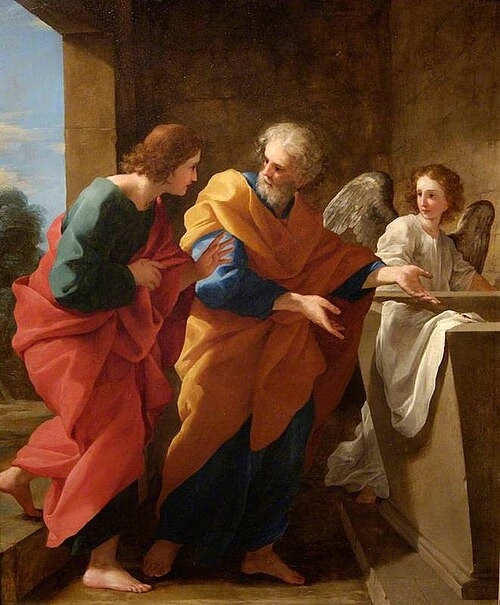
Two of them–Peter and John—immediately race to the tomb. John, being younger, runs faster and reaches the site first. He sees the linens, but pauses at the entrance, allowing Peter, as the leader of the apostles, to enter first. Inside, they find the burial cloths and the face cloth rolled up, placed aside in silence.
Though they had walked with Jesus for three years and witnessed His miracles, the disciples did not fully understand that He would rise from the dead. God’s victory had appeared in quiet of the night. It was only when Jesus appeared to Mary, and later to Peter and the twelve on numerous occasions, that the reality took hold. They ate with Him and talked with Him (Luke 24:13-35).
When Jesus appeared to Mary of Magdala and instructed her to tell the disciples, “Do not be afraid; go and tell my brothers to go to Galilee; there they will see me” (Matthew 28:10), and He met Peter on the shores of the Sea of Galilee, and sent him to “feed my sheep,” (John 21:17) that is when the disciples understood that Jesus was with them “until the end of time” (Matthew 28:20).
This first appearance was quiet, without spectacle. It stands in stark contrast to the end of times, when Jesus will return in glory and “every eye will see Him” (Revelation 1:7). On that first Easter Sunday, however, the apostles “…did not yet understand the Scripture, that he had to be risen.” (John 20:9). Therefore, Jesus met the disciples where they were at that point on their journey of faith. He did not impose the reality of the Resurrection on them but met them where they were, sent a message to them, instructed them, and later appeared to them, walked with them, and talked with them.
This is called the Divine Passive. (5) Jesus was patient, understood the disciples’ need to see, to touch, to witness the signs of His resurrection. From an initial fearfulness, lack of trust, grief, and disappointment, He let their inner eyes of faith open slowly. He waited for the inner spark to be kindled within them, until their “eyes were opened” and they recognized Him.
First, they had only a vague understanding of the closeness of Jesus, then they understood the reality of His presence. Their hearts were burning as He explained the Scriptures to them. (Luke 24:13-35). As they confirmed their understanding with their community, their joy became courage, and there was hope where there was only discouragement before. Encountering the Risen Lord changed the disciples. It was life being born again when there seemed to be only darkness and death before. (5)
In the same way as Jesus met the disciples where they were, and as they were, without imposition, without condemnation, and without recrimination, He waits for us today. He waits lovingly and patiently. When we invite Him, He walks with us, talks with us, and explains the Scriptures until we feel the presence of God and recognize Him with our inner eyes of faith.
The clear message of the Resurrection is that Jesus will not let us experience corruption; He is the definitive promise of eternal life.
Sources:
- Peters, T. (2026). 20:1-9, Easter Sunday, Gospel Reflection, Year A, Fr Tim Peters. Retrieved from: https://www.google.com/search?q=tim+peters%2C+John+20%3A1-9&sca_esv
- Lidman, M. (2023). Round-the-clock excavations at Church of Holy Sepulcher yields historical treasures. Retrieved from: https://www.timesofisrael.com/round-the-clock-excavations-at-church-of-holy-sepulchre-yield-historical-treasures/ Accessed: March 30, 2026.
- Harrod, C. (2025). Where is Jesus’ Empty Tomb? Retrieved from: https://stpaulcenter.com/posts/where-is-jesus-empty-tomb. Accessed: March 30, 2026.
- Zivotofsky, A. (2023). What’s the Truth About…The Kotel being Judaism’s Holiest Site? Jewish Action. Retrieved from: https://jewishaction.com/jewish-world/israel/whats-the-truth-about-the-kotel-being-judaisms-holiest-site/. Accessed: March 30, 2026.
- Brother Matthew (2020). Taizé Bible Reflection: Luke 24 :13-35, the disciples on the road to Emmaus. Retrieved from: https://www.youtube.com/watch?v=3kx2sGEo_1s. Accessed: March 31, 2026.