

The miracle of the resurrection of Lazarus underlines the greatest hope of Christian mystery—the resurrection. Today’s Gospel offers a revelation with poignant imagery about God’s reign. The miraculous signs that Jesus presents to us, of which the raising of Lazarus is the seventh miracle, is a testimony of God’s glory and His blessings.
SUNDAY GOSPEL: John 11:1-45
“Now a certain man was ill, Lazarus of Bethany, the village of Mary and her sister Martha. Mary was the one who anointed the Lord with perfume and wiped his feet with her hair; her brother Lazarus was ill. So, the sisters sent a message to Jesus saying, ’Lord, he whom you love is ill.’ But when Jesus heard it, he said, ‘This illness does not lead to death; rather it is for God’s glory, so that the Son of God may be glorified through it.’ Accordingly, though Jesus loved Martha and her sister and Lazarus, after having heard that Lazarus was ill, he stayed two days longer in the place where he was.
Then after this he said to the disciples, ‘Let us go to Judea again.’ The disciples said to him, ‘Rabbi, the Jews were just now trying to stone you, and are you going there again?’ Jesus answered, ‘Are there not twelve hours of daylight? Those who walk during the day do not stumble, because they see the light of this world. But those who walk at night stumble, because the light is not in them.’ After saying this, he told them, ‘Our friend Lazarus has fallen asleep, but I am going there to awaken him.’ The disciples said to him, ‘Lord, if he has fallen asleep, he will be all right.’ Jesus, however, had been speaking about his death, but they thought that he was referring merely to sleep. Then Jesus told them plainly, ‘Lazarus is dead. For your sake I am glad I was not there, so that you may believe. But let us go to him.’ Thomas, who was called the Twin, said to his fellow disciples, ‘Let us also go, that we may die with him.’
When Jesus arrived, he found that Lazarus had already been in the tomb four days. Now Bethany was near Jerusalem, some two milesaway, and many of the Jews had come to Martha and Mary to console them about their brother. When Martha heard that Jesus was coming, she went and met him, while Mary stayed at home. Martha said to Jesus, ‘Lord, if you had been here, my brother would not have died. But even now I know that God will give you whatever you ask of him.’ Jesus said to her, ‘Your brother will rise again.’ Martha said to him, ‘I know that he will rise again in the resurrection on the last day.’ Jesus said to her, ‘I am the resurrection and the life. Those who believe in me, even though they die, will live, and everyone who lives and believes in me will never die. Do you believe this?’ She said to him, ‘Yes, Lord, I believe that you are the Messiah, the Son of God, the one coming into the world.’
When she had said this, she went back and called her sister Mary, and told her privately, ‘The Teacher is here and is calling for you.’ And when she heard it, she got up quickly and went to him. Now Jesus had not yet come to the village but was still at the place where Martha had met him. The Jews who were with her in the house, consoling her, saw Mary get up quickly and go out. They followed her because they thought that she was going to the tomb to weep there. When Mary came where Jesus was and saw him, she knelt at his feet and said to him, ‘Lord, if you had been here, my brother would not have died.’ When Jesus saw her weeping, and the Jews who came with her also weeping, he was greatly disturbed in spirit and deeply moved. He said, ‘Where have you laid him?’ They said to him, ‘Lord, come and see.’ Jesus began to weep. So the Jews said, ‘See how he loved him!’ But some of them said, ‘Could not he who opened the eyes of the blind man have kept this man from dying?’
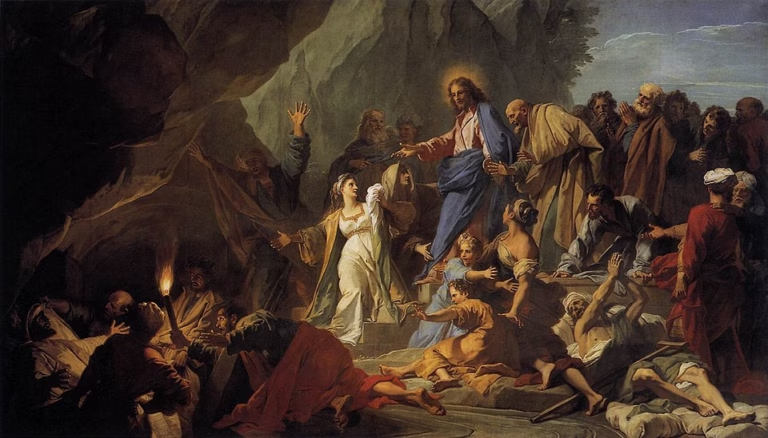
Then Jesus, again greatly disturbed, came to the tomb. It was a cave, and a stone was lying against it. Jesus said, ‘Take away the stone.’ Martha, the sister of the dead man, said to him, ‘Lord, already there is a stench because he has been dead four days.’Jesus said to her, ‘Did I not tell you that if you believed, you would see the glory of God?’ So, they took away the stone. And Jesus looked upward and said, ‘Father, I thank you for having heard me. I knew that you always hear me, but I have said this for the sake of the crowd standing here, so that they may believe that you sent me.’ When he had said this, he cried with a loud voice, ‘Lazarus, come out!’The dead man came out, his hands and feet bound with strips of cloth, and his face wrapped in a cloth. Jesus said to them, ‘Unbind him, and let him go.’”
GOSPEL REFLECTIONS:
Each of Jesus’ miracles reminds us of the Exodus, which recalls the signs and wonders that God performed to deliver His people from slavery, but instead of plagues, these are signs and wonders that are the testimony to Jesus’ identity. Jesus is the Savior of the world, and He leads His people from slavery to sin and death to the freedom of eternal life. (1)
In last week’s Gospel reading, we read that Jesus cured the blind man. He did this on a Sabbath, a day holy to the Jews in honor of God the Father, who created the world and rested on the Sabbath, establishing a divine rhythm for the whole of creation. Jesus, who healed on that day, was not acting in disobedience to the Sabbath, but as God’s chosen One, the Messiah, reflected the perfection of the divine creation manifested in the healing of the blind man. (2)
In today’s Gospel, Jesus performs His greatest and last miracle before His crucifixion, which is to foreshadow His own death and resurrection. This is to indicate that God has power over death and at the appointed end time of the world, when the Messiah will return in glory, those who believe in Him will be reborn into eternal life, not just in their spirit, but as Jesus promised, their heavenly bodies.
The miracle took place in Bethany, only two miles from Jerusalem. The shortness of the distance between the two locations tells us how close we have journeyed with Jesus on His mission on the way to the cross and the place of His resurrection.
The story of the resurrection of Lazarus, which reveals deep theological truths, begins with introducing the main characters: Mary, Martha, and Lazarus, who are siblings and friends of Jesus. We learn that Jesus knew Lazarus and was his friend. They welcomed Jesus in their home during His journeys, probably on several occasions while He stayed in Jerusalem or was teaching in the countryside. Mary is Mary of Magdala whom Jesus healed and who devotedly washed His feet, wiped them with her hair, and anointed Him with an expensive perfume which even some of the disciples found excessive (John 12:1-8). She had profound devotion for the Lord and honored Him by preparing His body for the suffering He would face, and for His death, which the apostles yet failed to comprehend. Mary sat at the feet of the Lord, listened to Him and learned from Him, while Martha prepared the meals (Luke 10; John 11-12). Thus, Mary, Martha and Lazarus were close and devoted friends of the Lord.
The action starts to rise when we learn that the sisters of Lazarus, Mary and Martha, send a message to Jesus that Lazarus is very ill. Like us, when we have a seriously ill relative, there is a sense of urgency about informing the closest family and requesting that they come to see the ill person, especially when there is a risk that they may die. Knowing Jesus as much as His friends did, Martha and Mary believed that Jesus could heal Lazarus. This is similar to when we pray to God for our ill relative, and we ask God to strengthen them, and to heal them, if possible, or to strengthen us as we care for them so that they may recover.
However, Jesus, who was teaching and healing somewhere else at the time, did not leave at once to be with Lazarus in his last hours. Instead, He stayed two more full days at the place where He was, and He said to the disciples that this illness will not lead to Lazarus’ death but to something that God wants to reveal through his illness. The disciples accepted this explanation without any questioning because they fully trusted Jesus and believed in His word.
The action continues to rise when we find out from the text that Lazarus was in fact dying, and Jesus stayed away on intention. Led by the Holy Spirit, and in communion with the Father, Jesus intended to show His disciples, and us, something great about God’s power and God’s plans. He wanted to wait until Lazarus was dead, in order for the power of God to raise him to life. So, after two days, Jesus said to His disciples that they are all going to Judea again. At this point, they started not to understand His reasons.
They were somewhere in the north of Israel, perhaps near Galilee. Judea and Jerusalem were where Jesus already healed the blind man, and where He had a confrontation with the Jewish authorities who failed to accept Him as the Messiah. They wanted to stone Him at least on two occasions when Jesus claimed His divinity and they considered that a blasphemy. He made the statements: “Before Abraham was, I am”; “I am the Son of God” and “The Father and I are One” (John 8:58 and John 10:31-33). He did this always in the context of a miraculous healing that the Jewish authorities could not explain and could not refute but could not accept. Jesus was going close to Jerusalem again to make a clear statement about His mission and identity for the third, and last time.
So, the disciples were perplexed, and Thomas, who was also known as the Twin, said, “Let us all go, that we may die with him.” (John 11:16). They were aware that Jesus was in mortal danger in Judea. But this was not going to stop Him from going to Judea. The occasion of Lazarus’ death was the impetus and the sign that the Holy Spirit gave to Jesus to now start walking toward Jerusalem and the place of His crucifixion and death, obeying the eternal promise of the Father that He will rise from the dead. His human will was entirely aligned with His divine will and purpose.
Jesus explained to the disciples that they must go to Bethany to see Lazarus who has “fallen asleep.” (John 11:11). The disciples, still in the mindset of the work they were doing, thought that Jesus was proposing a friendly visit to see Lazarus who was asleep. Jesus then told them plainly that Lazarus was dead and the purpose of the visit was to accomplish the will of God and show the disciples something to increase their faith and prepare them for the upcoming trials that Jesus would face in Jerusalem. “…I am going there to awaken him,” said Jesus (John 11:11). Besides, “Those who walk during the day do not stumble, because they see the light of this world. But those who walk at night stumble, because the light is not in them” (John 11:9-10)—Jesus said this in reference to His earlier statement that He is the light of the world, and fully understanding that He was nearing the end of His mission on Earth, where He wanted to use the last hours to the fullest.
Without fully understanding Him, but believing in Him, the disciples went with Jesus to Bethany. This part represents our lack of full comprehension of God’s ways when we are ill or attending an ill person. We may be praying for a speedy recovery, but divine healing may not be perceptible, or the intervention may be delayed as far as we can understand it.
There is a very beautiful statement by St. Thérèse of Lisieux which applies very well to Jesus’ reasoning in this story:
“It’s Jesus’ secret, but I believe that He is preparing very beautiful things in His little house… He has so much to work that it seems He forgot you… but no, without being seen, He looks at you through the window…. He likes to see you in the desert, having no other office than to love while suffering without even feeling that you love!” (3)
As they got close to the entrance of the city, they encountered Martha who greeted Jesus with the words, “Lord, if you had been here, my brother would not have died.” (John 11:21). Jesus then told her that Lazarus will rise again. To this she replied, “Lord, I know that he will rise again in the resurrection on the last day” (John 11:24). Martha knew this from her Jewish faith and from listening to Jesus. But Jesus made a profound theological revelation about Himself which was to anchor Him as the Messiah: “I am the resurrection and the life. Those who believe in me, even though they die, will live, and everyone who believes in me will never die.” (John 11:25-26). This is a profound revelation of Jesus being the Savior of the world, the Messiah, who was present to Martha and whom she recognized with the words: “Yes, Lord, I believe that you are the Messiah, the Son of God, the one coming into the world.” (John 11:27) This was Martha’s turn to accept Jesus with her whole being.
Mary also came to meet Jesus, and her first words to Him were the same as those of Martha: “Lord, if you had been here, my brother would not have died.” (John 11:32). Her statement echoes those of humanity, here repeated for the second time: “Lord, if you had been here with us, you could have prevented this from happening.” And Jesus’ reply is to say, “I am here.” Seeing Mary weep, Jesus was greatly disturbed and He, in His human nature, felt an overwhelming emotion of grief. He was weeping. Other than His agony in the Garden of Gethsemani, this is the only time we read about Jesus weepingin sorrow (Matthew 26:36-46, Mark 14:32-46, and Luke 22:39-46).
He asked them where the tomb was, and having been warned by Martha, whom we always encounter as rational and prudent, we learn that the body has been in the tomb already four days, “…There is already a stench…” (John 11:39). This is to say to us that from a state of being asleep—which the Bible reminds us is a transition state, such as when God created human beings and He made Adam sleep while He formed Eve from one of his side ribs (Genesis 2), or sending a deep sleep over the prophets and people He entrusted with a great mission, or for their protection (i.e., Abram in Genesis 15:12; Daniel 8:18; or Job 33:15-17; Isaiah 29:10; Saint Joseph in Matthew 1:20-21 and Matthew 2:13)—Lazarus had passed and was really dead. This means to us that even in death, God can have a purpose in the manner of restoration.
The climax of the story is when Jesus stands in front of the tomb and calls for Lazarus. This action represents how God calls to us by our names, personally, deeply, and imploringly: “Lazarus, come out!” (John 11:43) And Lazarus came out, his “…hands and feet covered with strips of cloth, and his face wrapped in a cloth” (John 11:44).
The dead man heard God’s voice and obeyed. He could barely walk, he could barely see but followed the light out of the cave where he was laid out to the light. We see how Jesus here embodied the Light of the World.
In the falling action, Jesus asks those who are standing there astounded: “Unbind him and let him go.” (John 11:44) This is the sign that Jesus gave to reveal that God frees us from the power of death and sin and leads us to freedom. (1) Our potential freedom, our limited freedom, what God gave us, is necessary to choose to walk toward the light. This light, although it may be revealed with help from others, such as when they unbound Lazarus and removed the cloth from his face, is a healing mission of God. It does not happen in a distant land, far away and removed from us, but here and now, where God knows us, where we call upon His name, and He is present.
Even if we call on His name for the sake of a loved one who may not be able to call by themselves, He is there. He acts and He directs the healing. He is alive and He is at work.
The raising of Lazarus was the last sign that Jesus gave which was to begin the fulfillment of the prophecy that He will give His life for the life of God’s people. (1) This miracle leads us into the Passover. The Passover leads to the resurrection and eternal life. The revelation God gives us in this reading is that our renewal is at hand, and our healing is at hand. It’s happening now.
In the Song of Songs, King Solomon shares a beautiful imagery in a Springtime Rhapsody: “My beloved is like a gazelle or a young stag. Look, there he stands behind our wall, gazing in at the windows, looking through the lattice.” (Song of Solomon 2:9)
Sources:
- Peters, T. (2026). John 11: The Gospel of John, The Resurrection, Catholic Bible Study, Fr. Tim Peters. Retrieved from: https://www.youtube.com/watch?v=0s2zRDCQ5gA Accessed: March 19, 2026.
- Peters, T. (2026). Fourth Sunday of Lent, Year A, Gospel Reflection, Laetare Sunday, Fr. Tim Peters. Retrieved from: https://www.youtube.com/watch?v=9d4vnes3dXs. Accessed: March 19, 2026.
- Thérèse of Lisieux, St. (1988). St. Thérèse of Lisieux: General correspondence (Vol. 2) (J. Clarke, Trans.). Institute of Carmelite Studies. (Original work published 1894).