
Fraternal correction is part of the life of a Chritian. Is is one of the works of mercy. To have the courage to correct the brother or sister to live a loving life.
Gospel Readings: Matthew 18:15-20
“Jesus said to his disciples: “If your brother sins against you, go and tell him his fault between you and him alone. If he listens to you, you have won over your brother. If he does not listen, take one or two others along with you, so that ‘every fact may be established on the testimony of two or three witnesses.’ If he refuses to listen to them, tell the church. If he refuses to listen even to the church, then treat him as you would a Gentile or a tax collector. Amen, I say to you, whatever you bind on earth shall be bound in heaven, and whatever you loose on earth shall be loosed in heaven. Again, amen, I say to you, if two of you agree on earth about anything for which they are to pray, it shall be granted to them by my Heavenly father. For where two or three are gathered together in my name, there I am in the midst of them.”
GOSPEL REFLECTIONS:
Today’s Gospel reading touches on two central topics: reconciliation and prayer. While Bible scholars tend to emphasize one or the other, we could argue—after examining both—that reconciliation and prayer are included together in this Gospel passage because both are essential for living in community and growing together as Children of God.
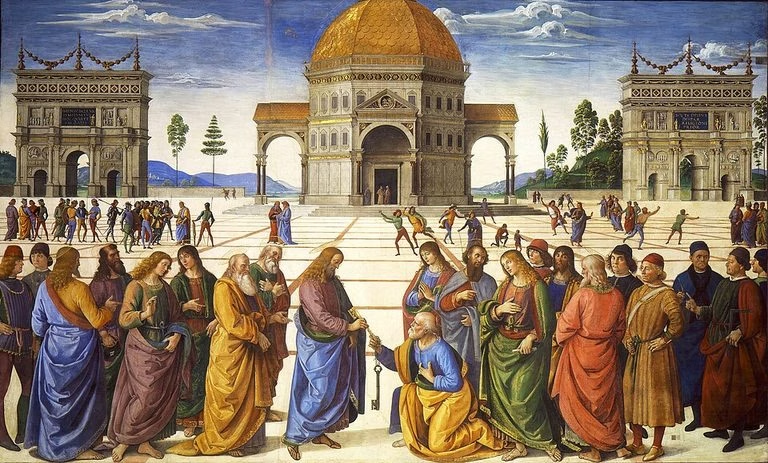
The first part of the Gospel reading, found in Matthew 18:15-18, deals with the issue of authority—specifically, Church authority. Jesus gave the “keys” to Peter, authorizing him to be the leader of the apostles and the head of the new Church. In Matthew 16:19, following Peter’s Spirit-guided declaration of Jesus’ divinity, we read Jesus’ words: “I will give you the keys of the kingdom of heaven, and whatever you bind on earth will be bound in heaven, and whatever you loose on earth will be loosed in heaven.” The same promise is later repeated to the rest of the disciples who were with Peter: “Truly, I tell you, whatever you bind on earth will be bound in heaven, and whatever you loose on earth will be loosed in heaven.” (Matthew 18:18).
The first part of this message establishes the authority of the apostles to serve as representatives of Jesus. Today, this representation continues through the offices of the Pope and the Bishops, and is further carried out by priests. While the Pope serves as the “servant of the servants of God,” the bishops likewise carry magisterial and administrative duties. This title was first used by Pope St. Gregory the Great (Pope from 590 to 604 AD). (1) He adopted it a sign of humility following the Gospel passage: “Whoever wants to become great among you must be your servant, and whoever want to be first must be you r slave—just as the Son of Man did not come to be served, but also to serve…” (Matthew 20:26-28). Over the centuries, these principles have guided the Church hierarchy and shaped how priests carry out their ministry of proclaiming the Gospel and administering the sacraments for the benefit of the people of God.
The Sacrament of Reconciliation was instituted by Jesus as a means of reuniting God’s people and providing healing after ruptures or transgressions lead them away from the Gospel message. As finite and fallible individuals, we are always in need of growth toward perfection. This applies not only to the person in the pew, but to the Pope, the bishops, the clergy, and the acolytes—in other words, to one and all. Mistakes, or sins, do not merely hurt the person who commits them by creating a willful shift away from God; they also harm the entire community. Yet, out of these imperfect people—these finite pieces—God desires to shape His Church to be His “perfect bride.” (CCC 796, 808; 2)
When we are truly in union with God and betrothed to Him, we take our freedoms and responsibilities seriously—not merely by following rules or Church teachings, but by actively living the Gospel message in our daily lives. Participation in the Sacrament of Reconciliation allows us to mend our broken relationships and gain strength in our spiritual journey toward holiness.
In this regard, Jesus’ words offer clear guidelines on how to handle those who have sinned or sinned against us. Rather than confronting them in anger, calling them out, pointing fingers, or publicly humiliating them, Jesus instructs us to handle these matters privately: “If another member of the Church sins against you, go and point out the fault when the two of you are alone. If the member listens to you, you have regained that one.” (Matthew 18:15).
Jesus favors a dialogue that is candid, private, and grounded in truth. It addresses the facts, the nature of the wrong, its impacts, and possible path toward repentance and growth. This process is known as “fraternal correction,” and it is one of the spiritual works of mercy. (CCC 2447, 1829; 2) Acting in good faith and reflecting on our understanding of the Gospel, we examine our own conscience before approaching another person. This open conversation helps them reflect on their own actions and consider how to make things right. Such conversations are not meant to be judgmental or condemning; rather, they gently point out mistakes so they can be corrected. In doing so, there is an opportunity to foster new insights and mutual understanding that allow everyone involved to move forward.
However, if this initial approach is unsuccessful because “you are not listened to…”, Jesus instructs: “…take one or two others along with you, so every word may be confirmed by the evidence of two or three witnesses.” (Matthew 18:16). This aligns with ancient Jewish custom—as reflected in the Book of Daniel, where a tribunal required two or three witnesses, and in the Book of Sirach (Ecclesiasticus) regarding the prohibition against bearing false witness. (3) In this way, testimony can be heard, facts can be verified, and reasonable actions can be taken to repair the rupture.
If the individual still resists, Jesus instructs: “…tell it to the church, and if the member refuses to listen even to the church, let such a one be you like a Gentile or a tax collector.” (Matthew 18:17). These are strong words, as Gentiles and tax collectors were considered “unclean” by the Jewish population of the time. However, before assuming that Jesus is encouraging harsh judgment or condemnation, we must remember that He called Matthew—a tax collector—to become one of His apostles, and that He came to save sinners rather than condemn them. Therefore, it is more accurate to say that in such cases, we are called to pray for those who refuse to listen and entrust their fate to God. What cannot be changed by human will alone remains possible through the power of God.
Finally, the concluding section of this Gospel passage focuses on prayer. Here, Jesus makes a profound promise: “Again, truly I tell you, if two of you agree on earth about anything you ask, it will be done for you by my Father in heaven. For where two or three are gathered in my name, I am there among them.” (Matthew 18:19-20). Prayer is our primary means of reconciling with God and drawing closer to the Father through Him; it is an indispensable way to remain united with God in heart and mind.
The relationship between these themes—teaching the Gospel, living the Gospel, and engaging in prayer—is thoughtfully captured in the following reflection by the late Pope Francis: (4)
“The Lord promised to Peter his own way—a way to the cross—a journey of total self-abandon and full confidence in Him. Interesting how we read in the other text that Peter confessed that Jesus is the Son of God—and he made his confession with the power of the Holy Spirit—and later lost his orientation. So, when Jesus spoke of the cross then Peter fell under the weight of human thinking and at the cross, when Jesus turned, and he saw that who was standing there was not Peter, it was John. What happened to Peter? He was nosy, and when Jesus talked about the cross, he changed the topic and he inquired about what’s going to happen to John. He was comparing himself with John. Just when he was put in charge, he was already comparing himself with John, forgetting the words of Jesus. This happens to all of us. But the Lord holds us up with his power and, including when we have to be martyrs, guides us by the hand. And I’d like to finish with a thought about the martyrs of today. There are more martyrs today than at the beginning of the Church. Christian martyrs who loose their lives because of their faith in Jesus, those who are in prison but trust in Jesus, our brothers and sisters, we are a Church of martyrs, and that is what triumphs, not the golden bars in the bank. This is what is victorious—the testimony of the martyrs—because martyr means witness. We mentioned that its those who give their lives, but it is also those men and women who work hard every day to educate their children and give an example are martyrs. ‘No, father, martyr is who is killed because of their faith.’ –Martyr means witness, to be a martyr is to give witness. This is translation from the Greek word. Everyone who gives a testimony of Jesus is a martyr. And this is what moves the Church forward. May God bless you, and do not forget to pray for me.”
Ultimately, the Gospel calls us to humility, to a prayerful life rooted in its teachings, and to earnest prayer for those most in need of God’s mercy—both those who suffer and those who spread suffering in the world.
Sources:
- Markus, R. A. (1997). Gregory the Great and His World. Cambridge University Press. https://doi.org/10.1017/CBO9780511582776
- Catholic Church. (2000). Catechism of the Catholic Church (2nd ed.). Vatican: Libreria Editrice Vaticana. (Paras. 796, 808).
- Peters, T. (2026). Matthew 18:15-20: 23rd Sunday in Ordinary Time, Year A. Retrieved from: https://www.youtube.com/watch?v=d8a5rqgGx24. Accessed: September 4, 2026.
- Vatican News (2021). Excerpt from an Interview in Spanish with Pope Francis by Noel Diaz [Tanslated by Maria Marshall]. Retrieved from: https://youtu.be/qtGDRHMnn4s?si=ReLArReoBQDlcyac