Confessing Jesus as Christ with the help of the Holy Spirit helps us mature spiritually: it prepares us to face our suffering, carry our cross, and understand the nature of the mission God entrusts to us.
GOSPEL PASSAGE: Matthew 16:13-20
Jesus went into the region of Caesarea Phillipi and he asked the disciples, “Who do people say that the Son of Man is?” They replied, “Some say John the Baptist, others Elijah, still others Jeremiah or one of the other prophets.” He said to them, “But who do you say that I am?” Simon Peter said in reply, “You are the Christ, the Son of the Living God.” Jesus said to him in reply, “Blessed are you Simon, Son of Jonah. For flesh and blood has not revealed this to you, but my Heavenly Father. And so I say to you, you are Peter, and upon this rock I will build my church, and the gates of the netherworld shall not prevail against it. I will give you the keys to the kingdom of heaven. Whatever you bind on earth shall be bound in heaven; and whatever you loose on earth shall be loosed in heaven.” Then he strictly ordered his disciples to tell no one that he was the Christ.”
GOSPEL REFLECTIONS:
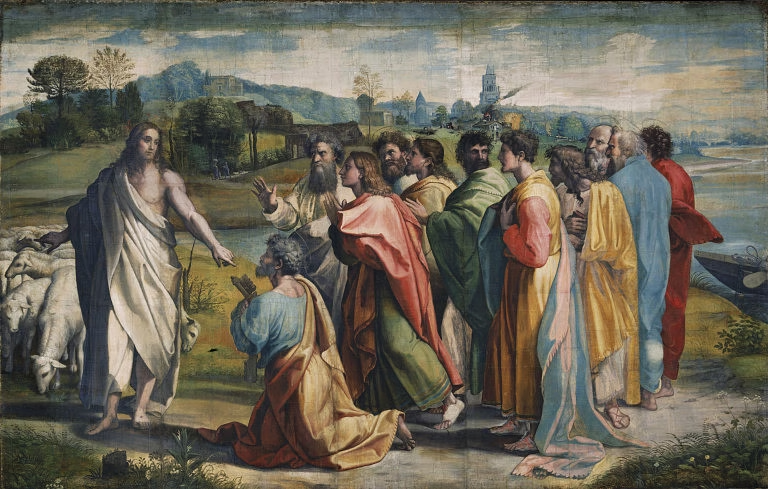
In today’s Gospel reading, we follow Jesus to the pinnacle of His journey before He turns directly toward Jerusalem to face the cross. This moment marks a key confession of faith by the Apostles, voiced by Peter, their leader and spokesperson. Here, we see that the Holy Spirit worked in the Apostles and helped them understand Jesus’ ministry to a certain degree. However, much remains for them to learn from Jesus before they can confidently announce Him as the Messiah to the world.
Jesus meets them where they are: at the foot of Mount Hermon near Caesarea Philippi in northern Israel—a region heavily influenced by Gentile culture and pagan worship. (1) Here, Jesus engages the Apostles in a discourse that sets them apart from the world because it centers on the Kingdom of God. This conversation is significant: Jesus affirms His identity as the Messiah, appoints Peter as the leader of the Apostles, and establishes him as a shepherd over God’s people on earth. Peter’s role is that of a viceroy or governor working in close collaboration with Jesus, the true King of the Kingdom of God. (1)
Jesus then explains what this kingship entails: sacrificial service (Matthew 16:21). From this point forward, He prepares them for His upcoming suffering, death, and resurrection. Although the disciples can affirm that Jesus is the Messiah because of His miracles, Peter and the others are not yet able to comprehend the reality of the cross and the suffering that lies ahead. On their journey with Jesus, they have come far, but they still have much further to go.
These men have traveled alongside Jesus, leaving behind their homes and professions. They have seen Him perform miracles, heal the sick, feed thousands, and walk on water. They have also witnessed Him opening the Kingdom to the Gentiles. Jesus asks them a seemingly casual question: “Who do people say that the Son of Man is?” (Matthew 16:13). By referring to Himself as the “Son of Man,” Jesus immediately connects His identity to Daniel’s vision in Daniel 7:13–14:
“I saw one like a human being coming with the clouds of heaven. And He came to the Ancient One and was presented before him. To him was given dominion and glory and kingship, that all peoples, nations, and languages should serve him. His dominion is an everlasting dominion that shall not pass away, and his kingship is one that shall never be destroyed.” (1)
As they pass through this foreign territory, a place filled with pagan shrines and a massive cave rock formation dedicated to Pan, known in the ancient world as a literal entrance to the underworld, Jesus asks what the crowds are saying about Him. (1)
The disciples report that some view Him as John the Baptist, Elijah, Jeremiah, or another prophet. Jesus then prompts them to move beyond surface-level talk with a direct, rhetorical question: “But who do you say that I am?” (Matthew 16: 15). He challenges them to reflect not just on popular opinion, but on what they deep down truly believe.
Peter stands up among the Apostles and replies, “You are the Christ, the Son of the Living God” (Matthew 16:16). With this statement, Peter declares that Jesus is the Messiah, the Son of God, and God’s Anointed One. (1) This confession connects back to God’s covenant with David in 2 Samuel 7:10–16, where God swore that a successor would sit on David’s throne forever. (1)
Jesus responds by praising Peter:
“Blessed are you, Simon son of Jonah. For flesh and blood has not revealed this to you, but my Heavenly Father. And so I say to you, you are Peter, and upon this rock I will build my church, and the gates of the netherworld shall not prevail against it. I will give you the keys to the kingdom of heaven. Whatever you bind on earth shall be bound in heaven; and whatever you loose on earth shall be loosed in heaven” (Matthew 16:17-19).
First, Jesus affirms Peter’s identity as the son of Jonah, noting that he could only have made this confession through the power of the Holy Spirit. Jesus then changes Simon’s name to Peter, meaning “rock.” Throughout Scripture, a name change signifies a new calling and vocation—just as Abram (the exalted father) became Abraham (The father of many), Sarai (my princess) became Sarah (a princess for the people of God), and Jacob (the usurper) became Israel (a people governed by God). (1)
Jesus gives Peter a clear mission: to act as the vicar of Christ on earth, leading the Apostles and guiding the Church as a servant leader. God Himself is often described as a rock because He provides security, stability, protection, and salvation. (1) Standing right before the dark caverns associated with underworld pagan worship, Jesus’ promise that the gates of the netherworld will not prevail carries profound visual power. In addition, Jesus gives Peter the “keys to the kingdom of heaven” (Matthew 16:19). The giving of keys draws directly on the imagery of Isaiah 22, where the king entrusts the keys of the house to a trusted steward or prime minister. (1)
Jesus also grants Peter the authority “to bind and to loose.” In this context, this signifies the authority to teach, to make binding decisions, and to forgive sins in Jesus’ name through the power of the Holy Spirit. Strengthened by the Spirit, Peter would eventually proclaim the Good News to all and declare that Gentiles are co-heirs in the Kingdom (Acts 10–15).
Yet, this moment of supreme spiritual insight is immediately followed by human frailty. When Jesus goes on to explain that He must suffer and die in Jerusalem, Peter pulls Him aside and tries to restrain Him—prompting Jesus’ famous rebuke: “Get behind me, Satan!” (Matthew 16:23). Peter readily accepted Jesus as Messiah, but he initially rejected the cross. Jesus uses this moment to issue a universal call to discipleship: “If anyone would come after me, let him deny himself and take up his cross and follow me” (Matthew 16:24). He reminds Peter—and all of us—that true leadership and faith require embracing the cross through daily self-denial and sacrificial love.
Historical tradition records that Peter served as Bishop of Antioch for 7 years and Bishop of Rome for 25 years. He was ultimately martyred during the reign of Nero, choosing to be crucified upside down because he felt unworthy to die in the same manner as Christ. (1)
From this moment in the Gospel, Apostolic Tradition was born. What began in the ministry of Peter eventually became what is known today as the seat of the Holy See. The popes over the centuries have carried on this office and mission, symbolized by the crossed keys: gold representing authority over spiritual matters of faith, and silver representing stewardship over the temporal administration of the Church. (1)
In setting up this structure, Jesus establishes the Church and places Peter at its head as the Vicar of Christ—a role carried out today by the Pope, alongside the bishops in teaching and governance (the Magisterium), and priests in administering the Sacraments. Jesus shows that He is far more than a prophet; He is the ultimate King, Priest, and Prophet. Yet, His leadership model is rooted entirely in servant leadership. (1)
The Church, as the Bride of Christ, exists to serve the people of God. Its mission is to make the Kingdom present on earth and to guide souls toward salvation and eternal life. Though the Church is an institution run by human beings—and thus subject to human frailty, vulnerability, and finiteness—it is sustained by spiritual means through the Sacraments and the power of the Holy Spirit. Through these gifts, Christ fulfills His promise that the powers of the netherworld will never prevail against it.
Ultimately, Jesus’ encounter with Peter points directly to our own lives. It is precisely when we face the cross and confront suffering that the question of our inner belief surfaces and truly matters: Who do we say that Jesus is? Our answer to that question gives us the spiritual strength to face life’s heaviest trials. When we confess Christ not just in moments of glory, but in the midst of our pain, we are equipped to confront suffering, endure the cross, and spiritually overcome it through His victorious grace. Through this process, we mature in faith and come to understand something much deeper about Christ, as well as the mission entrusted to us by God.
Near the end of His earthly life during His trial, Jesus was asked once again by the High Priest, “Are you the Christ, the Son of God?” (Matthew 26:63) Jesus affirmed, “You have said so,” adding, “From now on you will see the Son of Man seated at the right hand of Power and coming on the clouds of heaven” (Matthew 26:64)—prompting the High Priest to tear his robes in response.
The world will always express many different opinions about Jesus, and human theories will vary. However, when the Holy Spirit moves in our hearts to bring us to a firm conviction of who He truly is, Jesus meets us in that conviction—granting us the strength we need to pick up our cross and follow Him.
Sources:
- Peters, T. (2026). Matthew 16:13-20. 21st Sunday in Ordinary Time. Year A, Gospel Reflections, Fr. Tim Peters. Retrieved from: https://www.google.com/search?q=father+tim+peters+on+Matthew. Accessed: August 19, 2026.