

Where is God when we suffer, when we struggle, and when we face dangers where escape seems impossible?
GOSPEL PASSAGE: Matthew 14:22-33
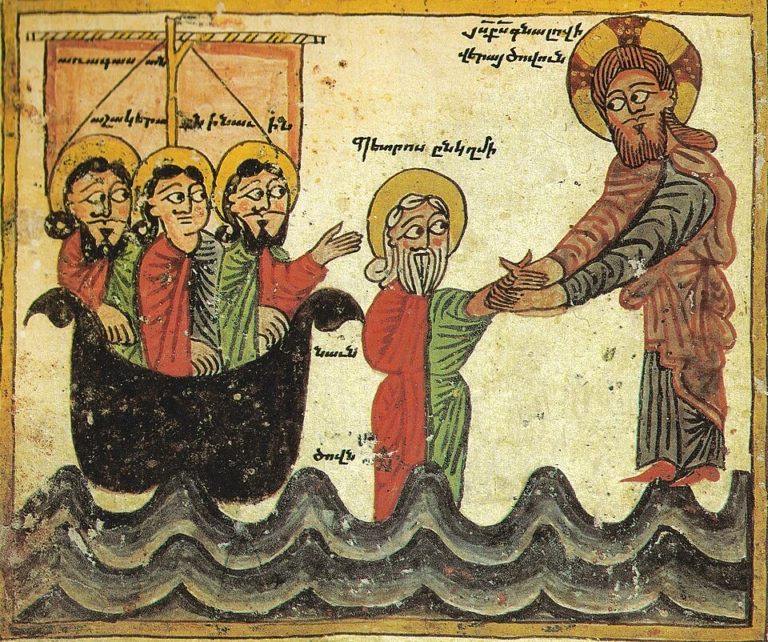
After he had fed the people, Jesus made the disciples get into a boat and precede him to the other side, while he dismissed the crowds. After doing so, he went up on the mountain by himself to pray. When it was evening, he was there alone. Meanwhile the boat, already a few miles offshore, was being tossed about by the waves, for the wind was against it. During the fourth watch of the night, he came toward them walking on the sea. When the disciples saw him walking on the sea, they were terrified. “It is a ghost,” they said, and they cried out in fear. At once Jesus spoke to them, “Take courage, it is I; do not be afraid.” Peter said to him in reply, “Lord, if it is you, command me to come to you on the water.” He said, “Come.” Peter got out of the boat and began to walk on the water toward Jesus. But when he saw how strong the wind was, he became frightened; and, beginning to sink, he cried out, “Lord, save me!” Immediately Jesus stretched out his hand and caught Peter and said to him, “Oh you of little faith, why did you doubt?” After they got into the boat, the wind died down. Those who were in the boat did him homage, saying, “Truly, you are the Son of God.”
GOSPEL REFLECTIONS:
Today’s Gospel reading invites us to trust God in all circumstances, including those that seem impossible. It is an extension of an earlier miracle that Jesus performed in front of the disciples, where He fed a crowd of thousands by miraculously multiplying five loaves and two fish. The miracle that followed was a private one, intended for the disciples—His closest friends and companions—to help them understand something profound about Jesus and God: there will be trials and hardships. There will be situations that seem impossible to manage, and danger will be close by. In such moments, when one fears for one’s life, God will not be distant, but immediately close and responsive, even when unrecognized or unexpected.
The setting unfolds from the hills of Capernaum to the Sea of Galilee. It was evening by the time Jesus finished teaching, healing, and providing a meal for the crowds. The disciples were witnesses to these events, but they had been with Jesus for only a short time and did not know Him well yet. They had heard the voice of God during His baptism, witnessed His first miracle in Cana, and now saw the multiplication of bread and fish. However, they had not yet faced a situation where their faith would be truly tested. The miracle of Jesus walking on the water was a miracle that touched them personally.
In the evening, Jesus asked the disciples to prepare the boat and go ahead to the other side of the shore while He personally dismissed the crowds. Here, we see that Jesus took personal care of everyone—praying for them and blessing them. He was personable. He was available. After that, as night fell, He went up to the mountain to pray to the Father. This was what Jesus had wanted to do since hearing of the death of John the Baptist, but this was the first opportunity He actually had because the people had needs, and He had compassion on them. He prioritized compassion over His own prayer time. We also see that prayer gave Jesus the strength to carry on.
Meanwhile, the disciples had been battling the waves all this time to reach the other shore. By the middle of the night, they were still not there, though they had advanced several miles away from land. By this time, there was no turning back; they were in the middle of the lake, tossed by the waves and struggling against the wind. They had to row hard and strong, but despite their efforts, they were unable to make much headway. Jesus, aware of their plight, finished His prayers and, toward the fourth watch of the night—just before dawn, during the darkest moment in every sense of the word—approached the boat.
He was walking toward them, but they did not recognize Him. They did not yet recognize that Jesus was God incarnate, fully human and fully God. So, they made the first assumption that came to mind: that Jesus must be a ghost, a phantom, or a lost soul who was about to harm them. They were so afraid of Him that they did not dare look at who it really was; instead, they crouched in fear and screamed in terror.
This image reminds us of moments in the Bible when the people of God were afraid to draw near to Him, did not know His face, and did not truly know Him. This stretches from Adam and Eve, who hid from the presence of God to the Israelites in Exodus, who sent Moses as their emissary to meet God because they were afraid of meeting Him themselves (Exodus 20). Here, Jesus does something which, according to the Old Testament, only God can do: He “…trampled the waves of the Sea” (Job 9:8). Yet, the disciples were so terrified that they failed to lift their eyes and failed to recognize Him.
So, He called out to them—just as God always calls first—and said to them: “Take heart. It is I. Do not be afraid.” (Matthew 14:27). With these three sentences, He again reminds us of the Old Testament, where God revealed His name to Moses and assured him not to be afraid.
Peter, acting as an emissary for the apostles and the Church, answered the Lord somewhat half-heartedly: “Lord, if it is you, command that I come to you on the water.” These are three distinct statements as well: “Lord,” “If it is you,” and “Command that I come to you.” It is a hypothetical, half-hearted request that shows uncertainty, fear, and disbelief. Jesus answered with only one word: “Come.”
So, Peter takes courage and gets out of the boat. Notice that while the others remain rigid with fear, Peter finds the mobility to step out of the safety of the boat’s interior into the unknown, walking on the water all the way toward Jesus. He is given the strength to reach his objective—the goal he requested: to “come to Jesus.”
Then, something unexpected happens. Peter takes the leap of faith; he walks, but then he stumbles and begins to sink. Why? Because while walking toward Jesus, his focus was entirely on Him, but as soon as he looked around, he became aware of the strength of the wind, the waves, and the depths. His reason took over his faith. Doubt struck him like lightning, and as he took his eyes off Jesus and realized the impossibility of the situation, he began to sink.
As he began to sink, he immediately cried out to Jesus: “Lord, save me!” This was the same desperate cry as the primordial scream in terror to the Lord during the time of Noah and the flood, the cry of Job, or the plea of Moses in the wilderness. Jesus was immediately there, stretching out His arm and saving Peter. Then Jesus said to him, “You of little faith, why did you doubt?” Jesus recognized Peter’s doubts, but He did not come to ridicule him; He came to reassure him that he could trust Him. Together, they got into the boat, and the wind calmed down.
The disciples then recognized Jesus as the “Son of God,” the Messiah, and they fell on their faces before Him and worshipped Him. This was a profound personal teaching moment for those closest to God, recalling Old Testament examples where God called His people to have not just an average or tepid faith, but a living faith in all circumstances. It serves as a reminder that as we travel together, there will be challenges and seemingly impossible situations, but God is always close, and He will always be there to save and rescue us.
At this point, the disciples had little faith, but as they walked with Jesus and learned from Him, they were transformed. In Acts 2, with the help of the Holy Spirit, Peter becomes an entirely different person—stepping up into a role he never thought possible. Sorrowful for the times he let Jesus down, denied Him, and ran away, he turns to face a large crowd and boldly testifies that Jesus is Lord. He becomes the leader of the disciples and the first Pope.
This transformation started with this personal encounter with Jesus and Peter’s realization of his own limits as a “person of little faith.” Representing human nature, Peter was afraid of the dark. He was afraid of the waves that tossed the boat and made navigation impossible. He was afraid of the figure approaching on the water, which eh thought was a ghost. Yet, he was most scared of the depths and the uncertainty of his entire existence when he stepped out of the safety of the boat. (2)
Aware that his own strength could not save him, he cried out to the Lord. This is a profound testimony that God can turn around even impossible situations and intervene in the forces of nature. Yet the greatest miracle is not when something spectacular happens, but when the heart of a person is transformed little by little. Sometimes this happens during hardships when we reach out for help, but it can also happen in ordinary situations as we listen to the Lord, walk with Him, and learn from Him. Peter aimed and advanced toward the Lord. Sinking, he entrusted his entire being–body, mind and spirit–to the care of the Lord.
This dynamic is especially salient in life-and-death situations. The Israelites were in such a position when they were about to enter the Promised Land, and Joshua was promised not to fear because the Lord would go before him and fight for him (Deuteronomy 3:22, Joshua 1:9; 1). It has also been true since the very beginning of Genesis, when the Lord first approached Abraham and told him “not to be afraid; the Lord will be your shield” (Genesis 15:1; 1).
In this event, we see not only the fulfillment of the message of Genesis, but a promise projected into our own lives for the future. God promises that He will be there: He will protect, care for, enable, and make the impossible possible. The greatest of these miracles is the closeness to Him that comes when we open our eyes to the true nature of God and Jesus, who came to tell us about the Father, who will return, and with whom we can personally converse.
His message to those closest to Him remains the same as God’s message throughout the ages: “Take heart. It is I. Do not be afraid.” Ages ago, then Elijah was instructed to go out and meet the Lord, He was not in the wind, not in the earthquake, and not in the fire; He was in the gentle breeze. And when Elijah heard the wind, he “wrapped his face in his mantle” for Lord passed by (1 Kings 19:11-13a).
The apostles encountered the Lord is the middle of a storm. And when they were all in the boat, the “wind ceased” (Matthew 14:32).
In 1939, King Goerge delivered a historic radio address during the first months of World War II. By this time, Poland had ben invaded, and Britain declared war. Europe braced in fear of the unknown. Quoting from the poem “The Gate of the Year” by Minnie Louise Haskins, King George uttered words of hope that are now inscribed at Windsor Castle:
“I said to the man who stood at the gate of the year, ‘Give me light that I may tread safely into the unknown,” And he replied, “Go out into the darkness and put your hand into the hand of God. That shall be to you better than light and safer than any known way.” (3)
King George ended his speech with the plea: “…And may that mighty hand guide us and uphold us all.” (3)
Jesus, who is the Alpha and the Omega, God, light of the world, and the Word of God—the ultimate Logos, is beckoning to “come” (Matthew 14:29). Always come and keep our eyes fixed on what is meaningful: what is true, what is good, what is beautiful. Keep our eyes fixed on the ways of the Lord. Walk, run, or crawl. Draw near to God and find safety in His arms, no matter what life may bring.
Sources:
- Peters, T. (2026). 19th Sunday in Ordinary Time. Year A. Gospel of Matthew 14:22-33. Retrieved from: https://www.google.com/search?q=father+tim+peters+Matthew+14%3A22-33&rlz=1C1SQJL_enCA897CA897&oq. Accessed: August 9, 2026.
- Beach, K. (2026). Sunday Homily, August 9, 2026. St. Isidore’s Parish. Kanata. Ottawa.
- King George (1939). King George’s 1939 Christmas Message—At the Gate of the Year. Retrieved from: https://www.youtube.com/watch?v=oBtix3-C1hQ&t=151s. Accessed: August 9, 2026.