

When the world withholds, destroys, or takes away, God nourishes, gives, and provides.
GOSPEL READINGS: Matthew 14:13-21
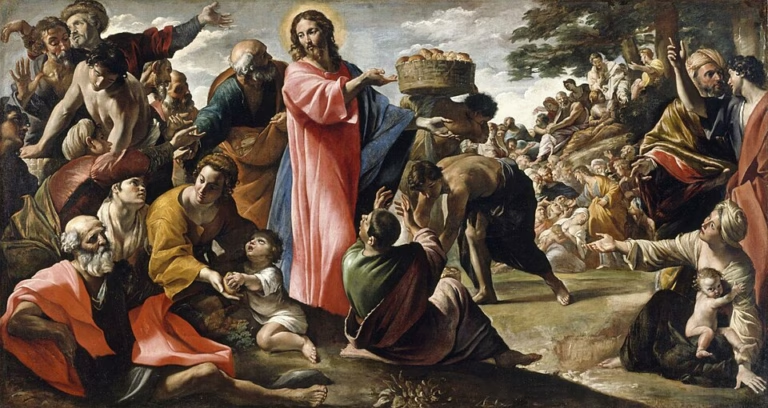
When Jesus heard of the death of John the Baptist, he withdrew in a boat to a deserted place by himself. The crowds heard of this and followed him on foot from their towns. When they disembarked and saw the vast crowd, his heart was moved with pity for them, and he cured their sick. When it was evening, the disciples approached him and said, “This is s deserted place, and it is already late; dismiss the crowds so that they can go to the villages and buy food for themselves.” Jesus said to them, “There is no need for them to go away; give them some food yourselves.” But they still said to him, “Five loaves of fish are all we have here.” Then he said, “Bring them here to me” and he ordered the crowds to sit down on the grass. Taking the five loaves and the two fish, and looking up to heaven, he said a blessing, broke the loaves, and gave them to the disciples, who gave them to the crowds. They all ate and were satisfied, and they picked up the fragments left over—twelve wicker baskets full. Those who ate were about five thousand men, not counting the women and the children.
GOSPEL REFLECTIONS:
Today’s Gospel reading takes us back in time, just after when Jesus called His first disciples. It occurs after the death of John the Baptist, who, as you recall, was a cousin of the Lord, only six months His senior. John the Baptist was foremost among the prophets because he announced the arrival of the Messiah. He was also the “greatest of those born of women” (Matthew 11:11 and Luke 7:28), for he came to prepare the way for the coming of Jesus. Yet, Jesus added that the least person in the kingdom of heaven is greater than John because John lived and died under the Old Covenant, whereas believers in the kingdom experience the full reality of the New Covenant (Matthew 11:11).
Since Jesus is the mediator of the New Covenant, His concern is with potential members of the kingdom of heaven, those whom John prepared and Christ sought out from among the “lost sheep” of Isreal—the people, the crowds (Matthew 10:5-6 and 15:24). They were ever-present companions during Jesus’ ministry, and He came to serve them and lead them.
Here, we see Jesus withdrawing to a seclude area after the death of John the Baptist, his cousin, an event that signals the full opening of Jesus’ public ministry (Matthew 4:12-17; Mark 1:14-15). Miraculous signs and signals that accompany His presence. One of them, the multiplication of loaves and the fish, feeding nearly 20,000 people, is a miracle that bridges the Old and the New Testaments. (1)
Jesus sought a quiet, deserted place because He wanted to pray. He withdrew intentionally to escape the noise of the cities and to grieve the loss of His cousin. John the Baptist’s life had ended tragically and cruelly due to the spiteful request of a young girl acting on the orders of her mother, Herodias, who lived in an illegitimate relationship with King Herod. John’s life was cut short by the calculated, self-centered decision of a tyrannical ruler.
How could Jesus draw our attention to the nature of God’s kingdom more clearly than through His actions when the crowds faithfully followed Him despite His grief? Jesus had compassion on them. His plans for solitude were interrupted, yet here lies the deeper meaning of the moment: an opportunity to serve the multitudes and teach them through action. Jesus did not become bitter, nor did He command the crowd to disappear. On the contrary, He moved toward them and stooped down to meet them. Moved by mercy for their suffering, He began healing their sick and afflicted. He did this all day until evening, when His disciples approached Him. Seeing that the day was ending, they suggested it was time to dismiss the crowds so they could go into the neighboring villages to buy food and find lodging (Matthew 14:15).
But Jesus—fully divine and fully human—was entirely in tune with the will of the Father. To the disciples’ surprise, He refused their suggestion to send the crowd away, telling them that the people did not need to leave. Furthermore, He asked the disciples to give them something to eat (Matthew 14:16).
This invitation, to give something to eat, was an invitation to the disciples, the future Apostles, who would be members and pillars of His Church, to care for the people and lead them with gentleness. When the disciples remarked that they had only five loaves of bread and two fish, Jesus said, “Bring them here to me.” (Matthew 14:18). He made these meager offerings His instruments for a miracle of multiplication and growth—the exact opposite of senseless destruction, loss, and death.
Jesus took the bread, gave thanks, broke it, and gave it to His disciples, unifying two pivotal realities in a single action:
- The historic provision of manna in the wilderness, which sustained the Israelites during their wanderings.
- The future institution of the Eucharist, during which Jesus performs these same actions—taking bread, giving thanks, breaking it, and giving it to His disciples. (1)
In this single miracle, the past (where God relentlessly cared for His people in a barren desert) meets the future (where Jesus gives His followers bread and wine—His own spiritual Body and Blood). Through this act, God supports, sustains, replaces loss, and mercifully heals. He provided for the physical needs of about 5,000 men—not counting women and children, bringing the total to perhaps 20,000 people—and gave them spiritual nourishment for the path ahead.
Let us observe this scene one more time: Jesus took the bread and fish, gave thanks, and handed them to His disciples to distribute to the people—thereby He united two events into one action: (1) the miraculous provision of manna in the desert which accompanied the Israelites while they were wandering in the desert; and (2) the institution of the Eucharist, during which Jesus performed the same actions of taking the bread, breaking it, and giving it to His disciples. (1)
These two events, one from the past, which shows us the relentless care and compassion of God even in the desert, where there is no food to be found—taking place at this remote place, where there was no food to be found for the crowds, and the second one, in the future, where Jesus would hand His disciples the bread and wine, His own spiritual body and blood, through which God continues to be fully present, are what take place in this one miracle. Through it, God supports, gives, life, supplants, cares for, and mercifully heals and tends. He provides for the physical needs of about 5000 men, not counting the women and the children, which could be a crowd as large as 20,000 individuals, he gives them spiritual nourishment for the path ahead.
Jesus took the bread and the fish, he gave thanks, and handed it to the disciples, who give these to the people. In the same way that God’s grace flows through the Church, Jesus showed that blessings come ultimately from God, not human hands.
Healing, mercy, compassion, and abundant life-sustaining resources characterize the kingdom of God. They exist so that God’s children are not left wandering aimlessly, but may find life, consolation, and peace.
When the leftovers were collected—so that nothing was wasted—there were twelve baskets full (Matthew 14:20). Symbolically, this represents an abundance of grace, enough for the twelve tribes of Israel and, by extension, all of humanity…and “they all ate and were filled” (Matthew 14:20). Through this miracle, Jesus teaches that He is the Lord of life. His kingdom is built on principles of justice, peace, mercy, and compassion, in which all can find a home. He invites His disciples—and His Church today—to convey these graces to the world, reminding us that in giving to others, more is generated. Inner abundance is gained, and what was lost can be found again. God heals what is broken and wounded, revealing new paths of hope because He is always faithful to His promises.
When the leftovers were collected, as there was nothing that was left to waste, there were twelve baskets full, which symbolically represents an abundance of grace, enough for the twelve tribes of Isreal, or symbolically, by extension, for all humanity.
With this miracle of the multiplication of the loaves, Jesus teaches that He is the Lord of the living and life giving. His kingdom is built on principles of justice, peace, mercy, and compassion, in which all can find a home. He invites His disciples—and His Church today—to convey these graces to the world, reminding us that in giving to others, more is generated. Inner abundance is gained, and what was lost can be found again. God heals what is broken and wounded, revealing new paths of hope because He is always faithful to His promises.
The multiplication of the loaves reminds us of the fullness of life in God. God has mercy on us when we suffer; He is not distant, distracted, or silent. He is active and creative, working ceaselessly in our hearts and minds to offer support the world cannot give. Instead of illness, He offers healing. Instead of death, He brings life. Instead of desolation, He provides consolation.
So let us go to Him—whether alone or in a crowd. Go to Him, receive His mercy, and extend that mercy to others. Share your gifts without fear, knowing that more will be provided. The Lord will provide abundantly, with measure pressed down and overflowing. Yet everything will be accounted for, so that nothing goes to waste.
Jesus reminds us of the importance of rest, solitude, and prayer. He also reminds us that when our plans are interrupted, those very disruptions often hold the deeper meaning of the moment—a manifestation of God’s greater will. Even if we do not understand His will at first, we will come to understand it later. May we always behold God’s gifts and mercy, ready to extend that same mercy to others. By participating in this life-giving economy of grace, we join in a power that overcomes evil, bringing fulfillment and purpose out of even the most futile circumstances. Where the hand of the Lord is at work, even meager resources become potent signs of His love and care.
To participate in the economy of growing, supplanting, life giving and life affirming, means to miraculously have the power to overcome evil and supersede it and bring something fulfilling and productive out of even the seemingly most futile and debased circumstances.
So, ask yourself: What meager resources, heavy burdens, or broken places in your own life is Jesus asking you to bring to Him today? Where the hand of the Lord works, even meager resources turn into potent signs and symbols of His love and care. Especially in our times of need, we can rely on Him for healing, well-being, and an everlasting wellspring of spiritual life—a healing power that goes beyond all measure and expectation.
Source:s
- Peters, T. (2026). Matthew 14:13-21: 18th Sunday in Ordinary Time, Year A. Retrieved from: https://www.google.com/search?q=father+Tim+Peters+Matthew+14%3A13-21&rlz=1C1SQJL_enCA897CA897&oq Accessed: July 29, 2026.