

Jesus teaches about the Kingdom of Heaven in the form of parables. These help the listeners understand fundamental truths about His Kingdom. The disciples would not understand the parables without an explanation following their questions. In this way, Jesus uses dialogue in His teaching that slowly reveals His message.
GOSPEL READING: Matthew 13:24-43
Jesus proposed another parable to the crowds saying: “The kingdom of heaven may be likened to a man who sowed good food in his field. While everyone was asleep his enemy came and sowed weeds all though the wheat and went off. When the crop grew and bore fruit, the weeds appeared as well. The slaves of the householder came to him and said, ‘Master, did you not sow good seed in your field?’ Where have the weeds come from?’ He answered that an enemy has done this.’ His slaves said to him, ‘Do you want us to go pull them up?’ He replied, “’No, if you pull up the weeds, you might uproot the wheat along with them. Let them grow together until the harvest; then at harvest time I will say to the harvesters: “First collect the weeds, tie them in bundles for burning; but gather the wheat into my barn.”’
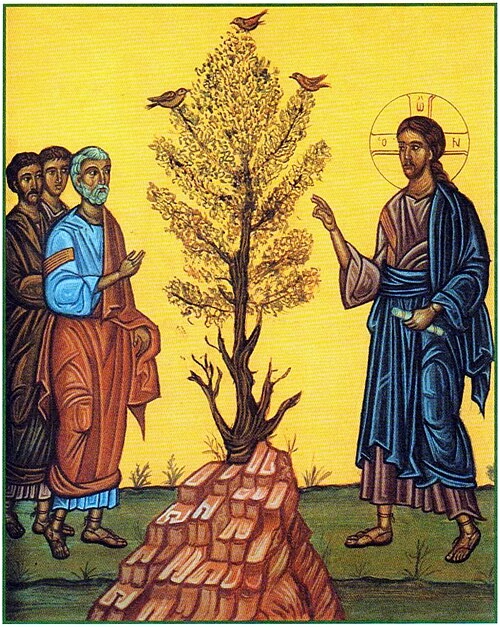
He proposed another parable to them. “The kingdom of heaven is like a mustard seed that a person took and sowed in a field. It is the smallest of all the seeds, yet when full-grown it is the largest of plants. It becomes a large bush, and “the birds of the sky come and dwell in its branches.’”
He spoke to them another parable. “The kingdom of heaven is like the yeast that a man took and mixed with three measures of wheat flour until the who batch was leavened.”
All these things Jesus spoke to the crowd in parables. He spoke to them only in parables, to fulfill what had been said through the prophet:
I will open my mouth in parables,
I will announce what has lain hidden
From the foundation of the world.
Then, dismissing the crowds, he went into the house. His disciples came to him and said, “Explain to us the parable of the weeds in the field. He said in reply, “He who sows good seed is the Son of Man, the field is the world, the good seed the children of the kingdom. The weeds are the children of the evil one, and the enemy who sows them is the devil. The harvest is the end of the age, and the harvesters are angels. Just as weeds are collected and burned up with fire, so will it be at the end of the age. The Son of Man will send his angels, and they will collect out of his kingdom all who cause others to sin and all evildoers. They will throw them into the fiery furnace, where there will be wailing and grinding of teeth. Then the righteous will shine like the sun in the kingdom of the Father. Whoever has ears ought to hear.
GOSPEL REFLECTIONS:
In the tradition of storytelling to reveal a profound truth, Jesus offers three parables about the Kingdom of God: the wheat and the weeds, the mustard seed, and the yeast. Each of these parables depicts an image—or rather, an aspect—of the Kingdom of God that Jesus wants to emphasize.
First, regarding the wheat and the weeds, Jesus explains to His disciples that the wheat represents the “children of the Kingdom” who listen to the word of God. These are not perfect individuals, but rather people who are aware of their imperfections and rely on God to show them how to live uprightly in a world that is often challenging, difficult, or vexatious. This is because the children of God, the “wheat,” are surrounded by influences and individuals who do not listen to the word of God, do not take it seriously, or do not live it out. Every evil act or deed—everything that causes suffering to these little ones—is not from God. Pain, death, sin, and suffering do not come from Him. As Jesus explains, these are “weeds” scattered by the evil one, the devil, to thwart God’s plans and mislead His children. The weeds are deceptive, overwhelming, and harmful. Yet, God allows evil to operate in the world until His plan of salvation, which began with the death and resurrection of Jesus, is brought to full completion at the second coming of the Messiah. This is when God will judge the peoples of the earth and separate what is evil from what is good. He will then put an infinite distance between the Kingdom of Evil and the Children of the Kingdom. Evil will finally be destroyed and be no more. Jesus wanted to reveal these truths so the disciples would understand that when they see evil in the world, they can have confidence that it will not have the last say. What looks powerful, overwhelming, and threatening will be vanquished forever.
The second parable is that of the mustard seed. Jesus says that good can start from a tiny place of faith, as tiny as a mustard seed. If one maintains confidence in God, that faith can grow and become larger and more powerful, until it is like a tree that gives shelter to the birds of the sky. Jesus shares this as a comforting truth: what is little, seemingly insignificant, and irrelevant can be placed into good soil and receive nurturing care. With that care, it can grow, mature, and bear good fruit. Jesus applies this to every person’s inner resources: their spirit. Through one’s spirit, it is possible to remain receptive to the word of God, which can transform what is little and seemingly negligible into something great and mighty. God can plant a garden and make a huge tree grow from what was just a tiny sapling, or even a tiny seed. If we have confidence and place it in Him, He will not disappoint, and He will not forget. Every detail will be brought to light, and every good deed will receive its reward. God can make something marvelous happen in the human heart that longs for Him and listens to Him. The heart that beats for God will find its rest. The sight that longs for light will meet its mark. The mind that longs for peace will be cradled in the bosom of the Lord. No one will be forgotten, no matter how small or unknown. God keeps watch over His children.
The third parable is that of the yeast. This is an everyday scene: a woman takes a measure of yeast, adds it to flour, and the dough is leavened, rising to be baked into a delicious bread, ready to eat. Jesus says that, just like yeast, we can take any everyday situation and add to it a touch of faith. Add to it a touch of hope. Add to it a touch of love. Do not forget to add into it God’s love for you. This way, you will be able to handle difficult situations or mundane tasks and rise above them. You will be able to handle suffering in a different way: there will be a bit of warmth, a bit of aroma, and a bit of softness, even amidst pain and suffering. Do not forget that God loves you, and that Jesus also said the children of God are the salt of the earth and the light of the world. They are the yeast in the bread—the ones who make a difference because their closeness to God impacts not just themselves, but others. So, Jesus says not to be afraid to be the yeast, growing beyond and rising above temporary situations toward eternal life.
Ultimately, the Kingdom of Heaven, as Jesus teaches, is not a nebulous and distant concept. It is built here on earth, right now, and right here—little by little, one step at a time, one day at a time, within one’s own lifetime.