
The image of the seed in the Parable of the Sower is the Word of God. The Word of God is living, life-giving, and transformative. Jesus invites us to welcome it and to be touched by it so that we may produce good fruit that will last.
GOSPEL PASSAGE: Matthew 13:1-23
On that day, Jesus went out of the house and sat down by the sea. Such large crowds gathered around him that he got into a boat and sat down, and the whole crowd stood along the shore. And he spoke to them at length in parables, saying: “A sower went out to sow. And as he sowed, some seed fell on the path, and the birds came and ate it up. Some fell on rocky ground, where it had little soil. It sprang up at once because the soil was not deep, and when the sun rose, it was scorched, and it withered for lack of roots. Some seed fell among thorns, and the thorns grew up and choked it. But some seed fell on rich soil, and produced fruit, a hundred or sixty or thirty-fold. Whoever has ears ought to hear.”
The disciples approached him and said, “Why do you speak to them in parables?” He said to them in reply, “Because knowledge of the mysteries of the kingdom of heaven has been granted to you, but to them it has not been granted. To anyone who has, more will be given and he will grow rich; from anyone who has not, even what he has will be taken away. This is why I speak to them in parables, because they look but do not see and hear but do not listen or understand. Isaiah’s prophecy is fulfilled in them, which says:
You shall indeed hear but not understand,
You shall indeed look but never see.
Gross is the heart of this people,
They will hardy hear with their ears,
They have closed their yes,
Lest they see with their eyes
And hear with their ears
And understand with their hearts and be converted,
And I heal them.
But blessed are your eyes, because they see, and you ears, because they hear. Amen, I say to you, man prophets and righteous people longed to see what you see but did not see it, and to hear what you hear but did not hear it. Hear then the parable of the sower. The seed sown on the path is the one who hears the word of the kingdom without understanding it, and the evil one comes and steals away what was sown in his heart. The second sown on rocky ground is the one who hears the word and who receives it at once with joy. But he has no root and he lasts only for a time. When some tribulations or persecution comes because of the word, he immediately falls away. The second seed sown among thorns is the one who hears the word, but then worldly anxiety and the lure of the riches choke the word and it bears no fruit. But the seed sown on rich soil is the one who hears the word and understands it, who indeed bears fruit and yields a hundred or sixty or thirtyfold.”
GOSPEL REFLECTIONS:
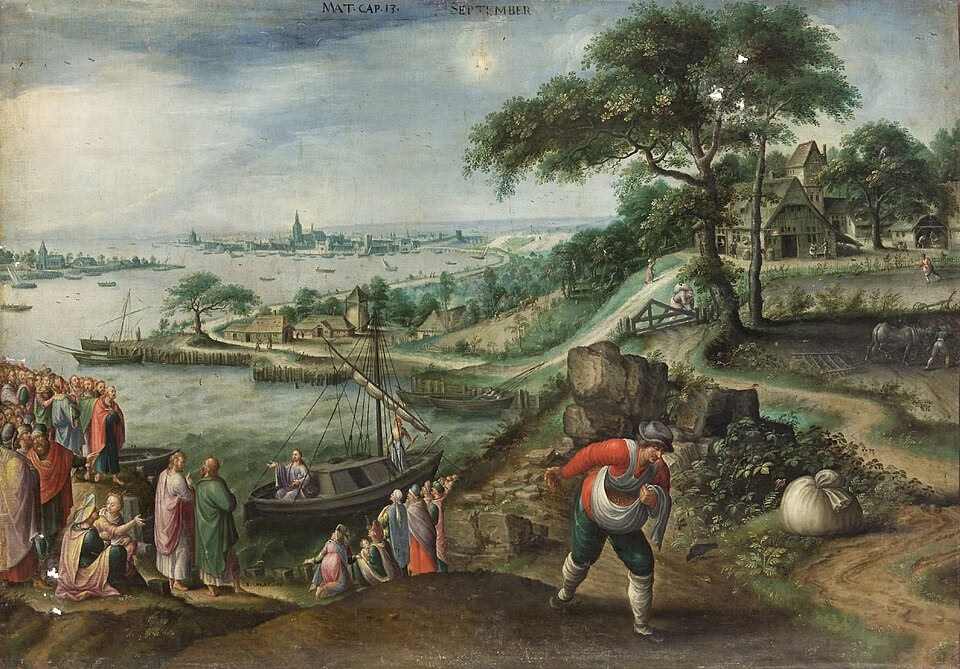
Today, Jesus invites us out of our everyday lives and into a quiet moment by the water to listen to a familiar story with a profound promise. He addresses a large and diverse crowd. This crowd could include you and me, alongside all sorts of other people who have heard about Jesus and have come to see Him and listen to His word. There are so many of us in this crowd that Jesus does not address us from the shore or from a hill; instead, He asks His disciples to cast out a boat. He stands in it so that everyone can see and hear Him. Standing in the boat, rocked by the waves, He is the center of our attention. What will He teach us today? Well, rather than simply telling us something, Jesus makes us think. He invites us to ponder His words and to make up our own minds.
He speaks about a sower. This is not a difficult image to ponder, as we ourselves may have been in the position of sowing seeds in our gardens or fields. How do we do it? We hold seeds in the palm of our hand, and we try to generously and evenly let go of them as we walk along a path. We pay attention to covering an area and then we move on, hoping that most of the seeds fall exactly where we intended. Usually, this is a garden or a well-prepared ground—tilled, hoed, raked, and fertilized—where the seed can receive enough sunlight and moisture to grow.
But some of the seed inadvertently falls to the side, among bushes and thorns, or into shallow ground where there is not enough moisture. If these seeds chance to sprout, they may quickly die from a lack of nutrients, the scorching heat, or weeds that suffocate them. Other seeds will be eaten by the birds. According to Jesus, there is only about a one-in-four chance that a new plant will sprout from the seeds we have sown. Yet, even with these less-than-ideal chances, the plants that do sprout and grow in the good soil will yield a great harvest—thirtyfold, sixtyfold, or even a hundredfold. Ultimately, many more seeds will be available by harvest time than what was originally sown, and the harvest will be plentiful.
Then, Jesus stops talking and sends us away to ponder what we have heard. This is a great challenge, because we might not be entirely sure what He was referring to. The image of the sower is familiar, but how can we achieve the greatest return from the harvest?
If the sower is God, and He mercifully and abundantly sows seeds along the path, it means the only way we can truly become a fruitful plant is if we listen to the Word of God and allow it to germinate in our souls. The decision Jesus leaves us with as He sends the crowd away to ponder is whether we are genuinely interested in listening to His word and ready to prepare good soil for it in our hearts. Or, are we only superficially interested—looking, listening, and then moving on without paying much attention? Listening and hearing without letting the Word of God prosper or live within us is a choice that happens when we are not ready to seriously live a Christian life. We may be distracted, occupied, weary, or lacking the depth required to stop and truly ponder. In these cases, the word has no way of taking root and no chance of changing us, because we continue to live our lives as if His word has no consequence. If we are joyful, we continue in our merry ways for as long as possible; if we are suffering, we continue to suffer without relying on God. If we are occupied with tasks and duties, we can become so dedicated to our work that we slowly forget to spend time with Jesus. Consequently, our relationship with Him becomes casual, inconsistent, or superficial, never developing beyond a certain level.
On the other hand, if we take the Word of God and ponder it, meditate on it, and participate in the life of the Church—meaning we follow Jesus with the intention of living according to the commandments and leading a sacrificial life—then Jesus can truly work in our lives. He can bring about something completely unexpected, something far greater than what was there initially.
Jesus does not ask for the impossible. What He promises is that He will be with us in hardships and will bring about a good harvest. What He asks in return is that we ready our hearts, prepare the soil for His word, and contemplate it. He is not pushing us unreasonably; rather, He allows the Word of God to work in us gradually, slowly, and by itself in a sublime, hidden way—just like a real seed. A seed is invisible until it starts to sprout and grow. He shows us that we do not need to do much other than keep the soil ready. Readiness and willingness are all He asks for. It may take weeks, months, or even years for a plant to grow, develop, and bear fruit. This does not matter to God. He is generous and patient; He tends, takes care of, and guards the plants. It is His time that matters, and He is merciful and generous. He will not quench the young shoot nor break it but will strengthen it and care for it.
Last week, Jesus asked us to give Him our cares, our worries, and all the tasks that are impossible and beyond our strength. Today He says: “Give me your heart, prepared to receive the word, and I will plant my word within it—a little seed that will grow and give life. You will then not be dead, but truly alive, and you will bring forth more fruit than ever before: thirtyfold, sixtyfold, and a hundredfold.”
This is a sublime miracle. The Lord is telling us that if we make ourselves ready and available, He will plant a tiny seed in us. It may be as small as a mustard seed, but it can grow big and wide, yielding a lot of fruit. In other words, God can make something out of us that we ourselves never expected. It is a mysterious promise that culminates in the image of a flourishing and fruitful plant, the ultimate symbol of life. This brings us to the imagery in Psalm 80, which reminds us that we are the vine taken out of Egypt and planted into the Promised Land. (1) This is how God will supply all our needs and make us fertile in all our deeds and words, finally gathering us into the Kingdom of God.
Therefore, this promise does not apply only to the young, the healthy, and the successful. It applies to the old, the weary, the suffering, and the downcast—especially to them, because Jesus came to gather everyone to Himself and manifest His glory through their lives. This provides a beautiful invitation and paints a very hopeful future, no matter what circumstances we find ourselves in. Jesus uses that exact soil, those circumstances, those conditions, that body, that mind, and that person for something great. He plants His word into them, and they become an example for others, living with the promise of eternal life. Jesus says that if we are faithful to Him, He makes us part of His vineyard: verdant, green, lush, healthy, and abundant with plentiful fruit.
Changes are always difficult. Letting go of something that is familiar and enter into uncharted territory is scary. The Lord encourages us to trust Him. Trust God who can truly work in our lives and bring about something completely unexpected.
So, let us ask ourselves today: Is the ground of our being ready? And will we allow God to do something extraordinary with our lives?
Sources:
- Peters, T. (2026). Matthew 13:1-23: 15th Sunday in Ordinary Time, Gospel Reflections. Retrieved from: https://www.google.com/search?q=father+tim+peters+matthew+13%3A1-23+catholic+interpretation. Accessed: July 7, 2026.