
A love that carries us to grace….
GOSPEL READING: Matthew 11:25-30
At that time, Jesus exclaimed, “I give praise to you, Father, Lord of heaven and earth, for although you have hidden these things from the wise and the learned you have revealed them to little ones. Yes, Father, such has been your gracious will. All things have been handed to me by my Father. No one knows the Son, except the Father, and no one knows the Father except the Son and anyone to whom the Son wishes to reveal him.
“Come to me all that labor and are burdened, and I will give you rest. Take my yoke upon you and learn from me, for I am meek and humble of heart; and you will find rest for yourselves. Fo my yoke is easy, and my burden light.
GOSPEL REFLECTIONS:
In today’s Gospel reading, Jesus invites the weary and heavily burdened to trade the crushing legalism of rigid, and inflexible principles for His light and life-giving yoke of love. The yoke stands for a relationship in which He meets us with understanding rather than cold judgement, he anchors our fragile stride and transforms our vulnerabilities into a sustainable path of true rest and meaning. Thus, we no longer need to strive to prove our worth or for perfection because we can rest in the trust that even our weakest, and most fragile days are held by love that carries us to grace.
The context of today’s Gospel reading is that after Jesus had sent out His twelve disciples to preach the Good News, to heal the sick, and cast out all demons, the disciples returned to Him and rejoiced because a great number of people were healed in the cities they had visited. A large number of people came to the disciples and listened to them out of desperation, because they had nowhere else to go and no other source of hope. Some in these cities, however, insulted the Apostles, seeing them as competitors and enemies. They wanted to denounce them and refused to change their hearts, even though they saw that many were healed and had altered their lives for the better.
Jesus lamented that not everyone was receptive to His message and that there was strong opposition. There were two camps, so to speak. On the one hand, there were those who showed humility, trust, and simplicity in depending on God, and who rejoiced that the Gospel values were being preached to them. Many of these people benefited from hearing the message and many were healed. On the other hand, there were those who showed defiance and intellectual superiority. They could not and would not accept the message from the disciples; instead, they remained on the peripheries, watching and judging the disciples’ actions. They did not benefit from the ministry because they rejected the message and despised the messengers, trusting instead in their own education, status, or position. The disciples could not help them because they would not listen and sought to obstruct the objective.
Therefore, when the disciples returned and reported to Jesus how their assignment went, Jesus exclaimed: “I give praise to you, Father, Lord of heaven and earth, for although you have hidden these things from the wise and the learned you have revealed them to little ones” (Matthew 11:25).
Jesus was referring to the truth at the essence of His message—the truth that gives spiritual life to His children and to those who listen to His voice. This truth remains hidden from the world, and from the skills and powers of the world, because it is a healing power that comes from God and supersedes all temporary human knowledge. This power is the power of divine love and providence, which abides with those who welcome it and believe in it.
Strangely, it often takes extreme life situations or circumstances to see through the external layers that cover this foundational truth. As the saying goes, sometimes it takes the ruins to help us see the stars. In rare instances, we gain a glimpse of the reality and truth behind what is obvious, tangible, and measurable—the things to which we are most accustomed. To see this piece of reality in everyday life requires the eyes of faith and meditation in prayer.
We see this truth vividly when the structures of traditional human wisdom–such as our intellect, security, or safety–are shaken or collapse and when we need to anchor ourselves in deeper truths and universal values. In crises, our sense of control vanishes. Sterile principles offer zero comfort. Human wisdom fails to provide answers, and its coldness is completely unmasked. It is precisely when our own strength and structures collapse that we fall backward into what actually matters. In that valley of desolation, we discover that what remains standing isn’t a theory or a rule—it is the living presence of Jesus. We find a deep, unshakeable security that doesn’t depend on our circumstances being perfect.
When Jesus praises the Father for hiding these things from the “wise and the learned” and revealing them to “little ones,” He is speaking of a profound spiritual paradox: often, it is only when we are stripped of our worldly status, our power, and our control that our eyes are opened to what really matters, what remains and remains standing that is strong enough to actually hold us: A love that carries us to grace.
We see this not when we become immature like children, but when we abandon ourselves with trust to God and though the eyes of faith, gain unusual levels of maturity and insight.
Consider the profound discernment attained by Viktor Frankl while imprisoned in concentration camps during the Second World War. In his spirit, he conversed with his wife, not knowing whether she was dead or alive. In his world-renowned book, Man’s Search for Meaning, Frankl wrote:
“A thought transfixed me: for the first time in my life, I saw the truth as it is set into songs by so many poets, proclaimed as the final wisdom by so many thinkers. The truth—that love is the ultimate and highest goal to which man can aspire. Then I grasped the greatest secret that human poetry and human thought and belief have to impart: The salvation of man is through love and in love. I understood how a man who has nothing left in this world still may know bliss, be it only for a brief moment, in the contemplation of his beloved. In a position of utter desolation, when man cannot express himself in positive action, when his only achievement may consist in enduring his sufferings in the right way—an honorable way—in such a position man can, through loving contemplation of the image he carries of his beloved, achieve fulfillment. For the first time in my life, I was able to understand the meaning of the words, ‘The angels are lost in perpetual contemplation of an infinite glory.’” (1:35-36).
Jesus continued by reiterating that He came into the world to acquaint us with the Father, so that God is no longer distant, silent, or unknown to us, but known—allowing us to relate to Him and understand that He relates to us: “Yes, Father, such has been your gracious will. All things have been handed to me by my Father. No one knows the Son, except the Father, and no one knows the Father except the Son and anyone to whom the Son wishes to reveal him” (Matthew 11:26-27).
In His human nature, Jesus experienced both the joys and sufferings of this life. He knew joy, such as at the wedding of Cana, which He attended with His disciples (John 2:1-11). There, two people started a new life together surrounded by a celebrating and jubilant community. Even when they ran out of wine, Jesus, at His mother’s request, ordered the jugs to be filled with water and miraculously turned it into wine, proving that the impossible becomes possible with divine intervention. By sharing in these moments, Jesus shows us that God is not absent from our human celebrations; He delights in our joy.
Or, even earlier, the joys that Jesus experienced in His home, raised by His stepfather Saint Joseph—a righteous man who taught Him his trade—and our Blessed Mother, who taught Him how to help around the house and participate in religious celebrations. He felt safe and protected with His parents, even though dangers and snares surrounded Him from the moment of His birth. Yet, because He fully shared our human condition, Jesus experienced suffering as well: indescribable physical suffering on the cross, and mental suffering to the point of death. He felt the deep sadness and abandonment in the Garden of Gethsemane when even the disciples He asked to stay awake and pray with Him fell asleep. (Matthew 26:36-46; Mark 14:32-42), Facing certain death, He was in agony to the point that His seat became like drops of blood falling to the ground (Luke 22:39-46).
Out of love for the Father, Jesus was obedient and carried His mission all the way to the cross and beyond, to the Resurrection. Years before His death, we see Him standing with the Father and the Holy Spirit, thanking the Father for the success achieved during the Apostles’ ministry and invoking His help for the steps ahead. He looked forward to the future, when He would send the disciples into the wider world beyond the borders of Palestine and Israel, into foreign lands, to the very margins of the earth.
What did He equip them with? The image of the Father, the Son, and the Holy Spirit in their inner eyes, hearts, and minds wherever they went. Through Jesus, access to the Father becomes firsthand. The guidance of the Holy Spirit becomes immediate and permanent. God now dwells among His people and knows them intimately—always accessible through the Sacraments and ever-present in prayer. His Spirit envelopes the world.
Finally, Jesus makes a comforting invitation: “Come to me, all who labor and are heavy laden, and I will give you rest. Take my yoke upon you, and learn from me, for I am gentle and lowly in heart, and you will find rest for your souls. For my yoke is easy, and my burden is light.” (Matthew 11:28-30).
He is calling all people to turn to Him. He sent out the disciples, but ultimately, He wants the people to come directly to Him. He promises, “I will give you rest,” and notes that He is gentle and humble of heart, emphasizing His mercy and compassion.
Jesus does not promise that the burden of life will be completely lifted. Just prior to this, He instructed us to “take up your cross” (Matthew 10:38). But today, He says, “Take my yoke upon you” (Matthew 11: 30).
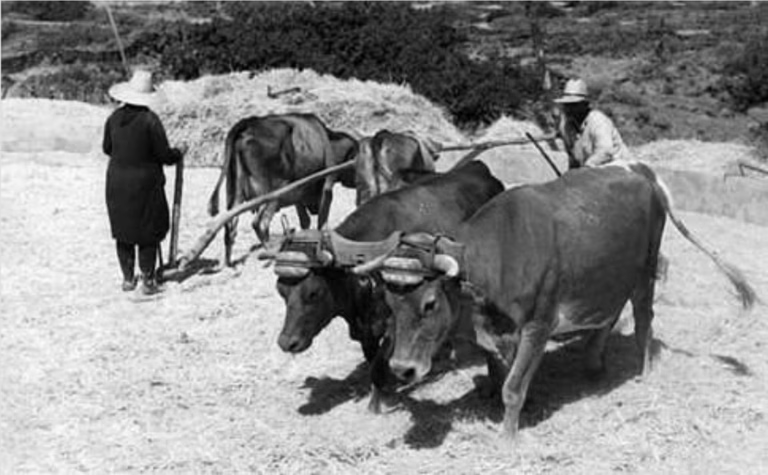
To the ancient crowds listening to Him, a yoke was a deeply familiar tool. It was a heavy wooden frame carved to link two oxen together so they could pull a plow as a single team. (2) In Jewish agricultural life, a wise farmer would never pair two weak or inexperienced animals together. Instead, they would yoke a young, untrained ox alongside an older, seasoned, and much stronger ox. The veteran ox would set the pace, maintain the direction, and bear the true, crushing weight of the burden. The younger animal simply had to walk in step, learning how to pull by staying close to the master. (2)
Jesus is not asking us to pull a heavy load in isolation; He is inviting us to couple our fragile lives to His infinite strength. When we take His yoke, we are stepping into the frame right beside Him. He does the heavy pulling, He navigates the rough terrain, and He anchors the stride. Our burden becomes light not because our troubles suddenly disappear, but because He is standing in the harness with us, carrying the weight.
If you think about the seasoned veteran ox in the agricultural metaphor, a young ox left to itself might panic, run too fast, exhaust itself, or trip over the rocks in the field. The older ox prevents this. By linking its massive, disciplined strength to the younger animal, it forces a steady, rhythmic, and sustainable pace. It “anchors” the movement so the journey can actually be completed without desolation.
Knowing that there is someone who cares for us and loves us—no matter what infirmities we live with, what injustices we battle, or what impossible obstacles, sicknesses, and sufferings this world throws at us—makes all the difference. It is always better to be in a place of understanding and kindness than one of cold indifference, rigid rules and legalistic precepts with no consideration for the unique weight of individual circumstances.
In one of his sermons, Saint Augustine famously pondered how Christ’s yoke can be possibly “easy and light,” (Matthew 11:30), when taking up the cross is heavy. He slowly came to develop a logical argument to illustrate this apparent paradox:
Famously, Saint Augustine remarked that: “You have made us for yourself, O Lord, and our heart is restless until it rests in you.” (3)
Reflecting on the tremendous responsibility that it takes to care for souls, which can be eased by love for the ones one serves, Saint Augustine made this observation:
“In love, the labor is not felt… Any rough labor is made easy and almost nothing by love. Look at how love labors, and you will see it is no burden.” (4)
Next, he elaborated on Christ’s love using the metaphor of a bird’s wings:
“The burden of Christ is like the plumage of a bird. If you take it off, you lighten the weight, but the bird cannot fly. If you leave it on, it adds weight, but it allows the bird to soar above the earth.” (5)
What je meant to say with the two illustrations is this: When we are yoked to Jesus, we aren’t suddenly free from individual circumstances or hardships. The weight is still there. But because it is a yoke made of relationship and love rather than cold obligation, the weight changes character. It stops pulling us down into desolation and begins to give us the stability to move forward.
The great Spanish mystic, Saint Theresa of Avila, who wrote her masterpiece, The Interior Castle, in 1577, picked up on the exact same thread of love:
“God does not look at the greatness of our works, but at the love with which they are done… (6)
She echoed Psalm 103:14 along with Saint Augustine:
He knows our frame; He remembers that we are dust.” (7)
This is to say that Jesus is not a distant judge handing down unbending dogmas from afar, but He is the companion who steps into the yoke with us, perfectly matching our uneven, limping stride in the hardships of our daily lives.
How could we translate these saintly truths into the rhythm of our daily lives?
Jesus offers the law of love. Love transcends whether we are capable or incapable, healthy or unhealthy, living or dying. Jesus is simply there, offering refreshment on a path that can often feel like a dry desert. When there is a firm objective and a final goal, it is much easier to traverse a barren land than if there are no markings, no hope, and no sense of direction. Walking toward the outstretched arms of the Father is always better than wandering aimlessly.
This is exactly what Jesus offers: A relationship that is loving and life-giving. Regardless of our situation, we can remain mindful of the outstretched arms of the Father and walk toward Him alongside Jesus. Guided day and night by the Holy Spirit, we can rest assured that He will meet us at any point of the journey. With the end in sight, we find the endurance and intentionality needed to finish the race.
Life is simply better with God than without Him. The sufferings of this life are far more bearable when carried with Him. Count on the consolation, the care, and the mercy that only God can offer—a mercy that eludes the rest of the world. Trust Him and walk toward Him. Do not walk alone. Trust, and take the first step.
It is just like a child learning to walk. At first, the mother holds their hand. Later, she stands a short distance away, and the child finds the confidence to look at the parent’s face and step forward. And when they cannot walk, they crawl; when they cannot crawl, they reach out; and before they can even reach out, they cry out.
And God responds. He responds even before our earthly parents do. He called us to life, He sustains our life, and He preserves us for life eternal.
Jesus promises to reveal the face of the Father to those who seek Him with simplicity of heart and trust, and he promises to carry them to grace.
Sources:
- Frankl, V. E. (2014). Man’s Search for Meaning. Boston, MA: Beacon Press.
- King, P. J. & Stager, L. E. (2001). Life in Biblical Isreal. Westminster John Knox Press.
- Augustine, St. (2008). Confessions. (H. Chadwick, Trans.). [Original work published c. 397-400 AD]. Oxford University Press.
- Augustine, St. (1994). The works of Saint Augustine: A translation for the 21st century (Part III: Sermons, Vol. 10) (J. E. Rotelle, Ed.: E. Hill, Trans.). New City Press.
- Augustine, St. (2001). Expositions of the Psalms, 51-72 (J. E. Rotelle, Ed.; M. Boulding, Trans.). New City Press.
- Teresa of Avila, St. (2007). The interior castle. (E. Allison Peers, Trans.). [Original work published in 1577]. Dover Publications.
- Augustine, St. (2003). Expositions of the Psalms, 99-120 (J. E. Rotelle, Ed.; M. Boulding, Trans.). New City Press.