

Jesus calls believers to follow in His deep compassion, healing a suffering world not as a nameless mass, but through individual love and shared mission.
GOSPEL PASSAGE: Matthew 9:36-10:8
At the sight of the crowds, Jesus’ heart was moved with pity for them because they were troubled and abandoned, like sheep without a shepherd. Then he said to his disciples, “The harvest is abundant, but the laborers are few; so ask the master of the harvest to send out laborers for his harvest.”
Then he summoned his twelve disciples and gave them the authority to cure every disease and every illness. The names of the twelve apostles are these: first, Simon, called Peter, and his brother, Andrew; James, the son of Zebedee, and his brother John; Phillip and Batholomew, Thomas and Matthew the tax collector; James, the son of Alpheus, and Thaddeus; Simon from Cana, and Judas Iscariot who betrayed him.
Jesus set out these twelve after instructing them thus, “Do not go into pagan territory or enter a Samaritan town. Go rather to the lost sheep of the house of Israel. As you go, make this proclamation: ‘The kingdom of heaven is at hand.’ Cure the sick, raise the dead, cleanse the lepers, drive out demons. Without cost you received; without cost you give.”
GOSPEL REFLECTIONS:
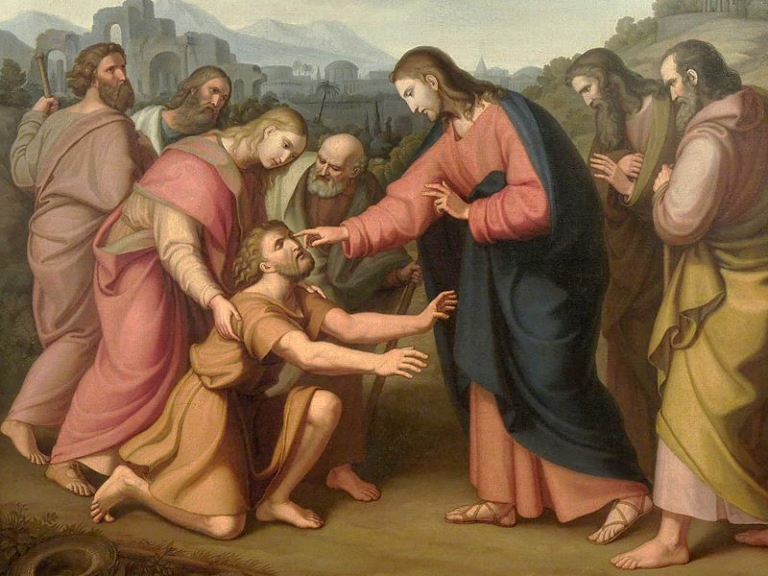
Out of mercy and compassion, the Lord called twelve Disciples, whom he named His twelve Apostles. As He sent out His Church into the world, He wished them to be fashioned according to His heart of mercy.
Today’s Gospel reading is best understood within the overarching narrative arc of the Gospel. After Jesus began His public ministry, He traveled throughout the countryside, teaching in the villages and synagogues of Galilee while curing every illness and sickness. Many signs and miracles accompanied His mission, leaving the people amazed. They gathered in large numbers to see Jesus, hear Him speak, and be healed. Upon seeing these vast crowds, Jesus had compassion on them because “…they were harassed and helpless, like sheep without a shepherd” (Matthew 9:36).
In the context of Jesus’s entire mission, we understand that in His human nature, He experienced deep sorrow whenever He witnessed injustice and the suffering of the innocent. He wanted to respond by helping and healing every type of illness and disease—healings that often took a physical form. We see this when He healed the man born mute (Matthew 9:32-34), the woman who had suffered from hemorrhages for twelve years (Matthew 9:18-26), and the two blind men (Matthew 9:27-31). Jesus healed through the power of God the Father and the Holy Spirit. He wanted His followers to possess this same charisma, intense involvement, empathy, and compassion for others, being deeply moved whenever they encountered suffering. (1) As Pope Francis reminded us, Jesus never views humanity as a nameless mass, but looks upon each person with an individual, tender gaze that acknowledges their unique story and inherent worth. (2)
During his apostolic visit to Spain, Pope Leo XIV made a stop in Barcelona where he listened to the testimonies of young people who suffered because of violence, trauma, and depression, and participated in a question-and-answer period. (3) One woman, Carmina, said that she has been suffering from depression for years. She carried this pain alone and in silence and wanted to keep going on like that by herself, until one Friday the pain got so intense that she lost the battle and attempted to commit suicide. Thanks to God she was saved and taken to hospital where she received treatment. Reflecting on the experience, she said that she was grateful for the people whom she encountered and who helped her. She realized that one’s past should not stand in the way of the future or define one’s identity. She said that she feels eternally grateful to God for the second chance she was given in life. Her question to the Holy Father echoes the question that so many people carry in silence: “Where is God when the pain feels endless and hope seems out of reach and when people feel that the only way out of pain is to disappear from life?” (3)
Responding to Carmina, Pope Leo XIV said that such experiences offer a very salient message to the Church and to all of us: “…Christ himself entered into humanity’s deepest suffering, showing that God does not stand apart from our pain but walks through it with us. Sometimes, faith is not about having all the answers, but trusting that even in the darkest night, God remains present, carrying us toward the light.” The Pope said that “…we must not spiritualize suffering, superficially reducing it to the will of God or to some mysterious plan of His. This risks minimizing suffering, silencing it, and wounding people. God does not want suffering. He carries it with us and invites us to trust in Him perseveringly.” (3)
Through His actions, Jesus revealed Himself as the true shepherd of Israel. The passage about Him being the Good Shepherd and appointing His Apostles to help Him in this task, reminds us of the prophecy in Ezekiel 34:5-9, which recalls how the rulers of Israel usurped wealth and resources but failed to show compassion to the people. (1) Ezekiel uses the metaphor of the sheep and the shepherd when he declares, “You eat the fat, you clothe yourselves with the wool, you slaughter the fatlings, but you do not feed the sheep” (Ezekiel 34:3). He describes a widespread, global phenomenon when he continues, “My sheep were scattered; they wandered over all the mountains and on every high hill; my sheep were scattered over the face of the earth, with no one to search or seek for them” (Ezekiel 34:6). Following these lines, Ezekiel proclaims the Lord’s will to change this situation, gather His people, and become their guide, stating, “I myself will search for my sheep, and I will seek them out” (Ezekiel 34:11).
Obeying the will of the Father, Jesus intended to call and equip His Apostles and disciples to be workers who would care for and lead the people. He used the Greek word “ergates” when He remarked that “The harvest is plentiful, but the laborers are few; therefore, ask the Lord of the harvest to send out laborers into his harvest” (Matthew 9:37-38). (1) Jesus desired for them to be formed after His own heart, to walk with Him every step of the way, and to show concern for everyone according to the special graces God bestowed upon them. (1) We call these graces charisms—special abilities and capacities evoked and strengthened by the Holy Spirit. (1) Beyond these gifts, we read that Jesus gave each of the Apostles “…authority over unclean spirits, to cast them out, and to cure every disease and every sickness” (Matthew 10:1). This authority was directly linked to the Father’s desire to abundantly bless the Apostles and pour out His divine grace through their ministry.
Consequently, Matthew lists the names of the Apostles in an intentional order, starting with Peter, their leader, followed by his brother Andrew, James the son of Zebedee and his brother John, Philip and Bartholomew, Thomas and Matthew, James the son of Alphaeus and Thaddeus, Simon, and Judas Iscariot. The twelve Apostles represent the twelve tribes of Israel and the nations of the world. (1) They prefigure not only consecrated priests, but all baptized members of the Church who are strengthened by the Holy Spirit to guide, heal, and serve the world while proclaiming the Good News. Jesus instructed the disciples to begin their ministry in Jerusalem, going first to the “lost sheep of the house of Israel” to “raise the dead, cure the sick, and cleanse the lepers,” and from there, advance to the ends of the earth (Matthew 10:1).
Jesus told His disciples, “You received without payment; give without payment” (Matthew 10:8). It is fascinating that this detail was recorded by Matthew, a former tax collector. This is certainly something he would have noted, given his professional background in keeping track of financial matters. Here, we find a call to absolute reliance on God, depending entirely on Him to provide for every need when it comes to receiving graces and helping others benefit from them. (1)
One question remains at the end: “Why is it not possible to cure every disease and heal every sickness today?” There are various answers to this question. Some believe it is because the Apostles were closer to Jesus in a unique way that sets them apart from consecrated priests today. Another perspective is that God the Father poured out these specific graces upon the Apostles for a limited time strictly to accompany and authenticate Jesus’s earthly mission. A third answer is that certain priests and believers are given special graces and continue to cure the sick today; after all, medically unexplained healings still occur. Notably, God works not only through consecrated priests or nuns, but also through laypeople who are close to Him. Similarly, God works through the professions and unique talents of specific individuals. He calls healthcare professionals, laypeople, and families alike to join this collective workforce to heal the world, revealing that the command to look after the fragile is a visible proof of our love for God and our fidelity to the Gospel (2).
Perhaps what we overlook in these answers is that regardless of where and when healing occurs—especially an unlikely or miraculous one—the professional, priest, or layperson is merely an instrument in God’s hands. All healing ultimately comes from Him. Is healing possible in today’s world? Absolutely. In fact, the most miraculous healing may not be physical at all, though physical healing serves as a powerful sign. Instead, it is metanoia—the internal transformation of a person. This is the turning of a human spirit toward the Spirit of God, receiving healing grace directly from the source. In his recent encyclical Magnifica Humanitas, Pope Leo XIV reminds us that in an era where human dignity is threatened by new forms of technological dehumanization, our most pressing duty is to remain profoundly human. True metanoia is the ultimate expression of this humanity, reorienting the soul toward its Creator. (4)
Whether or not this transformation is accompanied by psychological or physical benefits matters less than the person’s ultimate orientation toward God. This orientation saves them from feeling lost or abandoned, awakening them to their true dignity as children of God created in His image. For such a person, the Good News is a saving grace because it promises that the spirit never dies. At the end of the age, God will completely restore them with a glorious heavenly body and a perfect mind. They will never be forgotten, nor will they have to contend with the consequences of human fallibility, mortality, and vulnerability. Instead, they can live in the absolute assurance of their hope and trust that they will inherit eternal life.
Even now, while facing all sorts of suffering and limitations, they hold onto the promise that these trials are temporary. Our response to suffering can contribute to earning spiritual merits; ultimately, even unavoidable suffering can be united with the suffering of Christ. When we do this, compassion ceases to be a purely individual, isolated effort; it takes on a deeply communal, relational, and social dimension. In this way, eternal glory is shared and extended. (4)
Even those who, through their own lack of merit, might never have ventured near the Kingdom of God can now be assured that they have a vital role to play in God’s project of healing the world. No matter how great or small our circle of influence may be, it is uniquely ours. In this divine plan, no person is replaceable or dispensable. Everyone has a call, a mission, and a unique contribution to make—a process through which God sanctifies and elevates us, so that the humble worker, the servant, the last, and the least can become the beloved.
On the final day of his Apostolic Journey to Spain, Pope Leo visited the Atlantic Islands of Gran Canaria and Tenerife. In Tenerife, Spain, a young immigrant from Senegal, called Mbacke, stole the show when he gifted Pope Leo with a jersey from the Thirasa Taekwondo Club, asked him to bless and object, and convinced him to perform the viral 6-7 gesture together from the stage. In his testimony, Mbacke spoke about the many perils that face immigrants who arrive to the shores of Spain risking their lives. He asked the Pope to “continue reminding the world that behind every young migrant, there is a dream, a mother who prays, and a life that deserves a chance.” (5)
On his part, the Pope honored the thousands of lives lost at sea and warned that the fate of migrants should not be met with indifference. Addressing those that left their homes in search of safety and opportunity, the Pope said that migrants should no be reduced to statistics or bureaucratic cases. Instead, he urged people to recognize them as individuals with families, dreams, and lives worthy of respect. Hid words were, “Dear migrants, before I say any other word to you, I want to bow before your dignity. You are not numbers or case files. You are people—with a family and a home left behind, with dreams that no one has the right to scorn.” (5) Earlier during Mass in Tenerife, the Pope stated that indifference toward the suffering of others and Christian values are incompatible. Helping and caring for others unites us in a special way with the heart of Christ which we should strive for beyond appearances and superficiality. (6)
Jesus sends a call, a true vocation. He does not send it in a hidden code, but as a stirring in the depths of our hearts and minds—a clear signal that we matter, that our efforts are vital, and that He is counting on us to help heal the world. As we work, rejoice, or suffer, He is not removed from us but walks with us. When we feel alone, He is mercifully at our side. The Lord is not indifferent, He is not removed, or distant. He is right with us.
Just as the Lord called each disciple by name, He knows each of us intimately, reminding us that in His eyes, no one is just a face in the crowd—every single person is precious, wanted, and called for a specific mission.
Sources:
(1) Peters, T. (2026). 11th Sunday in Ordinary Time. Year A. Gospel of Matthew 9:36-10:8. Retrieved from: https://www.youtube.com/watch?v=fJLgoX68N_k. Accessed: June 11, 2026.
(2) Pope Leo XIV. (2026). Message of His Holiness Pope Leo XIV for the 34th World Day of the Sick. Dicastery for Promoting Integral Human Development.
(3) EWTN News (2026). Pope Visits Barcelona. June 10, 2026. Retrieved from: https://share.google/kMcbnfeqVKkKqkMXd. Accessed: June 12, 2026.
(4) Pope Leo XIV. (2026, May 15). Magnifica humanitas [Encyclical letter]. The Holy See.
(5) Vatican News (2026). Pope to human traffickers: Repent! Divine justice awaits you. Retrieved from: www.vaticannews.va. Accessed: June 12, 2026.
(6) EWTN News (2026). Pope Leo XIV in Spain/Holy Mass in Santa Cruz de Tenerife. June 12, 2026. Retrieved from: https://ewtn.co.uk/vod-live-pope-leo-xiv-in-spain-holy-mass-in-santa-cruz-de-tenerife-june-12-2026/. Accessed: June 12, 2026.