

On the Solemnity of the Most Holy Body and Blood of Christ—the Feast of Corpus Christi—Jesus connects the past, the present, and the future by declaring God’s salvific plan for all humanity.
GOSPEL PASSAGE: John 6:51-58
Jesus said to the Jewish crowds: “I am the living bread that came down from heaven; whoever eats this bread will live forever; and the bread that I will give is my flesh for the life of the world.”
The Jews quarreled among themselves, saying, “How can this man give us his flesh to eat?” Jesus said to them, “Amen, amen, I say to you, unless you eat the flesh of the Son of Man and drink his blood, you do not have life within you. Whoever eats my flesh and drinks my blood has eternal life, and I will raise him on the last day. For my flesh is true food, and my blood is true drink. Whoever eats my flesh and drinks my blood remains in me and me and I in him. Just as the living Father sent me and I have life because of the Father, so also the one who feeds on me will have life because of me. This is the bread that came down from heaven. Unlike your ancestors who ate and still died, whoever eats this bread will live forever.”
GOSPEL REFLECTIONS:
The setting of today’s Gospel is the synagogue of Capernaum. Peter, John, and James live here with their families, and they are excited that Jesus is teaching and healing in their community. Wondrous signs and miracles accompany His presence: He feeds five thousand people on the hills overlooking Galilee; He crosses the sea overnight between Capernaum and the opposite shore; and, to everyone’s amazement, He walks on water, returning to Capernaum the following day to teach. (John 6:1-34).
Jesus immediately attracted intense attention. Followers flocked together as word of mouth spread, and even a Pharisee, Nicodemus, traveled all the way from Jerusalem to get to know Jesus and hear His words. The consensus among the people was that He was a rabbi, a prophet, or perhaps someone even greater—though those who knew Jesus’ earthly family did not seem entirely sure how this could be possible, not even His own brothers (John 7). Yet the crowds were forceful, and because some even wanted to take Him by force to make Him king, He withdrew again to the mountain by Himself to pray. (John 6:15).
His actions deeply reminded the people of their past. In Exodus chapter 16 and Numbers chapter 11, we read how the people of Israel wandered in the desert for forty years and God provided them with food from heaven, called manna. In His providence, God provided for their needs and sustained them during a spiritual journey that required a purification of heart and mind before they could enter the Promised Land. Because of their unfaithfulness, only two people from that first generation, Joshua and Caleb, were permitted to enter Canaan.
Jesus’ first statement, “I am the living bread that came down from heaven; whoever eats this bread will live forever; and the bread that I will give is my flesh for the life of the world” (John 6:51) is a direct “I Am” statement—one of seven in the Gospels regarding His identity. It draws a stark parallel between the manna of the desert, which offered only temporary and perishable relief from hunger, and the new manna, which is for the revitalization of the soul: the living bread from heaven. The properties of this bread are entirely different from ordinary, perishable food, as Jesus points directly to Himself: “I am the living bread that came down from heaven.” He personifies God’s gift, bridging His own person with the divine.
Jesus is not speaking merely as a mortal human being, but as God. As God, He declares that those who eat this bread will live forever—possessing eternal life like God Himself. Then, referring to His mortal human body, He states: “…the bread that I will give is my flesh for the life of the world.” Here, Jesus refers to the offering of His life as a living sacrifice for the institution of a New Covenant. He foretells His suffering and death as the true Paschal Lamb, whose blood was used to seal the covenant in the Old Testament. In Exodus, the lamb was roasted over fire and its blood smeared over the doorposts, serving as a sign for the “destroyer” to pass over that house and spare its inhabitants from death during the first Passover (Exodus 12:13). This Old Testament event directly foreshadows the sacrificial death of Jesus, the “Lamb of God,” to redeem humanity from the power of sin and death.
Through these words, Jesus claims that He is the Messiah. Witnessing His miracles, some in the crowd were ready to accept this, saying, “Lord, give us this bread always!” and “This is indeed the prophet who is to come into the world” (John 6:34 and John 6:14). His words echoed the vision of Daniel (10:5-6), which foretold an awe-inspiring, heavenly messenger coming to deliver Israel. Alternatively, they may have found a comforting resemblance in Isaiah’s vision of a suffering and despised figure who would bear the sins of others and be exalted by God (Isaiah 52:13-53:12).
However, His commandment to “eat my flesh and drink my blood” ran directly contrary to the laws in Leviticus chapter 17, where God commands the Israelites to abstain from eating meat with the blood still in it. Because blood represents life, animals had to be slaughtered properly and drained of blood, lest a person become unclean and be “cut off” from the community. Understandably, the command to “eat my flesh and drink my blood” deeply stirred the crowds—especially those who strictly observed the religious laws and scrutinized every word. They began to question, “How can this man claim that he will give us his flesh to eat?” (John 6:52). They found the proposition contradictory, abhorrent, and bizarre. (1)
To the strictly literal mind, this teaching sounded like an impossible violation of God’s law. What the crowd could not yet see was that Jesus was not calling for a literal consumption of His mortal frame suggesting cannibalism but announcing a profound mystery: His bloody sacrifice on the Cross would be made present to all generations in an unbloody, sacramental manner under the appearances of bread and wine. Lacking this perspective, some questioned Jesus’ mental state and sanity, and many stopped following Him (John 6:60-71). Beyond doubting that the Messiah could come from Galilee, have a human family, or claim to be the Sacrificial Lamb, the crowd had now reached a breaking point of polarization and uncertainty.
This uproar mirrored the grumbling in the desert. Centuries earlier, the Israelites had questioned God’s power: could He really lead them across the Red Sea, sustain them in the desert for forty years, and give them a new land inhabited by tall, powerful nations? Incredulity reigned supreme. Consequently, those who followed Jesus merely to look for signs and miracles were quickly dissuaded. Some turned their backs, and many walked away. Even the disciples were greatly puzzled.
Therefore, Jesus repeated the same message with an even stronger emphasis, affirming that He was not speaking merely symbolically. What was given in the desert was physically tangible; the manna was a small, white, flake-like delicacy. Resembling dew or frost, it was sweet, the size of a coriander seed, white and pale yellow in color, and tasted like wafers made with honey and olive oil. The Israelites gathered it in the morning before the sun melted it, then ground it with hand mills, boiled it, or baked it into cakes (Exodus 16; Numbers 11:1-9).
What Jesus promises, however, is far greater than manna. In John 6:50, 51, and 53, He emphasizes that one must “eat” this food to rise to eternal life. The word used here is esthio, which in Greek means to consume food. (1) Yet in John 6 verses 54, 56, 57, and 58, Jesus shifts to an even stronger form of the verb. He uses the word trogo, which literally means to chew, gnaw, or feast upon. (1) The culmination of His statement is absolute: “Those who eat my flesh and drink my blood abide in me, and I in them. Just as the living Father sent me, and I live because of the Father, so whoever eats me will live forever.” (John 6:56-57).
The meaning of these words became a profound crucible of faith. “Does this offend you? Do you want to go away also?” –asked Jesus from the disciples. (John 6:67). Faced with this stark question, Simon Peter spoke for all those who choose love and trust over complete comprehension, declaring: “Lord, to whom shall we go? You have the words of eternal life.” (John 6:68). Peter did not claim to fully understand the details of the mystery, but he pledged himself entirely to the person of Christ.
Jesus then explained to them that it is the Spirit that gives life, while the flesh is useless (John 6:63). He would ascend to the Father, and those to whom the Father grants the gift of faith would be drawn to Him. There is, however, a critical difference between struggling to understand Jesus while asking for faith and actively turning against Him. From this point onward, it became clear that the religious authorities were plotting to kill Jesus (John 7:1). Consequently, He chose to remain in Galilee rather than travel to Judea, even though His brothers nudged Him to go directly to Jerusalem—not because they believed, but because they wanted to challenge Him (John 7:5). It was then that Jesus began to speak about how the world would “hate” Him because its actions were evil (John 7:5).
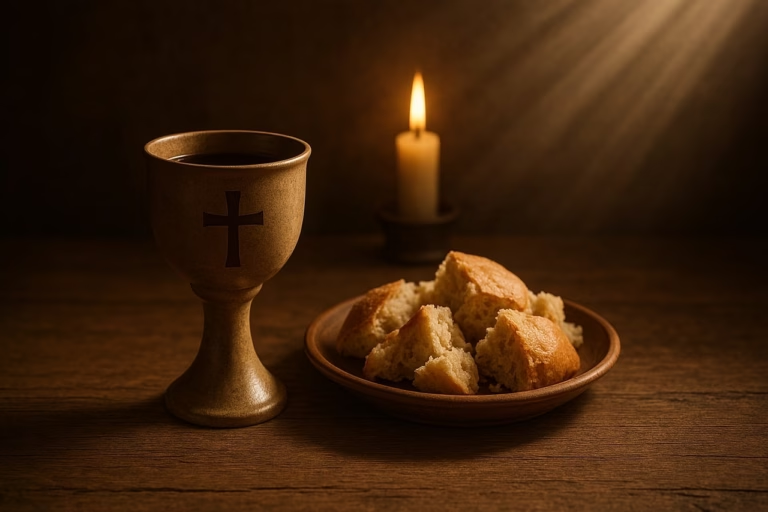
Yet, we must remember that this hatred and evil held no ultimate power over Him. On this occasion, as on many others, He escaped being put to death because His time had not yet come (John 6:7). The full depth of His words was not revealed to the disciples until the Last Supper, when He instituted the Eucharist. The piece of unleavened bread and the fruit of the vine are metaphysically—not just symbolically, but in a veiled form—His body and blood, given and shed for us. Faith reveals this reality to the spiritual eye. Jesus foresaw the Eucharist as a nurturing Sacrament for our spirits: the real presence of God, a foretaste of Heaven, and the pledge of eternal life.
The Eucharist is the physical manifestation of an invisible reality. Holy Communion is the ultimate expression of God’s presence and the communion of saints within our daily lives, carrying the promise of resurrection and eternal life. In it, we meet Jesus the humble and suffering servant; through His wounds, we encounter Christ the victorious and glorious King who will return in glory; and we are drawn into the divine mystery of the Trinity—Father, Son, and Holy Spirit. The Eucharist stands as the definitive sign of God’s unending love.
The hymn “Panis Angelicus” (“Angelic Bread”) is a thirteenth-century Latin text written for Corpus Christi by Thomas Aquinas that profoundly expresses the Catholic belief in the Real Presence. (2) Set to music by César Franck in 1872, the lyrics highlight the miraculous nature of the Eucharist, wherein the divine becomes accessible to humanity:
Panis angelicus, fit panis hominum; Dat panis coelicus figuris terminum: O res mirabilis! Manducat Dominum Pauper, servus et humilis. Pauper, servus et humilis.
Te trina Deitas unaque poscimus: Sic nos tu visita, sicut te colimus; Per tuas semitas duc nos quo tendimus, Ad luccem quam inhabitas. Amen.
The Bread of Angels becomes the bread of mankind; The heavenly Bread puts all foreshadowings to an end: Oh, miraculous thing! The poor, the servant, and the humble feed upon the Lord. The poor, the servant, and the humble.
We beseech Thee, Godhead, One in Three: So may Thou visit us, as we worship Thee; Lead us on Thy paths, to where we are going, To the light in which Thou dwellest. Amen.
The Eucharist is truly the source and summit of the Christian life. The term eucharistia in Greek means thanksgiving. (3) The Church teaches that: (1) the presence of Christ in the Eucharist is real, true, and substantial; (2) “Jesus awaits us in this sacrament of love” (st. John Paul II, Dominicae cenae, no. 3); (3) “The Eucharist makes present the one sacrifice of Christ the Savior” (ccc. No 1330); and (4) “It is called Eucharist because it is an action of thanksgiving to God” (ccc., no. 1328). “…By eating the Body and drinking the Blood of Christ in the Eucharist, we become united to the person of Christ through his humanity. In being united to the humanity of Christ, we are at the same time united to his divinity. Our mortal, corruptible natures are transformed by being joined to the source of life.” (3)
During the Liturgy of the Eucharist, the faithful bring gifts of bread and wine to the prepared altar, which will become the Body and Blood of Christ. The priest, according to the Order of the Mass, praises God for these gifts and places them upon the altar to begin the Eucharistic sacrifice. During the Eucharistic Prayer, the celebrant, acting in persona Christi (in the person of Christ), gathers the bread and wine along with all the prayers and petitions of the faithful, uniting our lives with Christ’s perfect sacrifice to offer them to the Father.
During the Consecration, the bread and wine become the ultimate Mystery of Faith—the real presence of Christ—and the congregation joins in the highest praises to God. The Communion Rite follows the Eucharistic prayer, and those who are in full communion with the Catholic Church are invited to receive Holy Communion.
The Communion Rite concludes with the Prayer after Communion, which asks that the graces of the Eucharist remain active and transformative in our daily lives. Having encountered the past in the foreshadowing of the law, and the present in the reality of the fulfillment of the Old Covenant in the New Covenant at the altar, the faithful are sent forth into the world. They are transformed by the “medicine of immortality,’ as St, Ignatius of Antioch, a prominent early Church Father and theologian from the First Century AD, referred to the Eucharist. (4) They bear within themselves the pledge of future resurrection and eternal glory.
According to the teaching of the Catholic Church the Eucharist is “not a prize for the perfect but a medicine for the sick.” (5) While we would want to receive the Sacrament of Reconciliation for grave and mortal sins before receiving the Eucharist, most of our sins, our ordinary sins and failings, should not prevent us from receiving the Eucharist. In fact, that is why we should receive the Eucharist, because it reconciles us with our Lord. (5)
According to the Catechesis of the Catholic Church, “As bodily nourishment restores lost strength, so the Eucharist strengthens our charity, which tends to be weakened in daily life; and this living charity wipes away venial sins” and allows us to be rooted in and re-connected with God (ccc 1394). So while we may feel at times unworthy to receive the Eucharist, this is because we care for receiving the Lord in a worthy manner. Exactly in times when we feel lacking, or in need of healing, and we come forward with authentic faith, is when Jesus extends healing from the very centre of God’s essence.
Sources:
- Peters, T. (2025). Catholic Bible Study: John 6:51-58, ‘I am the Bread of Life’/Corpus Christi. Retrieved from: https://www.youtube.com/watch?v=S2p-1PAYoNI. Accessed: June 2, 2026.
- Classic FM (2018). What are the Lyrics to Panis Angelicus and who wrote it? Retrieved from: https://www.classicfm.com/discover-music/panis-angelicus-lyrics-composer/
- United States Conference of Catholic Bishops (2026). Liturgy of the Eucharist. Retrieved from: www.usccb.org. Accessed: June 2, 2026.
- St. Ignatius of Antioch, Letter to the Ephesians, chap. 20, sec. 2, in The Apostolic Fathers, trans. Michael W. Holmes (Grand Rapids: Baker Academic, 2007), 133–35. Retrieved from: https://www.newadvent.org/fathers/0104.htm Accessed: June 2, 2026.
- Cole, C. (2026). The Eucharist is medicine for the sick. Retrieved from: https://www.facebook.com/reel/1443726797093319. Accessed: June 2, 2026.