The profound mystery of the Trinity invites humanity into and eternal relationship with God who is love.
GOSPEL PASSAGE: John 3:16-18
“God so loved the world that he gave his only Son, so that everyone who believes in him might not perish but might have eternal life. For God did not send his Son into the world to condemn the world, but that the world might be saved through him. Whoever believes in him will not be condemned, but whoever does believe has already been condemned, because he has not believed in the name of the only Son of God.”
GOSPEL REFLECTIONS:
While Jesus traveled preaching the Good News, large numbers of people constantly came to see Him to listen to His teaching and to be healed. During His time in Jerusalem for the Passover, in the middle of the night, another visitor arrived: a Pharisee who was a member of the Sanhedrin. His name was Nicodemus. He listened to Jesus intently and asked Him questions. Many things that Jesus said fascinated him, and many things he did not understand. Jesus spent time with him, nevertheless, patiently teaching and instructing him.
One of the things that Nicodemus had a hard time understanding was the Holy Spirit. In the ancient Sacred Scriptures, the “Spirit” of God appears several times, and each time it refers to God’s powerful deeds. For example, it represents God’s power to bring order into the world (e.g., Genesis 1:1), a vivifying power breathing life into creation (e.g., Genesis 2:7), a guiding power (e.g., Isaiah 11:2), and a healing power (Ezekiel 36:27). Jesus said to him, “Very truly I tell you, no one can enter the kingdom of God unless they are born of water and Spirit. Flesh gives birth to flesh, but the Spirit gives birth to spirit. You should not be surprised at my saying, ‘You must be born again’” (John 3:5). Jesus even poked fun at Nicodemus when he was incredulous, saying to him, “Are you a teacher of Israel and yet you do not understand these things?” (John 3:10).
The Old Testament revealed that God’s Spirit could come upon individuals and give them strength for a mission. This was temporary and not dependent on their spiritual condition (e.g., Saul, Samson, and the Judges). An indwelling was a sign of favor upon that individual (e.g., David), which could also be conditional, temporary, and last only for a certain mission (e.g., Samuel).
When Jesus promised the Holy Spirit, He was talking about a radical transformation of the person, so that they would turn their lives entirely over to God and the Spirit would permanently work within them. Regarding the work of the Holy Spirit, Jesus said, “This is the Spirit of truth, whom the world cannot receive, because it neither sees him nor knows him. You know him, because he abides with you, and he will be in you.” (John 14:17).
Nicodemus was a good teacher. He understood that listening to the word of God takes a lifetime to interpret and comprehend. He was not ashamed to admit when he did not understand. He did not fully grasp it at the time when Jesus told him, “…As Moses lifted up the serpent in the wilderness, so must the Son of Man be lifted up, that whoever believes in Him may have eternal life” (John 3:14). Nicodemus did not truly understand this until he glanced up at the cross and saw Jesus being lifted up. (1) He and a few other disciples removed Jesus’ dead body from the cross and carried it to the tomb of Joseph of Arimathea. Nicodemus showed up with one hundred pounds of incense, myrrh, and aloe—fit for the burial of a king. (1) With the simplicity of a child’s faith, Nicodemus understood then that the only way God rescues us is not by us becoming learned and self-assured, but by remaining humble and docile. Looking at the empty cross and the empty tomb, having stayed with Jesus to the end, Nicodemus understood that this was the moment when a new covenant was instituted alongside the old. After Jesus’ resurrection, he understood that our slavery to sin and death was broken, and the way to the Kingdom of Heaven was opened for all of humanity. (1)
Then, he recalled Jesus’ words, which John recorded in today’s Gospel: “For God so loved the world that he gave his only Son, so that everyone who believes in him may not perish but have eternal life” (John 3:16). With this statement, Jesus set Himself apart from all the sages, all the wise men, and all the prophets of the ages: He spoke of God the Father who sent Him, the Son, God’s only Son. Others spoke of God and acted as instructed by God. Jesus spoke in the name of God and acted with the authority of God. (2) Jesus held power over the elements of nature, over sickness, and over the human condition because He was distinct from God the Father, yet consubstantial with the Father. (2) He was God from God, light from light, who spoke with the Father and acted with the power of the Father. Jesus promised that the Father would send the Advocate, the Holy Spirit, to strengthen the Apostles in Spirit. And so, Nicodemus came to believe that Jesus was God incarnate in the world. (1)
Another thing that set Jesus apart from other prophets is that he did not talk about God’s love merely as one of God’s attributes. He stated that God is love. (2) Why was He in the world? Because of God’s love. Jesus, therefore, introduced the concept of the Trinity to Nicodemus. This was a hard lesson. According to Jewish law and teaching, there is only one God. Yet, Jesus introduced one God in three persons. How was Nicodemus to accept this?
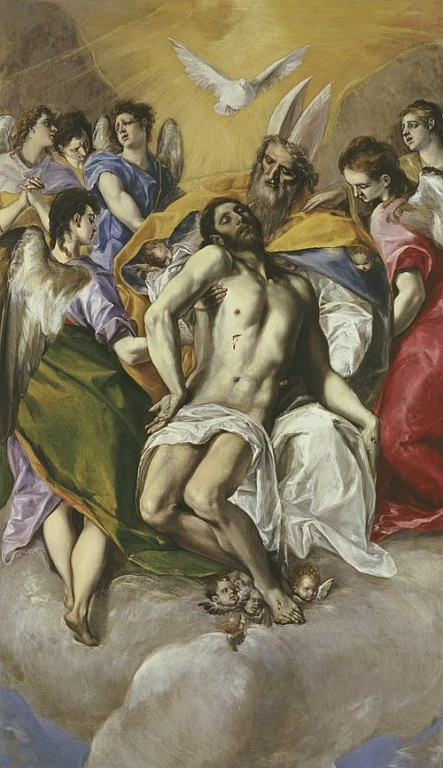
Jesus began with the Father and the Son. The Father sent the Son in love, and the Son responded to the Father in love. Jesus promised the Holy Spirit through the Father’s love. These three persons of God—God the Father, God the Son, and God the Holy Spirit—acting as one in love, were famously contemplated as the triune nature of love by Saint Augustine. If God is love, then this love, stated Saint Augustine, involves three elements that are one: a lover, a beloved, and the love they share. (3) The Father is the lover, the Son is the beloved, and the Spirit is the love that they share. Centuries later, Thomas Aquinas wrote that Jesus suffered and died according to his human nature, but as to his divine nature, he could not suffer and die. He was therefore raised in his human nature, while remaining, in His divine nature, equal to the Father. (4)
The relationship of these three persons was captured by the early Church Fathers under the term perichoresis, meaning mutual indwelling and enveloping. (5) This represents an intimacy beyond human understanding—dwelling together and enveloping one another for eternity. Everything that the Father is is communicated to the Son and to the Spirit. They share one and the same fullness of divine life. (5)
The three-dimensional aspect of a human person, who is created in the image of God, can be seen in the dimensions of body, mind, and spirit. (6) While we possess a physical body and a mind, our deepest essence is our spirit. (6) We are able to become aware of ourselves, reflect on ourselves, and love ourselves. At the same time, we are able to reach beyond ourselves while remaining the same person. The human spirit is a dynamic reality through which we can reach beyond ourselves to the transcendent. (6)
We receive the gifts of the Spirit—such as wisdom, understanding, counsel, fortitude, knowledge, piety, and fear of the Lord (Isaiah 11:2)—when we are infused with sanctifying grace, which is the very life of God within us. Our spirit is immortal and transcends time and space. Because God values our physical creation as much as our spiritual nature, at the end of the age, our spirits will be reunited with our perfect minds and glorious, resurrected bodies. As the Catechism states, “The Last judgement will reveal that God’s justice triumphs over all injustices committed by his creatures and that God’s love is stronger than death” (CCC 1039-1040; 7).
The Trinity reaching out to humanity can be understood in this way: The Father is perfection. The Son is the perfect image of the Father. Their perfect love for each other is the Holy Spirit. (2) God (the Father) so loved the world that He sent His only Son into the world (the Son) so that all who believe in Him may not perish but have eternal life, gathering us all back into the love of God through the Holy Spirit. Jesus entered all the way into death itself, but throughout His passion, He remained connected to the Holy Spirit and the Father. (2) When the Father, Son, and Holy Spirit called the Son’s human nature back into resurrection, the way for all of us to enter the Father’s love sprang wide open. Bishop Barron explained it this way: “Because God is Trinitarian, we can be saved, not outside God but through God’s grace inside God’s dynamics of grace, gathered inside the Holy Spirit.” (2)
Every human being is spirit. Beyond what we possess, our core identity is spirit. (6) Through this, every person is capable of relating to the divine Spirit of God. (6) Those who turn their lives over to God entirely link their human spirit with His Holy Spirit, entering into the shared love of the Father and the Son. The Sacraments confirm this belonging and strengthen it through grace. This prevents us from drifting; instead, we become active participants in the dynamics of God’s love. Because this love is impossible to live out alone or in isolation, it gathers us up, sustains us, and enables us to bring God’s love into the world.
According to Bishop Barron, the Sign of the Cross beautifully reminds us of this life in God. (2) The gesture starts by touching our forehead, symbolizing God the Father. Next, we touch our body below our chest, symbolically recalling how God sent His Son down into the world so that we might be gathered into the Holy Spirit through the love that connects them. Finally, we touch our left shoulder and then our right, signaling that from one end of the world to the other, love gathers and carries us.
This boundless love is exactly what we celebrate on Trinity Sunday. Nicodemus did not initially understand the full light. But he stayed, he witnessed the first dawn of that light, and ultimately, he believed. That same eternal flame of God’s love is what we celebrate today.
Sources:
- Oblates of the Virgin Mary (2024). Understanding John 3:16 – Fr. Peter Bible Study. Retrieved from: https://www.youtube.com/watch?v=KcbRnDE0t7A. Accessed: May 25, 2026.
- Barron, R. (2023). To the Father, Through the Son, in the Spirit. Trinity Sunday. 9th week of Ordinary Time. Retrieved from: https://www.wordonfire.org/videos/sermons/to-the-father-through-the-son-in-the-spirit/. Accessed: may 25, 2026.
- Augustine of Hippo (2002). Augustine: On the Trinity Books 8-15. Cambridge University Press. ISBN 978-0-521-79665-1. Page 26.
- Aquinas, Thomas (1975). Summa Contra Gentiles: Book 4: salvation Chapter 4. University of Notre Dame Press. ISBN 978-0-268-07482-1. Page 91.
- White, T. J. (2019). What is periochoresis? Retrieved from: https://share.google/bY0G00PJFzEzQpvEA.
- Frankl, V. E. (2000). Man’s search for ultimate meaning. New York, NY: Basic Books.
- Catholic Church (1997). Catechism of the Catholic Church (2nd ed.) Libreria Editrice Vaticana.