
Pentecost is a feast of the Third Person of God, God the Holy Spirit. The Three Persons of God, God the Father, Son and Holy Spirit act in communion, perfect harmony in unity and diversity.
GOSPEL PASSAGE: John 20:19-23
On the evening of that first day of the week, when the doors were locked, where the disciples were, for fear of the Jews, Jesus came and stood in their midst and said to them, “Peace be with you.” When he had said this, he showed them his hands and his side. The disciples rejoiced when they saw the Lord. Jesus said to them again, “Peace be with you. As the Father has sent me, so I send you” And when he had said this, he breathed on them and said to them, “Receive the Holy Spirit. Whose sins you forgive are forgiven them, and whose sins you retain are retained.”
GOSPEL REFLECTIONS:
Today’s Gospel provides the clearest account of Jesus commissioning His apostles to carry on His mission, just as He was sent by the Father. When Jesus institutes the Sacraments, he envisions us growing in communion with God and nurtured in graces according to the image of a perfect harmony of unity in diversity.
While the Synoptic Gospels (Matthew, Mark, and Luke) conclude their earthly narratives with Jesus’ ascension into heaven, John’s Gospel provides a unique, intimate detail: Jesus appears to the disciples on the very day of the Resurrection and breathes His Spirit upon them.
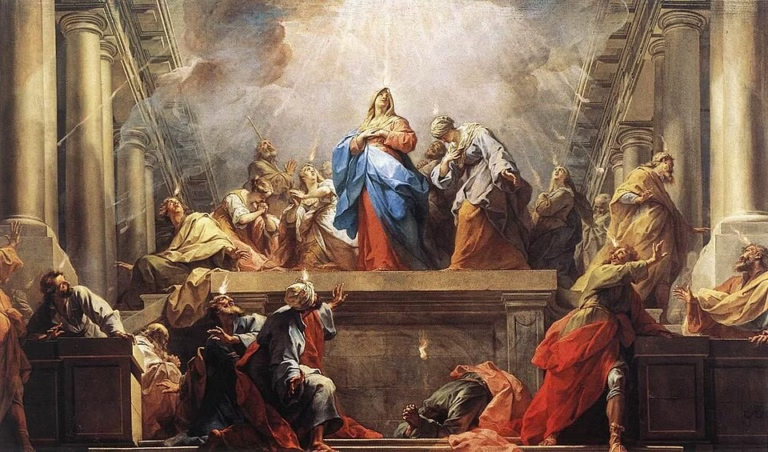
In the Acts of the Apostles, traditionally attributed to Luke, we find a description of what Pentecost looked like: (1)
“…They were all together in one place. And suddenly from heaven there came a sound like a rush of a violent wind, and it filled the entire house where they were sitting. Divided tongues, as of fire, appeared among them, and a tongue rested on each one of them. All of them were filled with the Holy Spirit and began to speak in other languages, as the Spirit gave them ability.” (Acts 2:1-4).
The events in today’s Gospel actually took place seven weeks prior to that public Pentecost, occurring on the day of the Resurrection while the disciples were gathered in the Upper Room. Through locked doors—which were closed to the world but open to God—Jesus came, stood among them, and said, “Peace be with you” (John 20:19). By showing them His hands and His side, He reassured the disciples of His identity and confronted them with the reality of His wounds. These wounds, inflicted on Jesus’ body through human sin, error, and judgment, were transformed into sources of grace flowing into the world, winning our salvation. (2) God’s redemptive action is confirmed as Jesus repeats, “Peace be with you” (John 20:21).
The next words of Jesus, “As the Father has sent me, so I send you” (John 20:21), represent an unmistakable imparting of a divine mission. Just as the Father entrusted the Son, Jesus sends His followers into the world to proclaim God’s plan of salvation. (3) This marks the beginning of the New Covenant, which fulfills the Old Covenant and extends to all humanity.
When Jesus breathed on them and said, “Receive the Holy Spirit” (John 20:22), the scene intentionally echoes Genesis 2:7: “…then the Lord God formed man from the dust of the ground and breathed into his nostrils the breath of life; and the man became a living being.” (2,3) When Jesus breathed His Spirit—the Spirit of God—upon the disciples, their new lives began as members of a community sent to be His witnesses to the ends of the earth. We consider this moment the birth of the Church, and this commissioning marks the beginning of the priestly ministry. (3)
Jesus told the disciples, “If you forgive the sins of any, they are forgiven them; if you retain the sins of any, they are retained” (John 20:23). This statement confirms the Apostles’ authority to forgive the sins of those who repent and seek reconciliation with God. (3) This is the moment Jesus instituted the Sacrament of Reconciliation—a visible symbol of God’s forgiveness communicated through the words of the Apostles and, today, their representatives, the ordained priests. (3)
Tracing the earthly ministry of Christ reveals how the seven Sacraments were instituted as historical and spiritual milestones:
- The Sacrament of Matrimony: Instituted during the Wedding at Cana and affirmed in His teachings on marriage (Matthew 19:4-6, John 2:1-11).
- The Sacrament of Baptism: Participated in during His own baptism and formalized during the Great Commission before His Ascension (Matthew 28:19).
- The Sacrament of the Anointing of the Sick: Established through Jesus’ healing ministry and later declared as a Church practice by the Apostle James (Mark 6:13, James 5:14-15).
- The Sacrament of Reconciliation: Instituted on Easter Sunday when the risen Jesus appeared to the disciples, breathed His Spirit upon them, and granted them authority to forgive sins (John 20:22-23).
- The Sacrament of the Holy Eucharist: Instituted on Holy Thursday during the Last Supper, when Jesus blessed the bread and wine, declared them to be His Body and Blood, and commanded His followers to receive Him (Matthew 26:26-28).
- The Sacrament of Holy Orders: Instituted during the Last Supper with the command, “Do this in memory of me” (Luke 22:19, 1 Corinthians 11:24), and uniquely empowered when He breathed His Spirit upon them for the forgiveness of sins (John 20:22) before issuing the Great Commission (Matthew 28:19).
- The Sacrament of Confirmation: Instituted on the Day of Pentecost, when the Holy Spirit was poured out upon the disciples, empowering them to spread the Gospel with courage (Acts 2:1-4).
These seven Sacraments, the visible signs of God’s invisible grace, act as channels of power and strength from the Father, the Son, and the Holy Spirit to nourish our faith, help us grow in holiness, and guide us through every major stage of life. (4)
The Sacraments are “powers that come forth from the Body of Christ, which is ever-living and life-giving.” (4) They are actions of the Holy Spirit at work in His Body, the Church—the “masterworks of God” in the new and everlasting Covenant. (4)
“They impart grace in a fruitful manner, allowing us to worship God rightly and practice charity.” (4)
These seven Sacraments remain fully available to us today, continuing the divine mission that began when Jesus first appeared in the locked room to commission His disciples to carry on His work in the world. God the Father, God the Son and God the Holy Spirit, are with us through these graces as One.
Through our differences, different languages, cultures and traditions, the Spirit brings us together into one community where we are fashioned according to God’s vision in harmony, celebrating our unity in diversity.
From the center and the heart, we are sent out in every corner of the world to bring that light which God entrusts us with.
With the help of the Holy Spirit, we are enabled to share the flame of God’s love with courage.
Through our different gifts, we are the living Body of Christ.
Sources:
- Britannica (2026). Acts of the Apostles. Retrieved from: www.britannica.com. Accessed: May 17, 2026.
- Barron, R. (2025). Everything Has Changed. Retrieved from: https://www.wordonfire.org/videos/sermons/everything-has-changed/ Accessed; May 7, 2026.
- Peters, T. (2026). Pentecost Sunday, Gospel Reflection, Year A, Father Tim Peters. Retrieved from: https://www.youtube.com/watch?v=5HnpUayerEc. Accessed: May 17, 2026.
- Roman Catholic Archdiocese of St. John’s (2026). Sacraments. Retrieved from: rcsj.org. Accessed: May 17, 2026.