
The ministry of Jesus and His apostles is a profound journey that transcends simple geography, weaving through complex physical terrains and the even more intricate landscapes of the human heart. Today’s Gospel reading explores how these nonlinear, winding paths, from the shores of Galilee to the ends of the earth, reveal a divine plan that transforms doubt into a purposeful mission for the glory of God.
GOSPEL PASSAGE: Matthew 28:16-20
The eleven disciples went to Galilee, to the mountain to which Jesus had ordered them. When they saw him, they worshipped, but they doubted. Then Jesus approached and said to them, “All power in heaven and on earth has been given to me. Go, therefore, and make disciples of all nations, baptizing them in the name of the Father, and of the Son, and of the Holy Spirit, teaching them to observe all that I have commanded you. And behold, I am with you always, until the end of the age.”
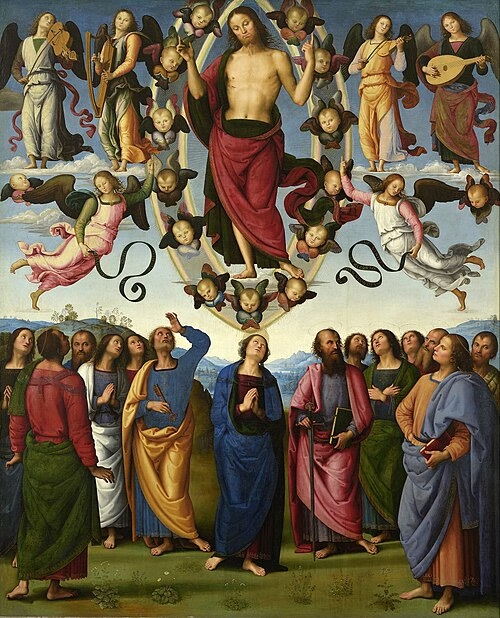
GOSPEL REFLECTIONS:
Jesus’ ministry was not linear, nor was it planar. It included nonlinear, saccadic, circular, and meandering paths, winding through complex terrains and dimensionally complex domains. These winding paths through Galilee and Judea were mirrored by the winding paths of the disciples’ hearts—moving from confusion and fear to a rooted, unshakeable peace. Their physical exhaustion on the road became the soil in which spiritual endurance was grown. The journey unfolded as it progressed, and its meaning and purpose became clear.
As we followed Jesus, we traveled from Bethlehem, where He was born, to Egypt, then back to Nazareth. We accompanied Him to Jerusalem, the River Jordan where He was baptized, and the Judean wilderness. From there, we moved to Cana, where He performed the first miracle, and Capernaum, where He invited the apostles and started to teach. From there we went to Nain, where He raised the widow’s son; the regions of the Decapolis, Tyre, and Sidon where He performed miracles; and Mount Hermon, the place of the Transfiguration.
During the final week of His ministry, we were with Him in Jericho, where He healed the blind man and met Zacchaeus; in Bethany, where He raised Lazarus from the dead; and the Mount of Olives and Bethphage, from where He entered Jerusalem. We saw Him teaching in the Temple, met Him in the Upper Room, followed Him to Gethsemane where He was arrested, and went into Jerusalem where He was tried and crucified on the hills of Golgotha. He was buried just opposite those hills, in the tomb of Joseph of Arimathea. After the Resurrection, He appeared to the disciples in Emmaus and by the Sea of Galilee. The Ascension took place near Jerusalem, on the Mount of Olives. (1)
Observing the trajectories of Jesus’ ministry, we see it as a pattern going from north to south, south to north, and from east to west, and west to east. After His death, He descended into hell and ascended to the Father. While His path followed a winding pattern, it was all part of the Divine plan.
Eleven disciples followed Him and stayed in Jerusalem until Pentecost. From there, they went in all directions of the world:
- Peter journeyed to Antioch and later to Rome, where he was crucified.
- Andrew went to Scythia (modern-day Ukraine and Russia) and Greece, where he was crucified.
- James the Greater preached in Spain and Jerusalem before being martyred.
- John remained in Ephesus and was later exiled to Patmos, where he died in old age.
- Philip preached in Phrygia (Asia Minor and modern-day Turkey).
- Bartholomew traveled to Armenia and India.
- Thomas preached in Persia and India.
- Matthew taught in Ethiopia and Persia.
- James the Lesser preached in Jerusalem and in Syria.
- Jude traveled through Syria, Iraq, and Persia.
- Simon the Zealot preached in North Africa and Persia. (2)
Jesus’ ministry started in Galilee and, after Jesus’ resurrection, it continued with the Great Commission: the sending of the disciples to proclaim the Gospel to the entire world. (3) To receive this message, Jesus instructed the apostles to journey from Jerusalem back to Galilee, where He first invited them. By returning to the shores where they first dropped their nets, the disciples realized that the Great Commission was not a brand-new task, but the fulfillment of the very first call. Jesus didn’t just give them a new destination; He gave them a new way of seeing the world they were about to traverse.
On the shores of the Sea of Galilee, Jesus appeared to the disciples who had been fishing. He instructed them to cast their net to the right side of the boat, resulting in such a great catch that they could not haul it in (John 21:1-6). He restored Peter, who had denied Him three times, saying to him, “Feed my lambs” (John 21:15-17). When they thought it was all over and they had gone back to what was familiar, what they were accustomed to, but Jesus had other plans for them.
The apostles obeyed, and they all went to the mountain that Jesus had directed them to. They believed that He was risen from the dead, but forty days after His resurrection, some still doubted. This passage illustrates that in our faith journey, despite having assurances, we may doubt; this is entirely human. At such times, Jesus invites us to return to the basics, to the very beginning. We go to a place where we feel safe, and in this place, He will meet us and gradually restore our faith. Then, we will be able to engage with the world again, and our strength with Him will be even more powerful than before, from a time when we were not yet fully prepared for what God has in store for us.
The command to “go” recalls when the Lord called Abaraham from Ur of the Chaldeans (Genesis 12:1-3), with a promise, which journey continued with the Israelites wandering in the wilderness on their journey towards the promised Land, which promise reached its fulfillment in Christ:
“Indeed, just as Abraham was commanded to leave the Ur of the Chaldeans to journey towards the promised land, so now the disciples have to leave behind all that they know as they preach the news of the Kingdom—promises which reach fulfillment in Christ.” (3)
As promised, Jesus met them on that mountain in Galilee and said to them: “All authority in heaven and on earth has been given to me.” With this, He sealed the Biblical vision of the Prophet Daniel (Chapter 7:13-14):
“I saw one like a human being coming with the clouds of heaven. And He came to the Ancient One and was presented before Him. To him was given dominion and glory and kingship, that all peoples, all nations, and languages should serve him. His dominion is an everlasting dominion that shall not pass away, and his kingship is one that shall never be destroyed.”
And Jesus sent the disciples into the world with the words, “Go, therefore, and make disciples of all nations, baptizing them in the name of the Father, and of the Son, and of the Holy Spirit, teaching them to observe all that I have commanded you.” He spoke of the commandments of the One God in three persons, revealed through the Father, through the incarnation of the Son, and through the Holy Spirit. This revelation connects history from past to present and future, where God dwells among His people and “all the nations shall see the glory of the Lord” (Isaiah 40:5 and 66:18).
Initially, the disciples approached the Jewish diaspora and the first Christian communities. Later, they went further and bolder to faraway lands. Jesus sent them as witnesses. And remember, He said, “I am with you always, to the end of the age.” Though Jesus ascended, He did not leave them without a guide for the complex terrains ahead. The Holy Spirit became their internal compass, turning their meandering paths into a purposeful mission that would eventually redraft the map of the known world.
Through prayer and in the Eucharist, Jesus slowly prepares, strengthens, supports, and accompanies us, so that what we do in His name is accomplished for His glory.
Sources:
- Maas, A. (1910). Chronology of the Life of Jesus Christ. In The Catholic Encyclopedia. New York: Robert Appleton Company. https://www.newadvent.org/cathen/08377a.htm
- Emmons, D. D. (2021). Getting to know the apostles. Saints and Spirituality. Retrieved from: https://www.oursundayvisitor.com/getting-to-know-the-apostles/. Accessed; May 11, 2026.
- Peters, T. (2026). Matthew 28:16-20. The Ascension, 7th Sunday of Easter: Gospel Reflection, Year A, Fr. Tim Peters.