

Upon the completion of His earthly mission, Jesus’ assurance of His presence and the beatific vision of unity changes the possibility of our relating to the Father from a promise to a firm certainty. This certainty offers us a foretaste of the beatific vision, an ultimate unity with God, beginning even now, through grace. The reality of this promise probes the hearts and minds of the faithful as it invites to pray for more than signs or miracles—it is a call for conversion.
GOSPEL PASSAGE: John 14:1-14
Jesus said to his disciples: “Do not let your hearts be troubled. You have faith in God; have faith also in me. In my Father’s house there are many dwelling places. If there were not, would I have told you that I am going to prepare a place for you? And if I go and prepare a place for you, I will come back again and take you to myself, so that where I am you also may be. Thomas asked him, “Master, we do not know where you are going; how can we know the way?” Jesus said to him, “I am the way and the truth and the life. No one comes to the Father, except through me. If you know me, them you will also know mt Father. From now on, you do know him and have seen him.” Phillip said to him, “Master, show us the Father and that will be enough for us.” Jesus said to him, “Have I been with you for so long a time and you still do not know me, Philip? Whoever has seen me has seen the Father. How can you say, “Show us the Father?” Do you not believe that I am in the Father and the Father is in me? The words that I speak to you; I do not speak them on my own. The Father who dwells in me is doing his works. Believe me that I am in the Father and the Father is in me, or else, believe because of the works themselves. Amen, amen, I say to you, whoever believes in me will do the works that I do, and will do greater ones than these, because I am going to the Father. I will do whatever you ask in my name, so that the Father may be glorified in the Son. If in my name you ask me for anything, I will do it.”
GOSPEL REFLECTIONS:
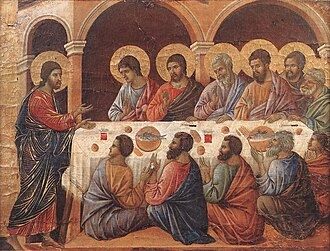
Today’s Gospel makes us privy to the last instructions Jesus gave to His disciples during the Last Supper. After telling them that He is giving them a new commandment—to “…love one another… Just as I have loved you, you also should love one another” (John 13:34)—Jesus tells them that He will be with them only a “little longer” (John 13:33). He declares, “Now the Son of man has been glorified, and God has been glorified in him” (John 13:31). Jesus then speaks of His departure: “Where I am going, you cannot come” (John 13:33). He was preparing them, for the last time, to be spiritually ready for the suffering He would endure and His resurrection, after which He would ascend to the throne of the Father in Heaven, from where He will come again in glory.
The disciples became restless upon hearing these words, and their thoughts went immediately to the most concrete aspect of the message: that things will change. Jesus will go to a place where they cannot yet follow Him; they will not hear Him or see Him the same way as before. So, Jesus broke down this message to explain its reason. He spoke to them kindly, listened to their concerns, and answered them reassuringly. As we read these words, they speak to us—who cannot see Jesus after His resurrection as the disciples did, and who must carry on the mission He entrusted to them. Perhaps the disciples’ concerns are etched in our daily realities as we experience fragmentation and discord, and struggle to find Jesus’ closeness amidst chaotic lives and sorrows. Perhaps His words are just as soothing and comforting to us in these times.
For Jesus says, “Do not let your hearts be troubled. Believe in God, believe also in me” (John 14:1). This preface says that as we honor God the Father, we should honor God the Son—not as different gods, but one God in the persons of the Father and the Son. Later, in John chapter 14 (15-31), Jesus also spoke about God the Holy Spirit. He promised that the Father will send the Holy Spirit to strengthen the disciples; thus, we honor God in three persons: Father, Son, and Holy Spirit. As one honors the Father and believes in His promises, the same applies to the promises of Jesus. With this statement, He underlines His authority and affirms that His promises will be kept.
Next, Jesus tells the disciples where He is going and why: “In my Father’s house there are many dwelling places. If it were not so, would I have told you that I go to prepare a place for you? And if I go and prepare a place for you, I will come again and I will take you to myself, so that where I am, there you may be also. And you know the way to the place where I am going” (John 14:2-4). This place is in the presence of the Father in the Kingdom of Heaven. Jesus promises to return as the glorious Messiah to gather all that belongs to the Father and unite it with the Kingdom of Heaven forever.
But the first concern arises. Thomas speaks up from among the twelve and says: “Lord, we do not know where you are going, how would we know the way?” (John 14:5). Thomas’ concern has to do with the unimaginable presence of the Father, which no human being has seen or can conceive. Concretely: which road takes us there? How do we follow Jesus? While a very earthly question, it is a very pertinent one.
This leads to Jesus’ important self-statement: “I am the way, and the truth, and the life. No one comes to the Father except through me” (John 14:6). This is clarified when Jesus adds: “If you know me, you will know my Father also. From now on you do know him and have seen him” (John 14:7). Jesus, God the Son, was incarnate to reveal the ways that are pleasing to God the Father. He lived, ate, drank, and taught on this earth, and the disciples learned from Him. His message was recorded in the Sacred Scriptures, and He promised His presence in prayer and in the Sacraments. This mission was the fulfillment of the Father’s desire to make the Son known to the world, helping us to be close to God and to know Him in a personal way.
The next concern was raised by Philip, who asked Jesus for the greatest miracle ever requested by a human being: to be shown the face of the Father. This was a humanly impossible wish in this life, because it was not the plan of the Father to show Himself directly. He sent the Son so that they may relate to God in a personal manner—through sight, touch, hearing, and feeling. So, Jesus appealed to reason: Jesus shows us the will and the ways of the Father. He is the way in which the Father chose to be known to us. Jesus underscored that all the signs, miracles, and healings were done through Him by the Father.
The Catholic Catechism explains that “Because of his transcendence, God cannot be seen as he is, unless he himself opens up his mystery to man’s immediate contemplation and gives him the capacity for it. The Church calls this contemplation of God in his heavenly glory ‘the beatific vision.‘” (1) Pope Benedict XII, in 1336, wrote that: “…the blessed in heaven see the divine essence with an intuitive vision and even face to face, without the mediation of any creature.” (2)
Thus, while the direct vision of God’s essence is the reward of the blessed in Heaven, Jesus reveals that He is the visible sign of the invisible God—“…the image of the invisible God, the firstborn of all creation” (Colossians 1:15).
And Jesus offered a wonderful promise: “Very truly, I tell you, the one who believes in me will also do the works that I do and, in fact, will do greater works than these, because I am going to the Father. I will do whatever you ask in my name, so that the Father may be glorified in the Son” (John 14:12-13). How are we to interpret this? Can any of us do greater things than Jesus? For the sake of the Father, and in accordance with His wishes, Jesus says that signs and wonders will be possible through the will of the Father. This means that when we ask in Jesus’ name, all that is the Father’s will will be accomplished through supplication. Through prayer, we ask to be united with the will of the Father, so that His will may be done through us—imperfect, finite, and fallible servants.
In Catholic tradition, the ‘greater works’ refer to the outpouring of the Holy Spirit through the Church. (3) While Jesus’ earthly ministry was localized, the ‘greater works’ of the faithful involve the conversion of nations and the administration of the Sacraments, bringing the miracle of God’s justifying grace to every corner of the world. (3)
Specifically, the Catechism states that “The mission of Christ and the Holy Spirit is brought to completion in the Church… The Spirit prepares men and goes out to them with his grace, in order to draw them to Christ. The Spirit manifests the risen Lord to them, recalls his word to them and opens their minds to the understanding of his Death and Resurrection. He makes present the mystery of Christ, supremely in the Eucharist, in order to reconcile them, to bring them into communion with God, that they may ‘bear much fruit” (3)
This teaching comes from the works of Saint Augustine who argued that converting a soul from sin to grace is a “greater work” than even the creation of the heavens and the earth, and therefore, greater than signs or miracles: “For he that believes on me, the works that I do shall he do also; and greater works than these shall he do… It is a greater work to make a righteous man out of a sinner than to create heaven and earth.” (4)
The same idea was upheld by Thomas Aquinas, who stated that “…the justification of the ungodly is the greatest work of God because it has an eternal effect, whereas physical miracles (like healing the blind) are temporal and pass away.” (5)
About the “conversion of nations” and “every corner of the world,” the Decree on the Mission Activity of the Church, explains that “…the Holy Spirit was sent on Pentecost to ‘exercise the mission of Christ’ through the Church, allowing the Gospel to be preached to all nations so that what began in Jesus might be fulfilled globally.” (6)
This is a great commission which ends with the beatific vision: God will gather us all in His loving arms when Jesus returns. But He will not leave us to face the challenges of life alone as we await His return; He promises that God abides with us personally through Jesus. God reaches down to us, gathers us into one, and cares for us singularly every step of the way.
To the anxious of heart, the oppressed, the poor, and the suffering, God offers His steadfast presence through Jesus. What we ask may be impossible for us, but it is not impossible for God. Everything may happen to us, but with God, we have the certainty of His presence and a larger, Divine plan, which includes a beatific vision of eternal unity in His kingdom. Jesus’ promise means that being in the presence of God here and now is not just a possibility, but a certainty.
Conversion of the heart is the greatest work of grace—the action of God in a person’s innermost essence–because it offers a foretaste of the beatific vision and an eternal unity that surpasses temporal physical signs and miracles. Turning from despair to hope are the signs of such healing as a result of restoring the disjointed connection between the essence of a person, their spirit, and God.
While a physical miracle (like healing the blind) is a sign of God’s power over matter, the conversion of a heart is a sign of God’s power over spirit. Because the soul is immortal, a spiritual healing has eternal consequences, whereas a physical healing is only for this life. Spiritual healing, which restores the connection between the human spirit and God is known as justification or sanctification. (7)
Mental healing occupies a place between regaining temporal health, such as in physical healing, and spiritual healing, restoring a broken relationship with God. Its signs are mental and emotional well being and interior peace. There is a connection between spiritual healing (healing of the heart) and mental healing (healing of the soul, or healing of the mind) because mental healing helps a person open up to spiritual grace. Opening up to spiritual grace can aide mental healing. (8)
Physical healing or miracle is a sign that is supposed to pint at a greater and deeper reality and that is the relevance of the healing of the soul. When God grants a physical healing through a miracle, it is thought to be to increase that person’s faith or the faith of the community in order that conversions may occur. (9) The Catechism explains that “By freeing some individuals from the earthly evils of hunger, injustice, illness and death, Jesus performed messianic signs. Nevertheless, he did not come to abolish all evils here below, but to free men from the gravest slavery, sin, which thwarts them in their vocation as God’s sons and causes their earthly enthrallment.” (9) God will vanquish all evil upon the second coming of Christ. (10)
Furthermore, the Catechism says that when despite prayer, physical or mantal healing does not come about, suffering can take on a new dimension and a new meaning: “Christ’s compassion toward the sick… does not take away all suffering… He gave a new meaning to suffering: it can henceforth configure us to him and unite us with his redemptive Passion.” (11)
Beyond a miracle, a mystery (mysterium) is a reality so deep that it can never be fully exhausted. The “mystery of faith” is the work of grace in the soul, which is more hidden and profound than a visible miracle. It is more significant because it prepares the spirit for eternal union with God.
It is important to note that the Catholic Church does not neglect the body and the mind, and Catholics believe that at the end of times, Jesus, as He promised, will reunite our spirits with our glorified bodies and perfect minds. (11, 12, 13, 14) However, the emphasis, if a choice had to be made about the type of prayer, is to prefer spiritual healing and the re-establishment of a relationship with God. In limit situations this is done through the administration of a final blessing, and the Viaticum, the Eucharist for the dying, or reconciliation, over praying for a physical cure per se. (15, 16)
The church also works with the medical professions to bring about the cure of the body and the mind. Pastoral care is used in encouraging the spirit. Seeking medical care and psychological care is not seen as a sign of lack of faith. On the contrary, encourages prayer that healing may be achieved through the work of the medical professionals. Working side by side, the Church offers its Sacraments, mostly reconciliation and the Eucharist, to facilitate a complete and total healing of the person as a body, mind and spirit entity. (17, 18, 19)
The late Pope Francis often cited a document written by Pope John Paul II on the Christian Meaning of Human Suffering: “Christ does not explain in the abstract the reasons for suffering, but before all else he says: ‘Follow me!’ Come! Take part through your suffering in this work of saving the world.” (19) Consequently, Pope Francis remarked, “Every medical action must have as its goal the integral good of the person… including their spiritual and transcendent dimension.” (20)
The Charter for Health Care Workers (first published in 1994 and re-published in 2016) by the Pontifical Council for Pastoral Assistance to Health Care Workers emphasizes that scientists and health care workers should never lose sight of the dignity of the person. Its main thesis is that the Church supports medical research, psychiatry, and palliative care, provided they respect the person’s dignity as an image of God (Imago Dei). (21)
Sources:
- Catholic Church. (2000). Catechism of the Catholic Church (2nd ed.). Paragraph 1028. Libreria Editrice Vaticana. https://www.vatican.va/archive/ENG0015/_INDEX.HTM
- Benedict XII. (1336). Benedictus Deus [On the beatific vision of God]. The Holy See. https://www.vatican.va/content/benedict-xii/en.html
- Catholic Church. (2000). Catechism of the Catholic Church (2nd ed.). Paragraph 737. Libreria Editrice Vaticana. https://www.vatican.va/archive/ENG0015/_INDEX.HTM
- Augustine. (n.d.). Tractates on the Gospel of John (J. Gibb & J. Bird, Trans.). New Advent. https://www.newadvent.org/fathers/1701072.htm (Original work published ca. 406–420).
- Aquinas, T. (n.d.). Summa theologiae (Fathers of the English Dominican Province, Trans.). New Advent. https://www.newadvent.org/summa/2113.htm#article9 (Original work published 1265–1274).
- Catholic Church. (1965, December 7). Vatican II Council. Ad gentes [Decree on the mission activity of the Church]. The Holy See. https://www.vatican.va/archive/hist_councils/ii_vatican_council/documents/vat-ii_decree_19651207_ad-gentes_en.html
- Aquinas, T. (n.d.). Summa theologiae (Fathers of the English Dominican Province, Trans.). New Advent. https://www.newadvent.org/summa/2113.htm#article9 (Original work published 1265–1274).
- Catholic Church. (2000). Catechism of the Catholic Church (2nd ed.). Paragraph 2710 (On contemplative Prayer lifting heart and mind). Libreria Editrice Vaticana. https://www.vatican.va/archive/ENG0015/_INDEX.HTMCCC 2710
- Catholic Church. (2000). Catechism of the Catholic Church (2nd ed.). Paragraph 549. Libreria Editrice Vaticana. https://www.vatican.va/archive/ENG0015/_INDEX.HTM
- Catholic Church. (2000). Catechism of the Catholic Church (2nd ed.). Paragraph 677. Libreria Editrice Vaticana. https://www.vatican.va/archive/ENG0015/_INDEX.HTM
- Catholic Church. (2000). Catechism of the Catholic Church (2nd ed.). Paragraph 1505. Libreria Editrice Vaticana. https://www.vatican.va/archive/ENG0015/_INDEX.HTM
- Catholic Church. (2000). Catechism of the Catholic Church (2nd ed.). Paragraph 999. Libreria Editrice Vaticana. https://www.vatican.va/archive/ENG0015/_INDEX.HTM
- Catholic Church. (2000). Catechism of the Catholic Church (2nd ed.). Paragraph 1023. Libreria Editrice Vaticana. https://www.vatican.va/archive/ENG0015/_INDEX.HTM
- Catholic Church. (2000). Catechism of the Catholic Church (2nd ed.). Paragraph 1005. Libreria Editrice Vaticana. https://www.vatican.va/archive/ENG0015/_INDEX.HTM
- Catholic Church. (2000). Catechism of the Catholic Church (2nd ed.). Paragraph 1446. Libreria Editrice Vaticana. https://www.vatican.va/archive/ENG0015/_INDEX.HTM
- Catholic Church. (2000). Catechism of the Catholic Church (2nd ed.). Paragraph 1525. Libreria Editrice Vaticana. https://www.vatican.va/archive/ENG0015/_INDEX.HTM
- Catholic Church. (2000). Catechism of the Catholic Church (2nd ed.). Paragraph 2293. Libreria Editrice Vaticana. https://www.vatican.va/archive/ENG0015/_INDEX.HTM
- Catholic Church. (2000). Catechism of the Catholic Church (2nd ed.). Paragraph 1503. Libreria Editrice Vaticana. https://www.vatican.va/archive/ENG0015/_INDEX.HTM
- Pontifical Council for Pastoral Assistance to Health Care Workers. (2016). New charter for health care workers. Libreria Editrice Vaticana. https://www.vatican.va/roman_curia/pontifical_councils/hlthwork/index.htm
- Francis. (2019, June 22). Address to the participants in the Congress of the World Federation of Catholic Medical Associations (FIAMC). The Holy See. https://www.vatican.va/content/francesco/en/speeches/2019/june/documents/papa-francesco_20190622_fiamc.html
- Pontifical Council for Pastoral Assistance to Health Care Workers. (2016). New charter for health care workers. Libreria Editrice Vaticana. https://www.vatican.va/roman_curia/pontifical_councils/hlthwork/index.htm