

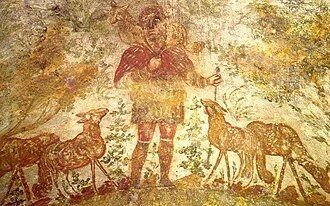
The parable of the Good Shepherd was shared in Jerusalem after Jesus had healed a blind man and opened his eyes. It is part of the discourse Jesus held with those who were searching for and debating His identity. Jesus uses the pastoral metaphor of a shepherd caring for his sheep as a powerful declaration about Himself. He states that He cares for God’s people in a way that no king or other worldly power can. Only God can give life and lead us on paths that never fail.
GOSPEL PASSAGE: John 10:1-10
Jesus said: “Amen, amen, I say to you, whoever does not enter the sheepfold through the gate but climbs over elsewhere is a thief and a robber. But whoever enters through the gate is the shepherd of the sheep. The gatekeeper opens it for him, and the sheep hear his voice, as the shepherd calls his own sheep by name and leads them out. When he has driven out all his own, he walks ahead of them, and the sheep follow him, because they recognize his voice. But they will not follow a stranger; they will run away from him, because they do not recognize the voice of strangers. Although Jesus used this figure of speech, the Pharisees did not realize what he was trying to tell them.
So, Jesus said again, “Amen, amen, I say to you, I am the gate for the sheep. All who come before me are thieves and robbers, but the sheep did not listen to them. I am the gate. Whoever enters through me will be saved and will come in and go out and will find pasture. A thief comes only to steal and slaughter and destroy; I come so that they might have life and have it more abundantly.”
GOSPEL REFLECTIONS:
Ever since the time of the prophets—Jeremiah, Ezekiel, Hosea, and Micah—the Jewish people had been longing for the coming of the Messiah. In the Sacred Writings, they are frequently referred to as scattered sheep with no shepherd. The prophet Micaiah, for example, describes “all Israel scattered on the mountains, as sheep that have no shepherd” (1 Kings 22:17). Moses also requested a new leader for the Israelites so they would not be “as sheep which have no shepherd” (Numbers 27:17). Later, Ezekiel (34:5-8) condemns the leaders of Israel who fed themselves instead of protecting the flock, allowing them to become prey for predators.
In response to the failures of these leaders, the prophecies foresee a time when God will bring His flock back to their own land and be their shepherd. They foretell the re-establishment of the Davidic line in the person of the Savior, the Messiah, who will rule the people with justice and equity and bring everlasting peace. In Ezekiel 37:22-28 we read, “My dwelling place shall be with them; and I will be their God, and they shall be my people. Then the nations shall know that I the Lord sanctify Israel, when my sanctuary is among them forevermore.” The image of the sheep and the shepherd is a particularly endearing metaphor, one that we encounter beautifully in Psalm 23: “The Lord is my shepherd; I shall not want….”
The image of the shepherd and the sheep was dear to the pastoral people of Israel, who often saw herds grazing in the oases of the desert. The flocks were led by a shepherd who knew the seasons and understood when and where to find the specific nourishment the sheep needed: lush, gentle grass and clover during the spring; thicker grass and broad-leaf plants in the summer; and dry branches and hay in the winter. These shepherds were ever watchful for wild beasts lurking in the shadows of the cliffs, preying on the young or the ill, and they were mindful of the traps and crevices that could cause injury. They guided the sheep with their voices, walking ahead of them. The sheep, who are quite near-sighted, listened for the sound of familiar whistles and promptings to follow their leader. Conversely, they showed fear toward strangers or those who commanded them with harshness or ignorance.
This caring image of the Good Shepherd is what Jesus used in reference to Himself as the King of Israel and the Messiah sent by God the Father. The imagery spoke deeply to His audience, yet it posed a challenge for the “learned” listeners. The Pharisees, Sadducees, and Scribes kept the commandments and feared God, but they were caught up in the political administration of the kings and princes of Israel. They expected a powerful warrior king who would deliver them from their foes and crush their enemies with overpowering strength; thus, they could not easily comprehend Jesus’ message. For those willing to reflect, His message required a study of the prophetic writings to see how His words translated into their reality.
Jesus called those who came before Him “thieves and bandits” (John 10:8). Plainly, this applied to those who misled the people into expectations of victory through violence and glory through hoarding or dishonest means. Thus, Jesus repeated the message for emphasis: “Very truly I tell you, I am the gate. Whoever enters by me will be saved and will come in and go out and find pasture” (John 10:7). The true way to the Kingdom of Heaven, Jesus taught, is not the way of violence. It is a gentle, humble, and obedient way. By referring to His death and resurrection, Jesus walked the path ahead to demonstrate the way of humility and trust.
“I came that they may have life and have it abundantly” (John 10:10). This is a key sentence often quoted as a motto for missions. It is a summary of God’s work of love, His self-giving, and His presence among us. Jesus—though in a veiled form, because their eyes could not yet perceive or comprehend the full truth—declared that He descended from Heaven and was incarnate for our sake. He came to lead the way and open the gates to heaven.
The message of today’s Gospel, to enter the “gate” of life, is reflected in the sermon of Pope Leo during his recent apostolic visit to Angola. (2) The Pope emphasized that God created us not for death, but for life. If we consider God merely as a religious idol for personal gain or selfish purposes—such as for luck, advantage, or material goods—we lose our connection to the living God. It is the God of the living who empowers people to overcome suffering, reject corruption, and build a just society; without Him, we become impoverished and robbed of our true mission. This was Jesus’ message to the religious leaders of His day, and it remains His message to us today.
In the face of evil, Christ, the Good Shepherd, “…hears the cry of the people and renews our history by lifting us up from every fall, comforting us in every suffering and encouraging us in our mission.” The Pope explained that “just as the Eucharist is the living bread that He never ceases to give us,” God comes down to us so that we may draw strength from Him, “…so too, His history knows no end.” (2) God walked with us two thousand years ago and continues to walk with us if we turn to Him with sincerity of heart, trust His promise, and share our pains and afflictions with Him.
The Pope explained that “…the Risen One opens up our lives through the power of His Spirit and removes the end of our history, that is death. Christ lives! He is our Redeemer. This is the Gospel that we share, making all the people of the earth our brothers and sisters. This is the proclamation that transforms sin into forgiveness. This is the faith that saves life!” (2)
The Easter witness—that Christ is risen from the dead—is a great sign for us because it not only expresses what we know to be true through the witnesses, but through faith, we become part of God’s plan. The Easter message “…pertains even to us because in Him the proclamation of our resurrection finds its voice.” (2)
The Pope reiterated that “…we did not come into this world to die.” Likewise, “…we were not born to become slaves either to the corruption of the flesh or that of the soul.” The Pope remarked that “every form of oppression, violence, exploitation and dishonesty negates the Resurrection of Christ, the supreme gift of our freedom.” (2)
Pope Leo clarified that our liberation from death does not happen only at the end of our days, but every day of our lives. It repeats each time we encounter the Risen Lord in our hearts and receive Him in the Eucharist. This is a sublime gift—the sign of our life in Christ—offering total surrender, conversion, forgiveness of sins, and everlasting life.
The Pope asked, “What must we do to welcome such a gift?” He referred to the Gospel for an answer: “’This is the work of God, that you believe in him whom he has sent’ (John 6:29). Yes, let us believe!” (2)
With this sentiment, the Holy Father recalled the verse from Psalm 119 which states: “Happy are those who walk in the law of the Lord.” “With the Gospel in your heart,” the Pope said, “you will have courage in the face of difficulties and disappointments because the way that God has opened for us never fails.” (2)
The Lord, he insisted, always walks with us so that we may continue on His path. “Christ Himself guides and strengthens our journey… to pursue a path of hope, reconciliation, and peace.” (2)
Many misuse the word “Peace.” They use the word almost compulsively—saying “Peace, peace!” and “Shalom, Shalom!”—but their actions do not follow the paths of peace. These are the false prophets whose words are deceptive, and their promises, empty.
When we live for Christ and Christ lives in us, everything we do and everything that happens to us takes on new significance because, through faith, we can hear His voice. Then all our experiences matter. We matter because we matter to the “Good Shepherd,” who is ready to lay down His life for His own. And “He will feed his flock like a shepherd; he will gather the lambs in his arms, and carry them in his bosom, and gently lead the mother sheep” (Isaiah 40:11).
Sources:
- (1) Peters, T. (2022). John Chapter 10, I am the Good Shepherd, Catholic Bible Studies. Retrieved from: https://www.google.com/search?q=Father+tim+peters+catholic+interpretaion+of+John. Accessed: April 22, 2026.
- (2) Castellano Lubov, D. (2026). Pope at Mass in Saurimo: ‘The Risen One illuminates our path and sanctifies us.’ Vatican News. Retrieved from: https://www.vaticannews.va/en/pope/news/2026-04/pope-at-mass-in-saurimo-angola-20-april-2026-leo-africa.html. Accessed: April 21, 2026.