
The transformative message of Christ and His peace, which changed the heart of the doubting disciple, Thomas, into an adoring apostle, is an example of how faith and trust can move mountains.
GOSPEL PASSAGE: John 20:19-31
On the evening of that first day of the week, when the doors where locked, where the disciples were, for fear of the Jews, Jesus came and stood in their midst and said to them, “Peace be with you.” When he had said this, he showed them his hands and his side. The disciples rejoiced when they saw the Lord. Jesus said to them again, Peace be with you. As the Father sent me, so I send you.” And when he had said this, he breathed on them and said to them, “Receive the Holy Spirit. Whose sins you forgive are forgiven them, and whose sins you retain are retained.”
Thomas, called Didymus, one of the Twelve, was not with them when Jesus came. So, the other disciples said to him, “We have seen the Lord.” But he said to them, “Unless I see the mark of the nails in his hands and put my fingers into the nail marks and put my hand into his side, I will not believe.”
Now a week later his disciples were again inside and Thomas was with them. Jesus came, although the doors were locked, and stood in their midst and said, “Peace be with you.” Then he said to Thomas, “Put your finger here and see my hands, and bring your hand and put it into my side, and do not be unbelieving, but believe.” Thomas answered and said to him, “My Lord and my God!” Jesus said to him, “Have you come to believe because you have seen me? Blessed are those who have not seen and believed.”
Now Jesus did many other signs in the presence of his disciples that are not written in this book. But these are written so that you may come to believe that Jesus is the Christ, the Son of God, and that through this belief you may have life in his name.
GOSPEL REFLECTIONS:
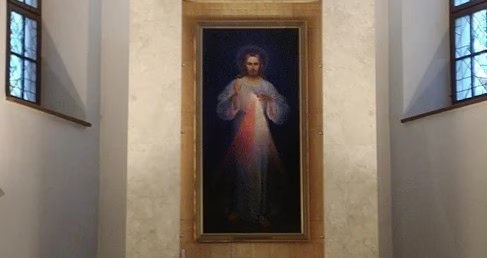
Today is Divine Mercy Sunday. This feast has been observed since April 2000, when Pope Saint John Paul II declared it a universal feast on the Sunday after Easter, based on a series of revelations to Saint Maria Faustina Kowalska, a Polish nun in the 1930s. In her diary, we find the following explanation:
“My daughter, tell the whole world about My inconceivable mercy. I desire that the Feast of Mercy be a refuge and a shelter for all souls, and especially for poor sinners. On that day the very depths of My tender mercy are open. I pour out a whole ocean of graces upon those souls who approach the fount of My mercy. The soul that will go to Confession and receive Holy Communion shall obtain complete forgiveness of sins and punishment. On that day are opened all the divine floodgates through which graces flow. Let no soul fear to draw near to Me, even though its sins be as scarlet. My mercy is so great that no mind, be it of man or of angel, will be able to fathom it throughout all eternity. Everything that exists has come from the very depths of My most tender mercy. Every soul in its relation to Me will contemplate My love and mercy throughout eternity. The Feast of Mercy emerged from My very depths of tenderness. It is My desire that it be solemnly celebrated on the first Sunday after Easter. Mankind will not have peace until it turns to the Fount of My mercy.” (1)
Mercy: Why do we talk about mercy? What is mercy?
Mercy is a compassionate act of withholding punishment from someone over whom one has power. It involves “kindness, forgiveness, and active help for those in need, often going beyond justice to offer grace, particularly in theological contexts.” (2) We know about human kindness, and, in Canada, we have a dedicated Kindness Week. It was observed February 15–21 this year and was established by federal law in 2021 to encourage empathy and charitable acts. The late Rabbi Reuven P. Bulka was essential in advocating for the introduction of Kindness Week. (3)
Of course, our kindness is a minuscule act of goodwill in comparison with the mercy of God. Pope Francis entitled one of his books The Name of God is Mercy. (4) In this book, the Pope humorously remarked, “Lord, forgive me if I have forgiven too much. But you are the one who gave me the bad example!” (4) In this work, the Pope speaks about mercifully reaching out to those who are marginalized, oppressed, ill, doubting, or experiencing a crisis of faith. The assertion of the Pope is that recognizing oneself as a sinner is a gift “…in that sin is where I encounter the mercy of Jesus.” (4) Divine Mercy Sunday is about God’s infinite love and mercy for those who draw near to Him. Through Jesus, God offers a pathway to healing and salvation.
Today’s Gospel, the encounter of the doubting Thomas with the risen Lord, is arguably one of the most frequently read passages of the New Testament. (5) Through it, God reveals what He intends to do to us, with us, and through us in the world.
The exclamation, “My Lord and My God!” (John 20:28) is a peak moment in John’s Gospel whereby the reader is led to follow the story of Thomas in order to bow to the mystery with him. Mary Magdalene, Peter, and John went to the empty tomb and encountered the risen Lord. Jesus appeared to them in His glorious heavenly body. “Peace be with you,” He said (John 20:19). He repeated the same greeting, “Peace be with you,” a second time, and when He had said this, He breathed on them and said, “As the Father sent me, so I send you.” (John 20:21). Again, to reassure the disciples, He said, “Peace be with you!” and “Receive the Holy Spirit. Whose sins you forgive are forgiven them, and whose sins you retain are retained.” (John 20:23). This was Jesus’ commissioning of the disciples as His emissaries to go into the world to proclaim the Good News. Jesus gave them authority to forgive sins in the name of God.
But Thomas, who was also called the Twin and who was not with them on these occasions, was still doubting: “Unless I see the mark of the nails in his hands and put my fingers into the nail marks and put my hand into his side, I will not believe.” (John 20:25). At the time, the disciples were still meeting behind closed doors, and the doors were heavily locked, for they were fearful of what the authorities might do to them. A week after Jesus first appeared to the disciples, on the Octave of Easter, they were together again, and this time Thomas was with them. Jesus repeated the same greeting: “Peace be with you!” And turning to Thomas, He said to him, “Put your finger here and see my hands, and bring your hand and put it into my side, and do not be unbelieving, but believe.” (John 20:27).
Jesus did not shy away from showing His wounds to the disciples: the marks of the nails on His hands and the gaping wound where the lance pierced His side. Even though He had a glorious heavenly body, these wounds were clearly visible. They were, in fact, so visible and so raw that Thomas—without actually reaching out and touching, and well aware that no ordinary man would ever be alive unless resurrected from the dead—fell to his knees and exclaimed: “My Lord and My God!” (John 20:28). This total and humble prostration before the truth—the passion, death, and resurrection of the Lord—is the final seal of proof that John presents from the mouth of Thomas, who doubted until he was changed from the inside out, transformed from a non-believing disciple to an adoring apostle.
Jesus said to him, “Have you come to believe because you have seen me? Blessed are those who have not seen and believed.” (John 20:29). This passage is for all those who read this text and hear the message of the Gospel today—all those who do not have a direct eyewitness account, as the disciples did, but must rely on their witnessing and the evidence they provide. The real evidence, says Jesus, is not something measurable, palpable, or tangible, although He provided those as well. It is by the grace of God that we grow to trust Him and come to learn about His ways.
Thomas’s doubt is the doubt that we can feel from time to time when our need for physical proof is lacking and when the world around us does not seem to have embraced the message of the Messiah. There is still too much cruelty, “obsession with power and indifference to the suffering” of others.
On the Saturday preceding Divine Mercy Sunday, Pope Leo XIV invited the faithful to join him at a Prayer Vigil for Peace. (6) On this occasion, he delivered a powerful appeal to “stop the madness of war,” citing that “prayer can move mountains,” since “war divides; hope unites. Arrogance tramples upon others; love lifts up. Idolatry blinds us; the living God enlightens.” (6) The Pope explained that “all it takes is a little faith, a mere ‘crumb’ of faith, in order to face this dramatic time in history together—as humanity alongside humanity.” He emphasized that prayer is not “a refuge in which to hide from our responsibilities, nor an anesthetic to numb the pain provoked by so much injustice,” but rather is “the most selfless, universal and transformative response to death.” (6)
Nothing on this earth, continued the Pope, has the power to confine us to a predetermined fate, even though people “…continue today to mercilessly crucify one another and eliminate life, with no regard for justice and mercy.” (6) Through prayer, mused the Pope, we can unite our limited potentials and possibilities to the infinite possibilities of God, and we can become the servants of the Kingdom of God where, through our thoughts and actions, there will be “…no sword, no drone, no vengeance, no trivialization of evil, no unjust profit, but only dignity, understanding and forgiveness.” (6)
The Pope warned against the idolatry of power and profit, which are false signs of strength. The true sign of strength “is shown in serving life.” (6) In this spirit, the Pope renewed a call for pursuing dialogue and mediation through friendship and fostering a culture of encounter. Returning to prayer strengthens us for this task, just as Rosary beads help us to get attuned to the peaceful rhythm of life: “Word by word, deed by deed, just as a rock is hollowed out drop by drop, or fabric woven stitch by stitch,” he said. (6) The challenge is to, instead of chasing, allow ourselves to return to a natural rhythm of serving—returning to “serving the rhythm of life, the harmony of creation and healing its wounds.” (6)
The Pope stressed that returning home to God through prayer and being obedient to God and His laws, rather than any human authority, leads to a profound conversion of heart. It leads to peace and reconciliation instead of a vicious cycle of grief and violence. (6) The Pope concluded this Prayer Vigil with a reminder that Christ won victory without any weapons through the disarming power of sacrificial love. “Peace,” he said, “is something we all carry in our hearts,” when we are gathered together and God is present in our midst.” (6)
As followers of the Risen Lord, we are sent to “…tell the whole world that it is possible to build peace—a new peace that can be lived together with all peoples, of all religions and of all races… united as brothers and sisters, all united in a world of peace.” (6)
Sources:
- The Divine Mercy (2026). What is Divine Mercy Sunday? Retrieved from: https://www.thedivinemercy.org/celebrate/greatgrace/dms. Accessed: April 12, 2026.
- Compassion International (2026). Mercy Definition: What It Is & Why It Matters. Retrieved from: https://www.compassion.com/blog/mercy-definition/. Accessed: April 12, 2026.
- Senate of Canada (2026). Senator Jim Munson’s Kindness Week becomes Law. Retrieved from: https://sencanada.ca/en/sencaplus/news/senator-jim-munsons-kindness-week-becomes-law/. Accessed; April 12, 2026.
- Rossmann, M. (2016). The Name of God is Mercy – Review. Retrieved from: https://thejesuitpost.org/2016/01/the-name-of-god-is-mercy-review/ Accessed: April 12, 2026.
- Peters, T. (2026). John 20:19-31: Th e2nd Sunday of Easter, Gospel Reflection for Catholic Mass, Divine Mercy Sunday. https://www.youtube.com/watch?v=ERIE65eS9jo. Accessed: April 12, 2026.
- Vatican News (2026). Highlights—11 April 2026, Vigil of Prayer for Peace—Pope Leo XIV. Retrieved from: https://www.vaticannews.va/en/pope/news/2026-04/pope-leo-xiv-leads-prayer-vigil-for-peace-in-the-world.html#. Accessed: April 12, 2026.