

The story of the Samaritan woman at the well illustrates the transformative journey of a social outcast who recognizes Jesus as the Messiah and becomes one of the first missionaries of the New Covenant.
GOSPEL PASSAGE: John 4:5-42
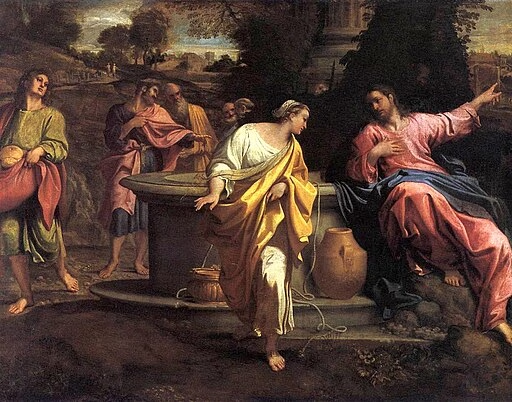
Jesus came to a town of Samaria called Sychar, near the plot of land that Jacob had given his son Joseph. Jacob’s well was there. Jesus, tired from his journey, sat down there at the well. It was about noon.
A woman of Samaria came to draw water. Jesu said to her, ‘Give me a drink.’ His disciples had gone into the town to buy food. The Samaritan woman said to him, ‘How can you, a Jew, ask me, a Samaritan woman, for a drink?’—For Jews use nothing in common with Samaritans. –Jesus answered and said to her, ‘If you knew the gift of God and who is saying to you, ‘Give me a drink,’ you would have asked him, and he would have given you living water. The woman said to him, ‘Sir, you do not even have a bucket and the cistern is deep; where then can you get this living water? Are you greater than our father Jacob, who gave us this cistern and drank from it himself with all his children and his flocks?’ Jesus answered to her, ‘Everyone who drinks this water will be thirsty again; but whoever drinks the water I shall give will never thirst; the water I shall give will become in him a spring of water welling up into eternal life.’ The woman said to him, ‘Sir, give me this water, so that I may not be thirsty or have to come here to draw water.’ ‘…I can see that you are a prophet. Our ancestors worshipped on this mountain; but you people say that the place to worship is in Jerusalem.’ Jesus said to her, ‘Believe me, woman, the hour is coming when you will not worship the Father neither on this mountain not in Jerusalem. You people worship what you do not understand; we worship what we understand, because salvation is from the Jews. But the hour is coming, and is now here, when true worshippers will worship the Father in Spirit and truth; and indeed, the Father seeks such people to worship him. God is Spirit, and those who worship him must worship in Spirit and truth.’ The woman said to him, ‘I know that the Messiah is coming, the one called the Christ; when he comes, he will tell us everything.’ Jesus said to her, ‘I am he, the one who is speaking with you.’
Many of the Samaritans of that town began to believe in him. When the Samaritans came to him, they invited him to stay with them; and he stayed there two days. Many more began to believe in him because of his word, and they said to the woman, ‘We no longer believe because of your words; for we have heard for ourselves, and we know that this is truly the savior of the world.’
REFLECTIONS:
Today’s Gospel is more than a witty conversation between Jesus and a Samaritan woman. It is a conversation between the Lord and a woman who gradually gets to know and recognize the person of the Messiah in Jesus and becomes one of His missionaries. According to theologians, shrouded in symbolism, the story of the Samaritan woman at the well is the story of God, the bridegroom, and the Church, His bride. (3) The metaphor of a relationship and marriage, which can be found interwoven throughout the entire text, refers to the relationship between God and His people.
Historical and Geographical Context
The story begins with an unlikely encounter between Jesus and a Samaritan woman. Jesus and the disciples were on their way from Judea to the North of Israel, back to Galilee, and they had to pass through a region belonging to Samaria. There was a divide between the Jews and the Samaritans because, historically, the Samaritans were the descendants of Jews who intermarried with people from other religious groups who worshipped foreign gods. (1) While Samaritans worshipped on Mount Gerizim, Jews worshipped in Jerusalem. (1) Jews avoided contact with Samaritans and, whenever they could, chose alternate routes rather than pass through Samaritan territories. (1)
Nevertheless, Jesus and the disciples took the road to Galilee through Samaria. On their way, they stopped to rest at a well. This was not an ordinary well; it was a historically significant well. It was located close to Sychar, a place close to Mount Gerizim. It was on Mount Gerizim that Abraham thought that God had asked him to sacrifice his only son, Isaac. The angel of the Lord prevented Abraham from completing this act, after which God blessed Abraham for not having hesitated to do what he understood was the will of God (Genesis 22). Since that time, there was an altar erected at this place, where the people worshipped God by presenting their burnt offerings. (2) According to tradition, Moses commanded to protect the mountain as a sacred space and to worship on it by making a pilgrimage to it three times a year. (2)
The Symbolism of the Well
Isaac’s son, Jacob, had a plot of land here, which he gave to his son, Joseph (John 4:5). Wells were of survival value to the people of this region, as well as places of meeting. (3) In the Old Testament, we find that Jacob met Rachel, his future wife, at the well when she came up with the sheep of her father, Laban, Jacob’s uncle on his mother’s side (Genesis 29). Moses met his future wife, Zipporah, at a well in Midian (Exodus 2:15-21). In both cases, the women were shepherdesses, and Jacob and Moses offered help rolling the heavy stone from the top of the well, protecting the women and flock from harm, and providing water for the sheep.
The Midday Encounter
Women usually visited the wells in groups and rarely alone. So, it is unusual that the woman from the nearby town, Sychar, arrived alone with a jug to draw water by herself when Jesus was resting there at midday. Since it was midday, it was probably very warm. The woman who arrived there alone at this time of the day suggests that she was intentionally acting different from the convention of drawing water in a group, and avoiding the other women of the town, likely to escape their gossip or judgement. Upon seeing a man sitting by the well, she kept coming closer.
Noticing the woman with the jug, Jesus also did something entirely unconventional. He asked her to pull up some water with the jug and give Him a drink. The woman was incredulous, asking how it is that “a Jew” would request water from a Samaritan. This, she pointed out, is culturally not allowed, or at least, frowned upon. Jesus was also putting himself in a position of vulnerability, sitting by a well with no bucket or cup, depending on the decision of a woman whether He was going to be able to quench His thirst. The Samaritan woman’s jug was considered “unclean” by the Jews. (1) Jesus broke the traditional religious and social barriers by intentionally placing himself in the position of need and inviting the Samaritan woman to enter into an exchange, a dialogue.
As soon as the woman started to evaluate whether to oblige despite the cultural and religious divide, Jesus changed the conversation to something that He could offer to her that is even better than what He was asking her to give Him: “‘If you knew the gift of God and who is saying to you, ‘Give me a drink,’ you would have asked him, and he would have given you living water.’” (John 4:10). Concretely, Jesus is implying that He has something to give to the woman that she is longing for. The reference to “living water” may have been familiar to the woman as it is mentioned several times in the Old Testament. It refers to the purifying, healing, and renewing gift of the Holy Spirit, and the presence of God. Living waters could be found in the Garden of Eden (Genesis 2:10-14), where they symbolize life and abundance; in the prophetic visions of Isaiah 44:3, Joel 2:28, Ezekiel 47, and Zechariah 14:8. Psalm 36:9 states, “For with you is the fountain of life…” and Revelation 22 envisions the “river of the water of life.”
Spiritual Thirst and Revelation
The woman is quick to catch on and she remarks, “Sir, you have nothing to draw water with…” “‘Sir, you do not even have a bucket and the cistern is deep; where then can you get this living water? Are you greater than our father Jacob, who gave us this cistern and drank from it himself with all his children and his flocks?’ (John 4:11-12). And Jesus confirms that He is talking about the figurative meaning of the “living waters.” Not water that quenches physical thirst, but water that quenches spiritual thirst: “‘Everyone who drinks this water will be thirsty again; but whoever drinks the water I shall give will never thirst; the water I shall give will become in him a spring of water welling up into eternal life.’” (John 4:13-14). The woman agrees that she is longing for this actual water and for spiritual sustenance: “‘Sir, give me this water, so that I may not be thirsty or have to come here to draw water.’” (John 4:15).
Subsequently, Jesus asked her to call her husband, to which she replied that she had none. Jesus remarked that she was right because she had five husbands and who she lives with now is not her husband. Theologians think that the number of husbands this woman had symbolically coincides with the number of tribes that have settled in the region of Samaria who worshipped foreign Gods. (3)
The woman changed the conversation and spoke directly as if she was to represent her people: “‘Sir, I see that you are a prophet. Our ancestors worshipped on this mountain; but you people say that the place to worship is in Jerusalem.’” (John 4:19-20). Jesus confirmed that He was about to fulfill the will of the Father: “the hour is coming, and is now here, when true worshippers will worship the Father in Spirit and truth; and indeed, the Father seeks such people to worship him. God is Spirit, and those who worship him must worship in Spirit and truth.’” (John 4:23). With these words, Jesus invited the woman to worship God with a free spirit and live in the truth. And she replied, “‘I know that the Messiah is coming, the one called the Christ; when he comes, he will tell us everything.’” (John 4:25). This is the climax of the story as Jesus declared: “I am he, the one who is speaking to you.’” (John 4:26).
The woman left her jug at the well, and she ran to the village to tell her kinsmen; “Come and see the man who told me everything I have ever done! He cannot be the Messiah, can he?” (John 4:29). And Jesus refused to eat or drink until he spoke with them and taught them. He stayed with them for two days “…and many believed in him because of his word.” (John 4:41) They said to the woman: “It is no longer because of what you said that we believe, but we have heard for ourselves, and we know, that this truly is the Savior of the world!” (John 4:42).
Conclusion
Thus, through a significant encounter and a dialogue, Jesus managed to make this woman a disciple and a missionary. She first addressed Him “a Jew,” “Sir,” a “prophet,” and maybe the “Messiah.” She gathered all the town’s people around and they listened to Jesus and they came to believe in Him.
In Deuteronomy, Moses is the Mediator of the Old Covenant. In the New Testament, Jesus is the mediator of the New Covenant. He is the Christ, the Messiah, and the anointed one. This title belongs to priests, prophets, and kings. Jesus is the most perfect of all of these. He is not just a priest but the High Priest of God Almighty. He is a prophet, but more than a prophet. He is the Word of God who became flesh. He is a not just a king of an earthly realm, such as the King of the Jews, but His kingship is of heaven and earth for all eternity. (3)
Marriages in the Old Testament were actually initiated at a well. Meetings took place there for the first time. (3) Asking for a drink at Jacob’s well may have taken the apostles completely by surprise. But they did not ask any questions. They understood that there was something very exceptional and significant about Jesus talking to a Samaritan woman at this well.
The story of the woman at the well prepares us to understand the New and eternal covenant. The Covenant made to Abraham still applies, and the Covenant with Moses is in full effect. There is a new Covenant which comes through the Jews but applies to Jews and to the non-Jews alike, which completes the Old Covenant. In this New Covenant, Christ is the bridegroom and the Church is His Bride, led by the gift of the Holy Spirit.
The woman left her jar by the well. Her life was transformed and what she was there for previously did not matter. She was sharing her life story and who she encountered. People came to see Jesus, and they believed in Him not because of her words, but because they themselves came to see and experience the goodness of the Lord.
When we long for spiritual renewal, for the presence of God among us, can it be, that, symbolically, the Samaritan woman at the well speaks for all of us?
When we evangelize, we share with people how God changed our lives. We may not fully know Christ or understand God’s will, but through willingness and openness to God’s word, we may be able to lead others to question with us: Can Jesus be the Messiah? Through encounter, we may recognize Him as a Jew, the Lord, a Priest, a King, a Prophet, the Messiah, and, like the citizens of Sychar, eventually come to know, “…. that [He] truly is the Savior of the world.” (John 4:42)
Sources:
- McClosky, P. (2020). The Rift Between Jews and Samaritans. Franciscan Media. Retrieved from: www.franciscanmedia.org. Accessed: March 3, 2026.
- UNESCO (2026). Mount Gerizim and the Samaritans. Retrieved from: whc.unesco.org. Accessed; March 3, 2026.
- Peters, T. (2026). John 4:5-42: 3rd Sunday of Lent, Year A, Sunday Gospel Reflection, Fr. Tim Peters. Retrieved from: https://www.youtube.com/watch?v=4voSotx0-1s. Accessed: March 3, 2026.