

Jesus’ Transfiguration is the manifestation of God’s glory. It is a moment of solace in the midst of chaos and suffering. It is a reminder that light conquers darkness and good triumphs over evil.
GOSPEL PASSAGE: Matthew 17:1-9
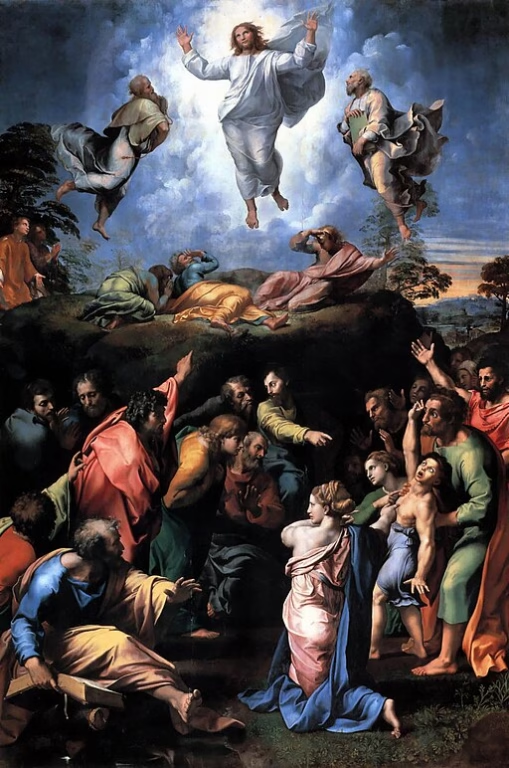
“Jesus took Peter, James, and John his brother, and led them to a high mountain by themselves. And he was transfigured before them; his face shone like the sun and his clothes became white as light. And behold, Moses and Elijah appeared to them, conversing with him. Then Peter said to Jesus in reply, ‘Lord it is good that we are here. If you wish, I will make three tents here, one for you, one for Moses and one for Elijah.’ While he was speaking, behold, a bright cloud cast a shadow over them, then from the cloud came a voice that said, ‘This is my beloved Son, with whom I am well pleased; listen to him.’ When the disciples heard this, they fell prostrate and were very much afraid. But Jesus came and touched them, saying, ‘Rise, and do not be afraid.’ And when the disciples raised their eyes, they saw no one else but Jesus alone.
As they were coming down from the mountain, Jesus charged them, ‘Do not tell the vision to anyone until the Son of Man has been raised from the dead.’”
REFLECTIONS:
Transfiguration is the event where Jesus revealed His divine nature and glory to the apostles. It is a momentous event, the peak of His mission between His baptism and ascension, whereby Jesus showed them what it means to be in the world but not of this world. He offered an exceptional vision of the foretaste of the Kingdom of God for their reassurance, consolation, and encouragement.
The Preparation for the Cross
Jesus’s Transfiguration took place well into His mission. He walked through the countryside teaching and healing and His fame spread. All the while, He started to prepare His disciples for His death and resurrection. But they did not understand what He was referring to. Peter, after confessing Jesus to be the Messiah and hearing from Jesus that “The Son of Man” will go to Jerusalem where He will be tortured and crucified, exclaimed, “‘God forbid it, Lord! This must never happen to you!’” (Matthew 16:22). But Jesus replied to him, “‘Get behind me, Satan!’ You are a stumbling block to me, for you are setting your mind not on divine things but on human things” (Matthew 16:23).
In line with the Jewish tradition, Peter and the rest of the disciples expected a glorious Messiah who would deliver them from pain and suffering. They did not imagine that the Messiah, as Isaiah prophesied, would suffer, die, and be raised from the dead, and return in glory again to judge the living and the dead (Isaiah 52:13; 53:12).
With the statement “Get behind me, Satan!” Jesus said no to the temptation to exercise His power over that of the Father’s. Jesus did not say, “go away from me,” to Peter, like He did to Satan, but He said, “stand behind me and follow me.” He explained that all His followers must pick up their crosses and carry them until the Son of Man will return with His angels in the glory of the Father and “repay everyone for what has been done” (Matthew 16:27).
But the disciples could not fathom what He meant. They could not imagine that the Messiah would have to suffer and die. They did not understand that they, too, would have to suffer and faithfully carry their crosses, after which they will share in the glory of the resurrection and live in the Kingdom of God. They did not understand the concept of the suffering servant, and the Messiah who has to suffer, die, and rise again in order to open the door of heaven to human beings.
The Vision on Mount Tabor
To understand the higher reality than what was available to their senses and their minds up to that point, Jesus invited His closest disciples—Peter, James, and John—to go with Him to the top of a mountain, where, in their presence, the veil from His humanity was lifted for an instant so they could plainly behold His divinity. The experience was to strengthen the apostles’ faith in the face of the “scandal and irrationality of the Cross” by showing that glory follows unavoidable suffering faithfully borne according to the will of God. (1)
Bible scholars think that the Transfiguration happened at the top of Mount Tabor. (2) Jesus’ clothes became dazzling white and “his face shone like the sun” (Matthew 17:2). Moses and Elijah appeared on His left and right and He spoke with them. Moses and Elijah are both prophets and great leaders who at the end of their earthly lives were assumed to heaven. They represent the Law and the Prophets, who authoritatively embody God’s rule and His will. (2)
Awestruck, Peter declared that it was good for them to be there. Wanting to be useful, he proposed to build three tents, one for Jesus, one for Moses, and one for Elijah. The tents would be dwelling places where Jesus, Moses, and Elijah could stay. But while he was still speaking, the vision unfolded even further: a bright cloud descended and cast a shadow on them. This luminous cloud was the Holy Spirit. From the cloud, the voice of the Father could be heard, “This is my Son, the Beloved, with whom I am well pleased.” These are the same words that the Father said when Jesus was baptized, but He added: “Listen to him!” (Matthew 17:5).
The Face of God
God the Father, God the Son, and God the Holy Spirit made themselves known to the disciples. (3) They were terrified and prostrated themselves. On Mount Sinai, even Moses covered his face in the presence of God. God explicitly told Moses that “You cannot see my face,” for no human being can see the face of God and live (Exodus 33:20). Theophanies—visible manifestations of God’s presence, such as a burning bush or the voice of God—were recorded in the Old Testament, but never a direct, full-glory viewing of God. The disciples showed full reverence by prostrating themselves before God until Jesus came and touched them and said to them, “Get up and do not be afraid” (Matthew 17:7).
When they looked up, they saw no one except Jesus. This confirms that God the Father’s face is invisible to humans and that the only full revelation of the Father is through Jesus, who said, “No one has seen the Father except the one who is from God; only he has seen the Father” (John 6:46), and “Anyone who has seen me has seen the Father” (John 14:9). Jesus explains that He has seen the Father and that the ultimate, visible revelation of the Father is through Him. The statement, “I and the Father are one” (John 10:30), which Jesus used in debate with the Jewish religious leaders, was condemned as blasphemous by them, but on Mount Tabor, appearing in the company of Moses, Elijah, the Holy Spirit, and the Father, Jesus’s declaration is reaffirmed.
Transformation and Hope
The Transfiguration is a sign of hope and a great expectation: it is a foreshadowing of the resurrection. This is what happens to those who are faithful followers of Christ. It teaches us to be mindful, even before suffering begins, that suffering will not have the last word. Suffering reveals the opportunity to transform ourselves and our pain into a great gift of love. (4)
Suffering is like Good Friday—full of injustice, confusion, wrongs, and loss. In advance, we need to remember that it is not the end; it is a valley. From there, one can look at the mountaintop and remember this message: glory follows suffering. It points outward and beyond our world—upward, beyond, and through. Our story does not end in darkness and obscurity, but in dazzling light. Transfiguration means that our lives take place in this world but are ultimately directed toward another dimension.
This call for transformation aims for us to live in the light of Christ’s love. The Greek word used in the text for the Transfiguration is metamorphosis. (1) This means to completely change from one state to another, to become qualitatively different in God’s presence, and to seek in everyday events the opportunity to love.
St. Ignatius said that life holds two types of spiritual states: occasions of desolation (spiritual desert or dryness) and occasions for consolation (spiritual renewal). When we are in the valleys, we can think of the heights; we remember the mountaintops and the peaks, so we are not afraid of the Cross. This is a vision oriented not to what lies below or ahead, but to what holds us up.
When we are tired, humiliated, despised, or belittled, we can remember that so was Christ. When we are defeated, and powerless, we can recall the wounds of Christ. For His human form and actions, Christ was discarded and dilapidated, while in His divine nature, He remained intact and glorious. He revealed His heavenly divine nature to the apostles to remind them of God’s plan which did not follow human calculations of success and power. God revealed His truths about the Kingdom to the “little ones”—the humble, dependent, God-fearing believers—and concealed them from the self-sufficiently “wise and intelligent, showing us that the greatest divine mysteries require docility, openness, and willingness to follow and to learn, rather than arrogance.
When we suffer, Christ draws near. When there is a question of suffering, God reveals something mysterious about Himself and His Kingdom. If we are willing to follow Him up the mountain, he will show us something worthwhile to behold.
Today, His message is, “trust me.”
A beautiful way of honoring this day is by lighting a candle as a symbol of God’s light which we want to be on earth, or by wearing a religious symbol of our faith which reminds us that our lives belong to the light and we love Jesus. Receiving the Eucharist on this day strengthens us for the ongoing work of transforming our lives according to God’s plan.
Sources:
- Catechism of the Catholic Church (2026). Articles 554-556.
- Meistermann, B. (1996-2026). Catholic Answers. Retrieved from: https://www.catholic.com/encyclopedia/transfiguration. Accessed; February 24, 2026.
- Poblocki, R. (2024). Transfiguration. St. Margaret Mary Catholic Church. Retrieved from: https://stmargaretmary.org/transfiguration/ Accessed: February 24, 2026.
- West Coast catholic (2025). The Transfiguration of the Lord: Meaning, Scripture & Catholic Significance. Retrieved from: https://westcoastcatholic.co/blogs/news/transfiguration-of-the-lord-meaning-biblical-significance-catholics#:~:text=1.,Carmel. Accessed: February 24, 2026.
- Ignatian Basics (2019). Consolation and Desolation. Retrieved from: https://godinallthings.com/2019/10/14/consolation-desolation. Accessed; February 24, 2026.