

Jesus teaches His disciples about the New Convenant which fulfills the Law of God given to Moses. Rather than constraining, His teaching is a pathway to becoming loving and holy.
GOSPEL PASSAGE: Matthew 5:17-37
Jesus said to his disciples: [Do not think that I have come to abolish the law or the prophets. I have come not to abolish but to fulfill. Amen, I say to you, until heaven and earth pass away, not the smallest letter or the smallest part of a letter will pass from the law, until all things have taken place. Therefore, whoever breaks one of the least of these commandments and teaches others to do so will be called least in the kingdom of heaven. But whoever obeys and teaches these commandments will be called greatest in the kingdom of heaven.]
I tell you, unless your righteousness surpasses that of the scribes and the Pharisees, you will not enter the kingdom of heaven.
“You have heard that it was said to your ancestors, You shall not kill; and whoever kills will be liable to judgement. But I say to you, whoever is angry with his brother will be liable to judgement; [and whoever says to his brother, “Raqa,” will be answerable to the Sanhedrin; and whoever says, ‘You fool,’ will be liable to fiery Gehenna. Therefore, if you bring your gift to the altar, and there recall that your brother has anything against you, leave your gift there at the altar, go first and be reconciled with your brother, and then come and offer your gift. Settle with your opponent quickly while on the way to court. Otherwise, your opponent will hand you over to the judge, and the judge will hand you over to the guard, and you will be thrown into prison. Amen, I say to you, you will not be released until you have paid the last penny.]
“You have heard that it was aid, You shall not commit adultery. But I say to you, everyone who looks at a woman with lust has already committed adultery with her in his heart.
[If your right eye causes you to sin, tear it out and throw it away. It is better for you to lose one of your members than to have your whole body thrown into Gehenna. And if your right hand causes you to sin, cut it off and throw it away. It is better for you to lose one of your members than to have your whole body go to Gehenna.
“It was also said, Whoever divorces his wife must give her a bill of divorce. But I say to you, whoever divorces his wife—unless the marriage is unlawful—causes her to commit adultery, and whoever marries a divorced woman commits adultery.]
“Again you have heard that it was aid to your ancestors, Do not take a false oath, but make good to the Lord all that your vow. But I say to you, do not swear at all;
[not by heaven, for it is God’s throne; nor by the earth, for it is his footstool; nor by Jerusalem, for it is the city of the great King. Do not swear by your head, for you cannot make a single hair white or black.]
Let your ‘Yes’ mean ‘Yes,’ and ‘No’ mean ‘No.’ Anything more is from the evil one.”
REFLECTIONS:
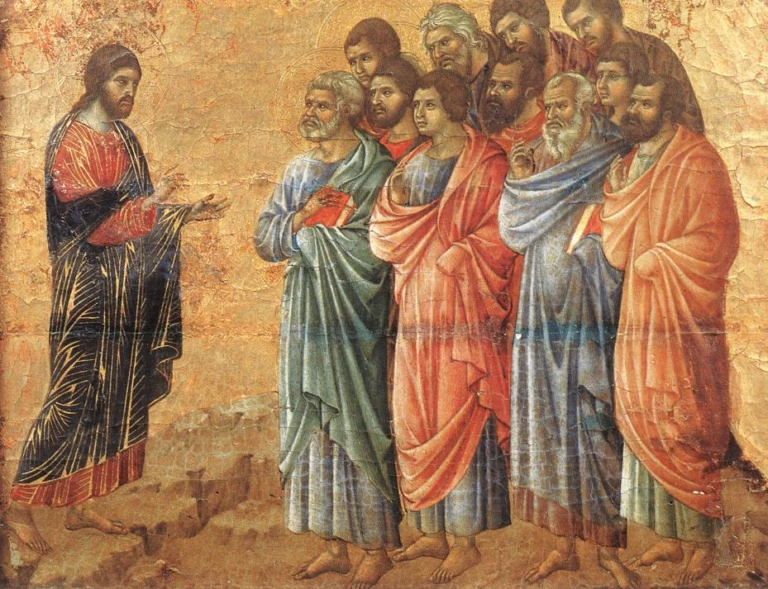
On the Mount of Beatitudes, Jesus introduces His listeners to the New Covenant. Building on the Old Covenant, He proclaims that following God’s commandments requires more than obedience to the Law. Throughout our entire lives, we can seek to be in communion with God through love.
His words follow from the Old Testament prophecy of Jermiah (3131-34): “…behold the days are coming, declares the Lord, when I will make a new covenant with the house of Israel and the house of Judah, not like to covenant I made with their fathers on the day when I took them by hand to bring them out of Egypt, my covenant that they broke, though I was their husband, declares the Lord. For this covenant that I will make with the house of Israel after those days, declares the Lord: I will put my law within them, and I will write it on their hearts.” This Law is introduced by Jesus on the Mount and declared at the Last Supper. (1) It is sealed after his death and resurrection and is the Fount of God’s mercy and grace.
In today’s Gospel reading, we find Jesus and His followers on Mount Eremos, close to Capernaum. Overlooking the Sea of Galilee, Jesus continues to instruct His followers and introduces the New Covenant. Earlier, He shared eight specific blessings with them which belong to those who are children of God in His Kingdom. He affirmed that they are the “salt of the earth and the light of the world” (Matthew 5:13). With these exhortations, Jesus instructed His followers to partake in His mission of healing the world and making its people holy.
In the 13th century BC, Moses, “the servant of the Lord,” communicated the Laws of the Old Covenant to the Israelites—laws that he received from God at Mount Sinai (Deuteronomy 34:5). These Laws served as fundamental guidelines for daily living and the organization of the community. Moses was instrumental in receiving and transmitting these laws to the Jewish community. The Ten Commandments were first written on stone tablets. Later, the tablets were destroyed, but the laws lived on in the writings of the Torah, the first five books of the Old Testament. Even today, they form an essential part of Jewish living. (2)
Jesus, “The Son of God,” came into the world to offer His life as a ransom for the life of sinners, to defeat death and open the way to eternal life (John 1:34; Matthew 16:16-17, Luke 1:35, John 3:16). At the start of His public mission, which was to eventually lead Him to the cross and resurrection, He taught His disciples about the unfolding of God’s plan. The Old Covenant was received by Moses and applied to the Jews who received it. The New Covenant originated among the Jewish people of Israel; however, it extended the promise of the New Covenant to all the people of God in the world. (1,3)
From the Old Covenant to the New Covenant, we see a progression in the way God communicated with human beings through history. The Old Covenant was received by Moses and communicated to the people of Israel. With the New Covenant, God the Father sent His Son, Jesus, to proclaim it with authority. Led by the Holy Spirit, the New Covenant embraces the Old Covenant and achieves its completion through Jesus. (1,4)
This New Covenant does not do away with the Old Covenant or replace it but brings it to fullness through a radically new way of living. It emphasizes seeking what is good, true, and beautiful, and rejecting all that is the opposite. It prepares the people of God to be aware and ready to face temptations. (4)
As He teaches, Jesus uses direct references to the Law, images, and paraboles to teach His listeners. He talks about His mission: the fulfillment of God’s plan. (4) He has come to offer His life for the salvation of mankind because of their sins. Sins are defined as trespasses of the Laws that are guides for righteous living. Jesus specifies that giving in to temptations that lead away from an upright way of living is to be avoided at all costs. By breaking down what can consist of common misunderstandings or deceptions, He lays the foundation for seeking God and seeking the truth with one’s whole heart.
As Jesus refers to the Law, it is clear to His followers that no one can keep the Law without God’s help. (4) Jesus, through His incarnation, placed Himself subject to the Law; He is sinless and can guide us in preparing ourselves to serve the Lord and grow in holiness. This requires an awareness of God’s will even more precisely than just avoiding breaking the Law. The Lord calls for awareness of this clear distinction He is using to judge the human heart: to call for repentance and conversion. What He is revealing to His followers calls them to a greater responsibility than merely observing if they have kept or trespassed the Law. God is asking them to put forth their best effort to fulfill the spirit of the law. (4)
God’s promise is that with repentance, sins will be forgiven and “remembered no more” (Jeremiah 31:34). This does not mean that God “forgets” the sins, but that through the sacrifice of Jesus and His victory over sin and death, those who renounce their sins and turn to Him find grace and comfort, and their sins will be removed from them.
Jesus says that sin will not corrupt the children of God, but it will be assigned a place in Gehenna. This place of desolation was well-known to His listeners. The Valley of Gehenna (Ge-Hinnom Valley) is a place on the south side of Jerusalem. The place had an eerie and horrific reputation. In the seventh century BC, it was a place of pagan worship where human sacrifices were offered to pagan gods. Since the time of the Second Temple, the place was deserted and designated as a garbage dump site, where continual fires destroyed the refuse. (5) This was an image that Jesus used for the end that awaits what is unholy.
There are four fundamental teachings of the Mosaic Law that Jesus specifically chose to illustrate how the New Testament will go beyond the Old Testament.
- The first is, “You shall not murder” and “whoever murders shall be liable to judgment” (Matthew 5:21). “But I say to you,” continues Jesus with authority, “…if you are angry with a brother or sister, you will be liable to judgment” (Matthew 5:22). Fundamental parts of this commandment are written in the heart: no words that lead in the direction of animosity and violence are acceptable to God. If you are aware that you are not reconciled with someone, leave your gift to God, and first reconcile with your brother. With this statement, Jesus teaches against hypocrisy and bribery. God knows everything, and there is no way of deceiving or manipulating God. (4) A sacrifice and gift offered to God while not respecting a neighbor is of no value. One cannot please God while in a state of sin. First, one needs to seek reconciliation and resolve conflicts before praising God. Praising God should lead to concrete steps of living in peace with others.
- The second teaching is about the commandment to not commit adultery. Jesus says that even if one looks at another with lust, one has already trespassed the law of purity and chastity. In dealing with temptations, He uses a hyperbole to prove a point: “Better for you to lose a member than to commit sin...” (Matthew 5:30). Hyperboles are literary means of argument that should not be taken literally but are used to make a strong point. (4) The profound part when Jesus says, “better for you to tear out [your eye if it causes you to sin; Matthew 5:29],” is that He says to make every effort to avoid falling into a trap. One needs to be aware of the places and ways in which one can be tempted and avoid those occasions as much as possible. With this teaching, Jesus instructs His followers to be ready and prepared to handle temptations and difficult moments. Avoid situations of temptation: do not put yourselves into situations where you are likely to fall into sin.
- The third teaching pertains to marriage and providing the right paperwork after a divorce. Jesus argues that such legal formalities are required because of the hardness of hearts. He protects the sacredness of the marital covenant, unless grave reasons arise which make divorce necessary. This teaching implies that commitments and responsibilities are binding as long as there are no impediments that make their fulfillment impossible.
- The fourth teaching is about integrity. Jesus says, “You have heard that it was said to those of ancient times, ‘You shall not swear falsely…’” (Matthew 5:33). Jesus advises not to swear at all. Speak plainly; let what you say mean what it is. At least on a few occasions, swearing in Old Testament times led to hasty resolutions with catastrophic consequences. In the Book of Judges, Chapter 11, Jephthah made a quick oath that he would sacrifice to God whoever crossed the threshold of his home if he were granted victory over the Ammonites. When, to his dismay, he was informed that it was his only daughter who came to celebrate his victory, it was too late to take his oath back. In 1 Samuel 14, King Saul made a rash, self-imposed oath that any of his men engaged in battle against the Philistines found eating before victory was achieved would be killed. When his own son, Jonathan, admitted to having eaten honey, the people had to rescue him to prevent his execution. During a drunken feast, King Herod swore an oath to Salome, the daughter of Herodias, that he would grant her request. When the girl demanded John the Baptist’s head on a platter, it was too late to appease the vengeful mother who requested the execution.
Jesus warns against hasty actions, careless speech, and impulsive decisions. He illustrates how unchecked thoughts and impulses can lead to deplorable actions, and a lack of awareness of temptations leads to falling into the trap of sin. He says that keeping the law is good and required, but beyond that, the people of God need to be vigilant of their everyday thoughts and feelings. One cannot simply impose the law and expect punishment and obedience or rely on internalized parent figures to act as a deterrent through fear. God wants His people to consciously fashion themselves with responsibility according to what God’s vision is for them. Jesus says that there is freedom that God gave human beings, and in this freedom, they can decide to love God. The highest form of “fearing” God is the fullest form of loving Him—doing this not because of punishment, but out of love for His kingdom.
God’s message is justice and grace to those who turn to Him.
Sources:
- Pope Paul VI (1964). Lumen Gentium. Retrieved from : www.vatican.va/archive/hist_councils/ii_vatican_council/documents/vat-ii_const_19641121_lumen-gentium_en.html. Accessed: February 10, 2026.
- Union for Reform Judaism (2026). Torah; The Tree of Life. Retrieved from: https://reformjudaism.org/learning/torah-study/torah-tree-life. Accessed: February 10, 2026.
- Catholic Culture (2026). Catechism of the Catholic Church. Sections 761—762. Retrieved from: www.catholicculture.org/culture/library/catechism/index.cfm?recnum=2962. Accessed: February 10, 2026.
- Peters, T. (2026). Matthew 5:17-37: The 6th Sunday in Ordinary Time, Year A. Retrieved from: https://www.google.com/search?q=Matthew+5%3A17-37+Catholic+interpretation&sca_esv=074920bdea4960d4&rlz=1C1SQJL. Accessed: February 10, 2026.
- Armstrong, D. (2018). Gehenna: Where children were sacrificed to false gods. Detroit Catholic. Retrieved from: www.dteroitcatholic.com/voices/gehenna-where-children-were-sacrificed-to-false-gods#:~:text. Accessed: February 10, 2026.