
The same as Jesus called His disciples to follow Him, every person is called to a mission. For the Christian, that mission is inseparable from imitating Christ.
GOSPEL PASSAGE: Matthew 4:12-23
When Jesus heard that John had been arrested, he withdrew to Galilee. He left Nazareth and went to live in Capernaum by the sea, in the region of Zebulun and Naphtali, that what had been said through Isaiah the prophet might be fulfilled:
’Land of Zebulun and land of Naphtali,
The way to the sae, beyond the Jordan,
Galilee of the Gentiles,
The people who sit in darkness have seen a great light,
On those dwelling in a land overshadowed by death
Light has arisen.’
From that time on, Jesus began to preach and say, ‘repent, for the kingdom of heaven is at hand.’
As he was walking by the Sea of Galilee, he saw two brothers, Simon who is called Peter, and his bother Andrew, casting a net into the sea; they were fishermen. He said to them, ‘Come after me, and I will make you fishers of men.’ At once they left their nest and followed him. He walked along from there and saw other brothers, James, the son of Zebedee, and his brother John. They were in a boat with their father, wit their father, Zebedee, mending their nets. He called them, and immediately their left their boat and their father and followed him. He went around in Galilee, teaching in their synagogues, proclaiming the gospel of the kingdom, and curing every disease and illness among the people.”
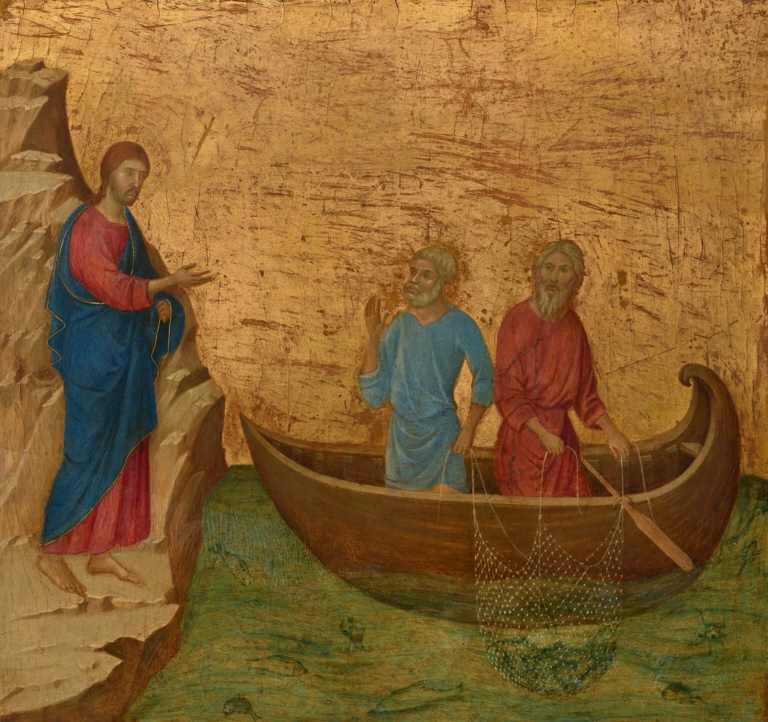
National Gallery of Art, Washington, DC
REFLECTIONS:
Today’s Gospel recounts the calling of the first Apostles, as recorded by Matthew. Matthew himself would later be called to follow Christ, joining the ranks of Peter, Andrew, James, and John. (1) While this account flows naturally from the narrative of Jesus’ baptism, we must look to all four Gospel witnesses to piece together the full chronological journey of these pivotal days. (2)
Following His baptism, where John the Baptist identified Him as the “Lamb of God who takes away the sin of the world” (John 1:29), Jesus was led by the Spirit into the wilderness. There, He faced the temptations of the devil, fasting and praying for forty days. As Mark beautifully notes, “He was with the wild beasts, and angels ministered to Him” (Mark 1:13).
Emerging from the desert fortified by the Spirit, Jesus returned to the Jordan. At Aenon, near Salim, John the Baptist saw Jesus approaching and again bore witness to His identity: “Look, the Lamb of God!” (John 1:35). On this occasion, John the Baptist selflessly directed his own disciples, Andrew and John, to follow Jesus. This moment was the culmination of the Baptist’s own mission. As he famously declared: “I am not the Messiah, but I have been sent ahead of him… He must increase, but I must decrease” (John 3:28-30).
The following day, as Andrew and John followed Him, Jesus turned and asked a question that echoes through the ages: “What are you seeking?” (John 1:38). Their response—“Rabbi, where are you staying?”—led to an entire day spent in His presence. This intimate encounter moved them to invite Jesus into their own lives and families.
Andrew immediately sought out his brother, Simon, with the jubilant news: “We have found the Messiah!” (John 1:41). When Jesus met Simon, He looked at him and spoke into his destiny: “You are to be called Cephas,” which translates to Peter, the Rock. In this providential meeting at Capernaum, the foundation of the apostolic community began to take shape, rooted in personal witness and the transformative power of Christ’s call.
Around this time, as Andrew and John began to follow Jesus, John the Baptist was arrested. When this news reached Jesus, He departed from His hometown of Nazareth to travel through the regions of Zebulun and Naphtali, near the Jordan River and the Sea of Galilee. In doing so, Jesus fulfilled the 700-year-old prophecy of Isaiah: “Land of Zebulun and land of Naphtali, the Way of the Sea, beyond the Jordan, Galilee of the Gentiles—the people living in darkness have seen a great light…” (Matthew 4:15-16).
The following day—three days after last seeing John by the Jordan—Jesus walked along the shore of the Sea of Galilee. There, He saw brothers at work: Peter and Andrew were casting their nets into the lake. Jesus approached and called them to follow Him. A short distance further, He saw James and John mending their nets. He called them as well, inviting them to become “fishers of men.” (Matthew 4:19) Immediately, they left their nets and followed Him (Matthew 4:22).
Two elements stand out in this account. The first is the dramatic trajectory of Jesus’ early ministry: from the glory of His Baptism to the abyss of the desert, Jesus emerges fortified. He visits John the Baptist, who rejoices to see Him, only for John to be arrested and eventually put to death. Jesus withdraws to Galilee to call His disciples. These sharp “ups and downs” illustrate a divine mission constantly confronted by evil—a struggle of light against darkness that has persisted since the time of the prophets. Despite this opposition, the mission of God remains unstoppable.
The second element is the power of witness. The encounter between Jesus and His disciples is facilitated by those who testify of Him: John the Baptist directs his followers toward Christ; Andrew rushes to tell his brother, Peter, that he has found the Messiah; John shares the news with his brother, James. These first disciples are drawn to Him with a sense of profound hope and optimism. Their immediate “yes” suggests that their entire lives had been a preparation for this providential moment. It was the right time, with the right people—men who would witness even greater wonders as Jesus moved from Galilee in the north toward Judea and Jerusalem in the south.
These first disciples were men of Galilee who spoke a distinctive Aramean dialect. Living in a region influenced by Hellenism and surrounded by non-Jewish populations, they were part of a vibrant community rich in agricultural and fishing resources. Though removed from the religious sophistication of the Jerusalem Temple and ruled by a Herodian prince rather than a Roman prefect, they were deeply aware of the social and political climate. They participated in communal life and attended local synagogues, where Scriptures were read and current events discussed. Like many of their peers, they fervently expected the Messiah and remained alert to the “signs of the times.” (3)
Andrew and John, the younger brothers, had even spent their free time learning from John the Baptist. This “educational” pursuit placed them exactly where they needed to be to encounter Jesus—who was also a kinsman of the Baptist. This portion of the story highlights the human side of history, interwoven with synchronicities and “chance” encounters that perfectly fulfill ancient prophecy. Such complexity points directly to Divine Providence.
We might wonder if hearing a certain passage, encountering a specific phrase, or meeting a particular person is truly a coincidence. Everything surrounding us has a history. Our presence here, at this moment, is not an accident but an intentional opportunity to engage with the Word of God. Through these finite, ephemeral moments, we encounter the everlasting.
It is worth pondering how a single instance can fulfill years of preparation. We might call this a “pinnacle”—a moment of clarity regarding our life’s purpose and a revelation of our destination. There is comfort in knowing that if these instances exist, there is a reason for our being. Even when the “reason” is hidden from our eyes, we are on a journey with Jesus. The pinnacle awaits; he gives our lives a meaning that, once grasped, we never want to let go.
Sources:
- Martin, J. (2015). In John 1:35, who were the two disciples of John the Baptist. Biblical Hermeneutics. Retrieved from: https://hermeneutics.stackexchange.com/questions/15372/in-john-135-who-were-the-two-disciples-of-john-the-baptist Accessed on: January 20, 2026.
- Dudek, R. (2012). Wilderness or Wedding? Answers in Genesis. Retrieved from: https://answersingenesis.org/jesus/wilderness-or-wedding/?srsltid=AfmBOopLPKO502_CK_g5DhV1fredlt7J8CMfFIdUFSPZqdmXmJtKILK_ Accessed: January 20, 2026.
- Taylor, J. (2011). 7 Differences Between Galilee and Judea in the Time of Jesus. https://www.thegospelcoalition.org/blogs/justin-taylor/7-differences-between-galilee-and-judea-in-the-time-of-jesus/ Accessed: January 20, 2026.