
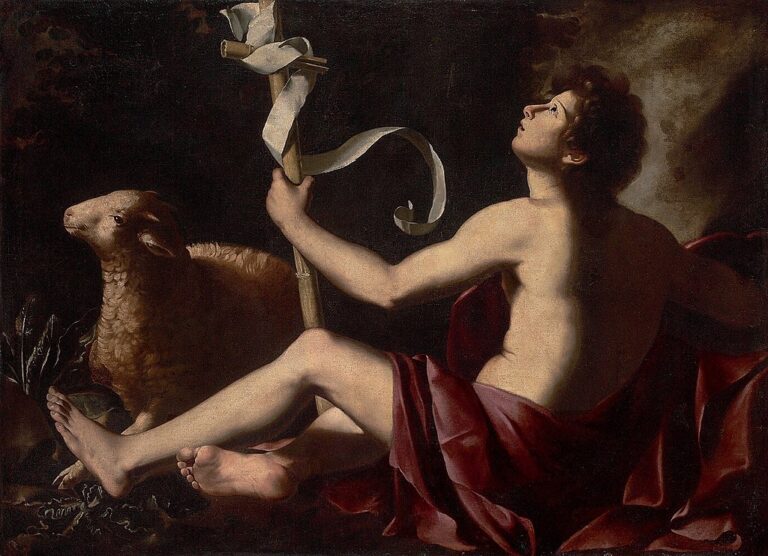
To signify Jesus’ sacrificial offering, John the Baptist called Him the Lamb of God. How we relate to the Lamb of God reaveals something profound about ourselves.
GOSPEL PASSAGE: John 1:29-34
“John the Baptist saw Jesus coming toward him and said, “Behold the Lamb of God, who takes away the sin of the world. He is the one of whom I said, ‘A man is coming after me who ranks ahead of me because he existed before me.’ I did not know him, but the reason why I cam baptizing with water was that he might be made known to Israel.’” John testified further, saying, “I saw the Spirit come down like a dove from heaven and remain upon him. I did not know him, but the one who sent me to baptize with water told me, ‘On whomever you see the Spirit come down and remain, he is the one who will baptize with the Holy Spirit.’ Now I have seen and testify that he is the Son of God.’”
REFLECTIONS:
In last week’s Gospel message, we read about Jesus’ baptism by the River Jordan. He approached John the Baptist, who first objected to baptizing Him, since Jesus was sinless and did not need to repent of his sins. Jesus submitted himself to baptism by water to subject himself entirely to the Law and to take human sinfulness upon himself. By approaching John and going through Baptism, Jesus emerged from the water fully in communion with humanity. God the Father and the Holy Spirit were present and blessed Jesus, the Son. From this moment on, Jesus’s formal Messianic ministry began.
John’s Gospel recounts what John the Baptist testified immediately before Jesus’ baptism, and what he said right after. John welcomed Jesus with these words: “’Behold the Lamb of God, who takes away the sin of the world.’ He is the one of whom I said, ‘A man is coming after me who ranks ahead of me because he existed before me. I did not know him, but the reason why I came baptizing with water was that he might be made known to Israel.’” (John 1:31) John acknowledges that Jesus is fully God because He existed before him. John did not know Him, as one does not know the full will of God the Father. John the Baptist was led by the Holy Spirit to discern who the Messiah was. He knew that this was his earthy mission; to prepare the way for the Messiah. He perceived Jesus in his human form. He felt prompted by the Holy Spirit to testify about Jesus, saying that “He is the Lamb of God.” (John 1:29)
The second time John testified about Jesus was right after Jesus’ baptism. When the heavens opened and the Holy Spirit descended upon Jesus, the voice of the Father could be heard: “This is my Son, the Beloved, with whom I am well pleased,” (Matthew 3:17) John the Baptist received confirmation of the prompting of the Spirit. God the Father confirmed Jesus’ identity and mission. Subsequently, John exclaimed, “He is the Son of God.” (John 1:34)
“The Lamb of God” and the “Son of God” are two of Jesus’ titles which legitimize His Messianic mission. The “Lamb of God” is associated with the sacrifice of the Passover lamb. (1) In the Exodus, it was the sacrifice of the Paschal lamb which set the Exodus into motion, liberating the Israelites from bondage. Through the blood of the lamb, the Israelites were saved from death. The lamb is therefore associated with freedom from slavery, deliverance from death, and rescue. (1) By associating Jesus with the Paschal Lamb, John is signaling that Jesus will be a true sacrificial lamb, the Lamb of God, who will save us from the power of death, and inaugurate an exodus through this life toward the “Promised Land”—the kingdom of heaven. (1)
Isaiah 53 describes the characteristics of the suffering servant who was “…despised and rejected by others; a man of suffering and acquainted with infirmity; and as one from whom others hide their faces he was despised, and we held him of no account…” (Is 53:3) And, “He was oppressed and he was afflicted, yet he did not open his mouth; like a lamb that is led to the slaughter, and like a sheep that before its shearers is silent; so he did not open his mouth” (Is 53:7) Jesus is that sacrificial victim who perfectly God and fully human, reached down to humanity to offer up his life for the salvation of the world. He reached down to be lifted up; died and rose from the dead; who is seated at the right hand of the Father and welcomes us into eternal life. (2)
“Behold, the Lamb of God, who takes away the sins of the world!” is a proclamation during the Mass when the priest lifts the Eucharist. (2) This act re-enacts Jesus’ sacrifice in a spiritual way. Through his death and resurrection, Jesus came down among us, to emerge victorious over death and sin. In the sacrifice of the Mass, he comes among us to heal us. Surely, he knows our afflictions, he knows our transgressions. As Isaiah says, “The righteous one, my servant, shall make many righteous, and he shall bear their inequities. Therefore, I will allot him a portion with the great, and he shall divide the spoil with the strong; because he poured out himself to death and was numbered with the transgressors; yet he bore the sin of many and made intercessions for the transgressors.” (Is 53:12)
When we receive the Eucharist, Jesus comes to us and we literally walk toward Jesus to receive Him. In prayer, we prepare our hearts to welcome Him. We ask him to heal our wounds and hurts, cleanse us from our sins, and help us to carry our suffering, and fill all the places of deficiency with God’s divine love and grace that we may be whole again and praise God forever.
Through understanding more about Jesus’ baptism, we come to appreciate more who Jesus is, and what is His mission. In the light of His mission, we come to understand more about who we are and what our mission is. We come to experience that God’s love is a grace that we cannot earn, we do not deserve, but it is given to us as a gift of love.
“Father Richard Rohr said, ‘We are not loved because we are good. We become good because we are loved.’ …God never ever turns away from us. And the promise of that is Jesus’ blood. Jesus sheds his blood not to appease some angry God, Jesus’ death changes nothing in the heart of God, because God’s promise is eternal love…But that blood shed for us is the eternal promise that we might believe and never forget how much God loves us.” (1)
In the poem, “The Avowal,” Denise Levertov wrote,
“The swimmers dare
To lie face to the sky
And water bears them,
As hawks rest upon air
And sustains them,
So would I learn to attain
Freefall, and float
Into Creator Spirit’s deep embrace,
Knowing no effort earns that all-surrounding grace.” (3)
When we would be tempted to turn away, to run from the wounds of the world, or to hide our own, God comes to the rescue to put His healing balm on our sores. In his tender care, He reassures us that we are loved and protected, and He asks us to love those who are dear to Him.
Jesus is Son of the Father, the Lamb of God, who takes away the sins of the world.
Sources:
- Sparrow, M. (2017). Behold the Lamb of God—Full Homily [John 1:29-34]. Available from YouTube: https://www.youtube.com/watch?v=OKZRUBOIZ3g.
- Barron, R. (2023). Behold, the Lamb of God! Sermons. Available on YouTube: https://www.wordonfire.org/videos/sermons/behold-the-lamb-of-god-2/
- Lavertov, D. (2007). The Avowal. Poem. Retrieved from: https://allpoetry.com/the-avowal. Retrieved: January 13, 2026.