
The Three Kings symbolize the complementary nature of faith and reason. Discernement through the lifespan requires both.
GOSPEL PASSAGE: Matthew 2:1-12
When Jesus was born in Bethlehem of Judea, in the days of King Herod, behold, magi from the east arrived in Jerusalem, saying, “Where is the newborn king of the Jews? We saw his star at its rising and have come to do him homage. When King Herod heard this, he was greatly troubled, and all Jerusalem with him. Assembling all the chief priests and the scribes of the people, he inquired of them where the Christ was to be born. They said to him, “In Bethlehem, Judea, for thus it has been written through the prophet:
‘And you Bethlehem, land of Judah,
Are by no means the least among the rulers of Judah,
Since from you shall come a ruler, who is to shepherd my people, Israel.’”
Then Herod called the magi secretly and ascertained from them the time of the str’s appearance. He sent them to Bethlehem and said, “Go and search diligently for the child. When you have found him, bring me word, that I too may go and do him homage.” After their audience wit the king, they set out. And, behold, the star that they had seen at its rising preceded them, until it came and stopped over the place where the child was. They were overjoyed at seeing the star, and on entering the house, they saw the child with Mary, his mother. They prostrated themselves and did him homage. They opened their treasures and offered him gifts of gold, frankincense, and myrrh.
And, having been warned in adream not to return to Herod, they departed for their country, by another way.
REFLECTIONS:
The prophecy of Isaiah 9:2 states, “The people who walked in darkness have seen a great light; those who dwelt in a land of deep darkness, on them has light shone.” These words were written 700 years before the birth of Christ. (1) They were known to Prophet Daniel, who lived during the 6th century BC, and was a counselor and wise man to King Nebuchadnezzar and to Babylonian and Persian rulers, such as Darius, and Cyrus. (1) “Waiting for the King of the Jews,” an integral part of the Jewish faith, was thus known to the learned men of Babylonia and Persia. (2)
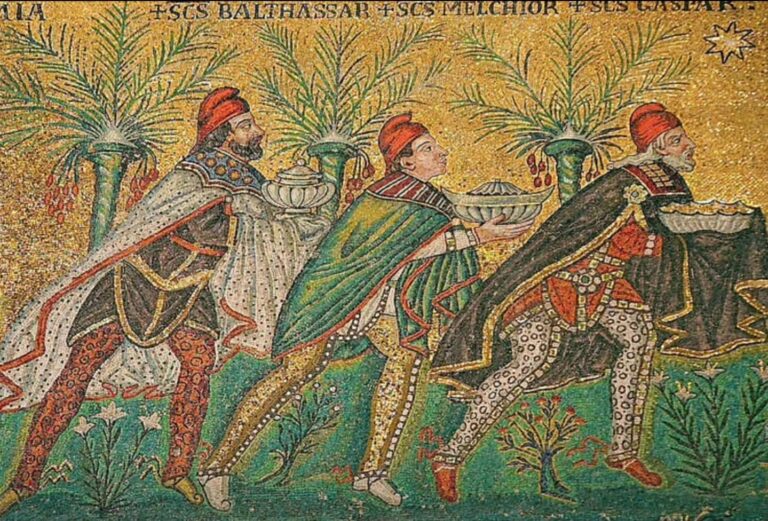
According to a Byzantine tablet from 565 AD, the magi were three wise men. (3) Their names were Balthasar, Melchor, and Gaspar. According to scientists of today, the magi were most likely of Persian origin. (2) However, by the sixth century they came to be represented as different ages and ethnicities, bringing different gifts: Caspar, an older man with a beard, from Asia, offering frankincense; Melchior, portrayed as middle-aged man from Europe carrying gold; and Balthasar, a younger man from Africa, presenting myrrh. (3) They were through to be astrologists, theologians, educated men and scientists, advisors of kings, and skilled in reading the star formations. (2, 4, 5) Most likely, they were familiar with the Jewish culture and religion, and they looked forward to the birth of the Messiah. (2) They heard about King Herod, who ruled over Judea from Jerusalem. They expected that the new king would be born in his household. Their distinct ages came to represent different stages of maturity. (3) Their different ethnicities came to represent Christ’s message for everyone. (3) Their gifts; the frankincense was offered to Jesus as a High Priest symbolizing his Divinity; the gold was fitting to a King representing Jesus’s royalty; and the myrrh, a burial spice, was a foreshadowing of Jesus’ suffering and death. (3)
After a long and perilous journey, the three magi went into Jerusalem and met with King Herod and his court and inquired: “Where is the newborn king of the Jews? We saw his star at its rising and have come to do him homage.” (Matthew 2:2). They told Herod that they had seen a star in the east, heralding the birth of a new king in his kingdom. Since Persia is in the East of Jerusalem, the star was probably in the eastern sky. (2) The sun rises in the east; the Moon rises in the east and they both set in the west. (2) Could they have been confused? To their surprise, Herod was the one most perplexed. No one in Jerusalem has seen the star or has appreciated its significance. No one seemed to know about Micah’s prophecy. Everyone looked at them with bewilderment, because Herod was jealous king and most of all, he was paranoid. (2) He would not have tolerated the birth of a rival king.
According to Popes Benedict and Francis, the magi seeing a light is symbol of lights that illuminate our lives to mark the path toward our destination. (4,5) On our journey, we are searching for truth, beauty, and goodness. The magi set out “…because of a deep desire which prompted them to leave everything and begin a journey. It was as though they had always been waiting for the star. It was as through they had always been waiting for the star. It was as if the journey had always been part of their destiny and was finally about to begin.” (5) We too are to set out to search for truth, justice and love. The ultimate goal is to have an encounter with Christ, which cannot take place without faith. (5)
The magi came to recognize that what they were looking for was lost from their sight in Jerusalem. The star was not perceptible, the King behaved erratically and strangely; he scrambled to assemble his high priests and scribes and to inquire from them about the possibility of the birth of a new king. After searching, they found in the lesser-known writings of Micah, a few lines which revealed the answer: “…Bethlehem….” (Matthew 2:6). Six miles south of Jerusalem is the expected birthplace of the Messiah. King Herod revealed this to the magi in a secret meeting with the words, “Go and search diligently for the child. When you have found him, bring me word, that I too may go and do him homage.” (Matthew 2:8). By this time, the magi grew suspicious of Herod. He was calculating, and sly. They started to realize that they were on the wrong path. They were looking for “their” star in vain in Jerusalem.
How great was their joy when they left Jerusalem and on their way to Bethlehem, they saw the star again, and it went before them, down from Jerusalem to Bethlehem. It stood over the place where the child was (Matthew 2:9).
According to scientists, what is unusual about the star is that it stayed over the place where the child was. So, it could not have been a comet, which would have burned up in the atmosphere, but most likely a conjunction of stars or a supernova. (2) Kepler calculated one such supernova that happened in 7 BC, but the birth of Jesus probably happened in 3 or 4 BC. (2) A conjunction in the constellation Leo (a symbol of Judah) took place in 2 BC with a triple conjunction of Venus, but the problem with this theory is that, according to the historical records, Herod died in 4 BC. (2) Herod. A comet could have appeared in 3 BC, but not all comets would have been recorded at that time. (2) Furthermore, any celestial object moves from east to west, but not to south, so it would have been in front of them while going from Jerusalem to Bethlehem. Also, a star would not have been continuously visible, and it could not have stayed over the place where Jesus was. (2) In the absence of a natural explanation, only a supernatural explanation will fit the star of Bethlehem visible only to a few people, at a singular time in history (2)
Matthew tells us about this miraculous event. Miraculous signs accompanied the birth of Jesus. There were angels, dreams, and a virgin birth. Natural explanation of such events is impossible and maybe unnecessary, for it would erode faith in the power of Divine grace and providence. (2)
According to Pope Benedict, the light of the Star of Bethlehem symbolizes the search of every person for light, recognizing that Jesus is the light of the world. (5) In other words, the lights that illuminate our path are true guides only if they have a reference in the super-natural realm of the Transcendent.
According to Pope Benedict, we still have the wise men at our side, who teach us to not to be content with being mediocre and to search for what is worthwhile. (5) Nowadays, the magi, according to the words of Saint Augustine do not move:” …they guide us, they point out the way; but they themselves do not travel, they stand stock-still.” (5) They help us to discern the “signature” of God in creation and “search’ the path we should take in life. (5)
After the magi set out from Bethlehem, their external journey was over, but their internal journey just began as their lives changed after the encounter with a very different King than what they expected. On their way home, they avoided Herod. They came to recognize the difference between good and evil. They were knowledgeable. Now they have become wise.
On their way home, “…they kept the memory alive: the Holy Face of Christ.” (5)
Pope Benedict ended his homily with fitting words for the first Sunday of the new year, “…May Jesus, the face of the merciful Lord for every person, continue to light our way, like the star that guided the Magi, and fill us with his joy.” (5)
May Christ our Light continue to guide us in this new year.
We will close this reflection with the Priestly Blessing given to Moses and his descendants, and recited in the Catholic faith tradition: (6)
“May the Lord bless you and keep you;
The Lord make His face shine upon you,
And be gracious to you;
The Lord lift up his countenance upon you,
And give you peace.” (Numbers 6:24-26).
Sources:
- Britannica (2025). The Book of Daniel. Retrieved from: https://www.britannica.com/topic/The-Book-of-Daniel-Old-Testament. Accessed: December 29, 2025.
- Faulkner, D. (2024). A Scientific Explanation of the Christmas Star. https://www.youtube.com/watch?v=ozxqp0B1npU
- Musacchio, f. (2024). The three Magi: Unraveling their history and symbolism. Retrieved from: https://www.fabriziomusacchio.com/weekend_stories/told/2024/2024-12-08-the_three_Magi/ Accessed: December 31, 2025.
- Harris, E. (2014). Pope Francis: Journey of the Magi Symbolizes Humanity’s ‘Destiny.’ Catholic National Register/EWTN News. https://www.ncregister.com/news/pope-francis-journey-of-the-magi-symbolizes-humanity-s-destiny
- Hoopes, T. (2023). This Sunday, Follow the Star with Pope Benedict. Retrieved from: https://media.benedictine.edu/this-sunday-follow-the-star-with-pope-benedict-xvi. Accessed: December 31, 2025.
- Bible Gateway (2025). Priestly Blessing. Numbers 6:22-27. Retrieved from: https://www.biblegateway.com/passage/?search=Numbers%206%3A22-27&version=NIV. Accessed: December 31, 2025.